
Tesla Emergency Drive Away: New Supercharger Safety Feature Explained
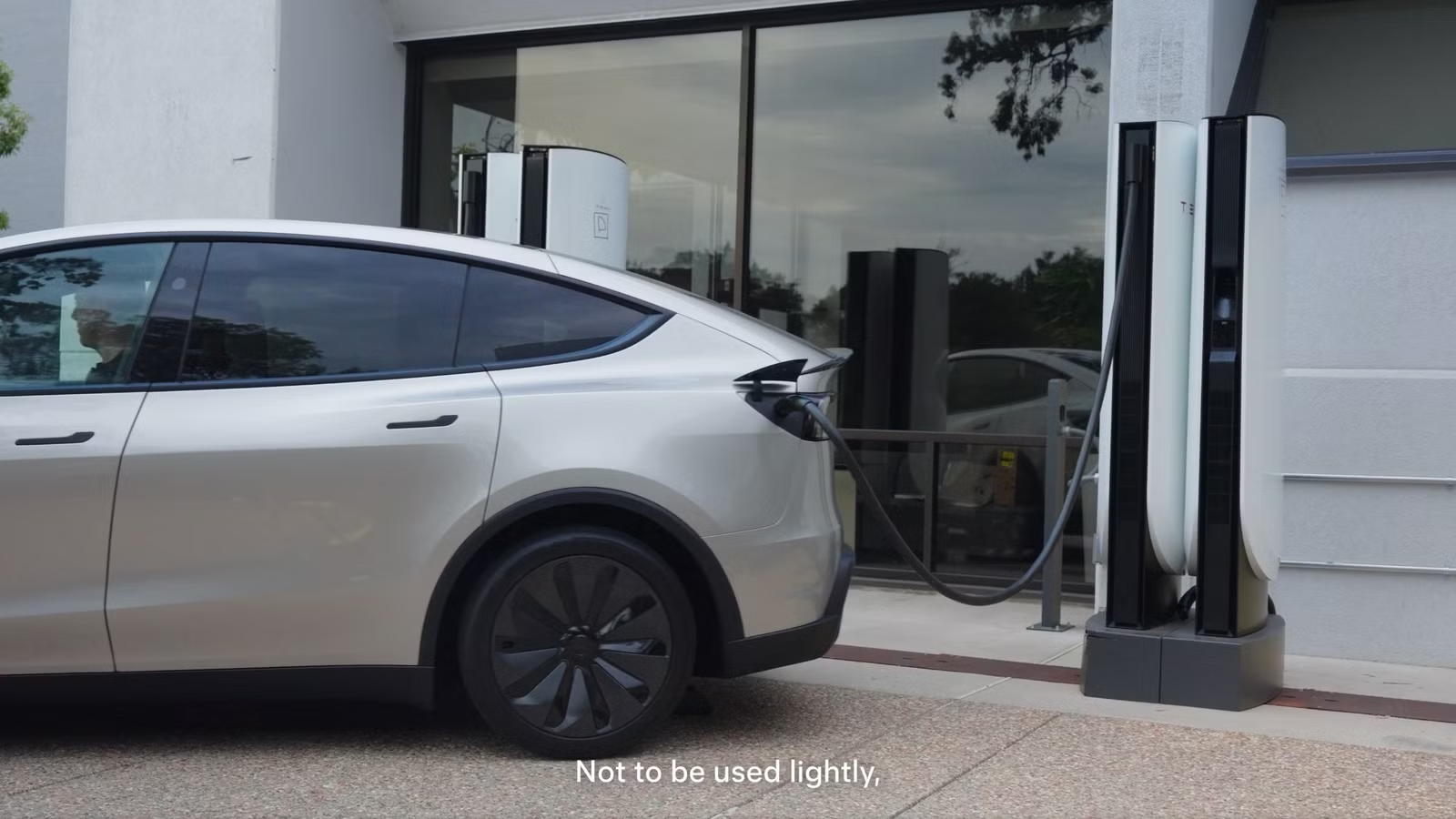
Tesla has pushed out an over-the-air update that lets drivers shift into Drive and pull away from a Supercharger while the cable is still plugged in, letting the connector snap free rather than keeping the car locked in place. The feature, called Emergency Drive Away, arrived this week via software version 2026.38.3, roughly two months after a gunman killed three people and injured seven at a Supercharger station next to an In-N-Out in Twin Falls, Idaho, on August 1.

It’s a safety override Tesla says it never wanted to build. Every Tesla has always kept the shift lever locked out of Drive while a charging cable is connected, a sensible rule under normal circumstances but a real liability if someone needs to leave immediately and can’t risk stepping outside to unplug first.
How The Breakaway Actually Works
Activating Emergency Drive Away isn’t subtle. Shift into Drive while still connected to a Supercharger, and the touchscreen throws up a red emergency prompt. Hold the brake, confirm “Activate,” and the car will let you accelerate away with the handle still attached. Tesla’s own demo video shows the charging port door going slack as the connector tears free, with coolant visibly leaking from the severed cable onto the pavement.

Tesla isn’t dressing this up as a clean escape. The company states plainly that using the feature “will damage your vehicle and the Supercharger,” and that a mandatory service visit is required afterward just to repair the charge port. Fixing the Supercharger stall’s electrical and civil infrastructure can run as high as $25,000, according to Tesla. The car also automatically sends a short clip of the activation back to Tesla, and the company has warned that deliberate misuse will bring unspecified “additional penalties.”
Why Tesla Had To Design For Panic, Not Composure
Max de Zegher, Tesla’s director of charging, framed the update bluntly on X: “A feature we hope you never need… We went back and forth on this for years, but believe offering it is the right call.” That hesitation makes sense. Every Supercharger stall sitting without a working lockout, or every driver tempted to skip disconnecting when they’re in a hurry, is a cost Tesla has to weigh against the rare but real scenario where someone is in immediate danger and physically can’t get out to release the cable by hand.
That’s the core engineering problem: you can’t rely on a person in a life-threatening situation to calmly navigate a touchscreen menu, unlock the charge port, and wait for the latch to release. Tesla built the override specifically for the moments when none of that is realistic, which is also why the feature carries so many guardrails against casual use.
The timing isn’t accidental, even though Tesla’s own announcement never mentioned Twin Falls directly. A Tesla owner was also shot and killed at a Colorado Supercharger back in 2023. After Twin Falls, enough owners pushed for a native solution that some turned to EVject, a third-party breakaway adapter Tesla had previously sued over safety concerns, including claims it could reach 100°C under high-current charging.
A Stopgap, Not The Final Answer

Tesla has been explicit that this is an interim fix rather than the ideal one. The feature only works at U.S. Superchargers for now, doesn’t support Model S or Model X built before 2021, and requires the 2026.38.3 update. De Zegher said Tesla plans to “improve it quickly based on feedback,” which suggests the company knows a software lockout override that sacrifices hardware isn’t where this ends.
The longer-term fix Tesla has hinted at is a way to disconnect the cable autonomously, without destroying the port or the stall, which would also help drivers with mobility challenges who struggle to physically handle a heavy DC fast-charging cable. Stellantis has filed a similar-minded patent for ejecting an overheating EV battery pack and driving a short distance clear using the 12-volt system, a sign that the industry is starting to treat emergency disconnection as a real design category, not an edge case. For now, Tesla’s answer trades a damaged charge port for a chance to get away.

Related posts






Latest Post


No Comments