
Spyker’s New 800-HP Hypercar Rejects Automatics For A Real Manual Gearbox
Spyker has unveiled the C8 Preliator XXV Coupé at The Quail during Monterey Car Week — the Dutch marque’s first entirely new hypercar in years and the clearest statement yet of what the brand intends to be under new co-owner Volodymyr Nosov. Powered by a 4.0-liter twin-turbo V8 producing 800 horsepower and 1,000 Nm of torque, with a top speed exceeding 217 mph, the car is built around a genuine manual gearbox at a time when virtually every rival has abandoned the third pedal entirely.

Production is limited to 25 individually commissioned examples. Chassis 270 — the car on display at The Quail, finished in Quail Green with rose-gold accents and Tuscan Saddle leather — is also the last of the 255 Spykers built since the marque’s 2000 revival, making it a tangible bridge between eras. Following its world debut, the C8 Preliator XXV Coupé will appear on the Concept Car Lawn at the Pebble Beach Concours d’Elegance on August 16.
2,100 Hours Of Aluminum, Zero Carbon Fiber
In an industry where carbon fiber has become the default material for anything with serious performance ambitions, Spyker has taken a deliberate step in the opposite direction. Every exterior panel of the C8 Preliator XXV Coupé is hand-shaped in aluminum by the craftsmen of Coventry Prototype Panels in England, laid over a spaceframe engineered entirely in-house and completely redesigned for this car. The process takes roughly 2,100 hours per vehicle.


The level of hand-finishing extends to details most owners will never consciously register. The steering wheel is stitched with two needles simultaneously by a single craftsman over four hours. The dashboard, turned from aluminum, is a nod to pre-1925 Spykers and is milled by a workshop that has finished automotive parts since the same decade the company was founded. Screw heads inside the cabin are hand-aligned to face the same direction. Each chassis number is stamped by hand into the aluminum spaceframe, so no two impressions are identical.
Founder and CEO Victor Muller frames the material choice as a philosophy, not a constraint: “While carbon fiber is rightfully celebrated for its technical virtues, we have always preferred aluminum, a living metal that can be shaped by the hand of an experienced craftsman, polished to perfection, its beauty only deepening with age, like a fine Cabernet. For Spyker, this is what modern ultra-luxury should feel like: rare, personal, and made by human hands.”
Aviation DNA Runs Deeper Than Ever

Spyker’s aviation heritage dates to 1914, when the company merged with the Dutch Aircraft Factory. That lineage has shaped every generation of its modern cars, and the C8 Preliator XXV Coupé carries it further than any predecessor. NACA ducts serve as air intakes. The rear lights are shaped like fighter jet afterburners. A bold fin tail — a subtle nod on earlier models, most recently the 2006 D12 Peking-to-Paris — returns here in prominent form, directly echoing the original 1919 Spyker C1 Aerocoque.

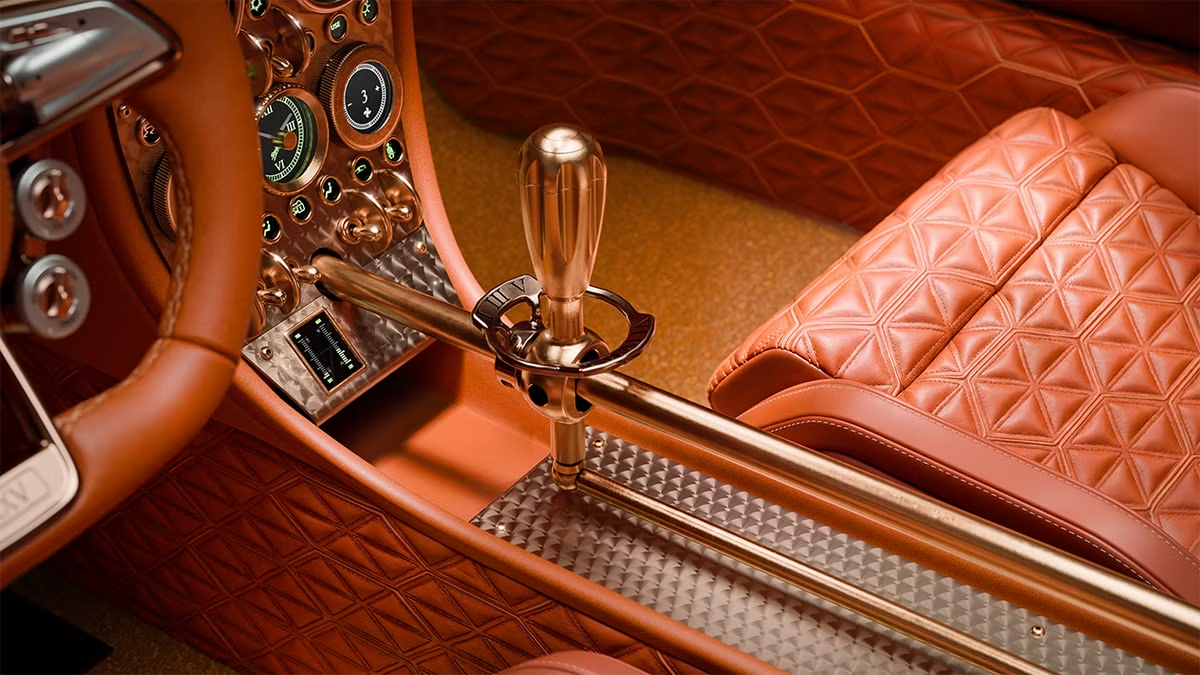
An isogrid lattice of interlocking triangles, a structural concept borrowed from rocket engineering to reduce weight while increasing strength, appears throughout: in the grilles, vents, pedals, exhaust mesh, and seat upholstery. The headlights carry the model designation XXV in their design. Spyker’s signature exposed gear linkage — present since the first modern-era cars — remains, as does a mechanical detail borrowed from the brand’s Le Mans race cars: the fuel tank has been relocated from the sills to a trapezoidal space behind the seats and ahead of the engine. The rear boot moves entirely to the front, and the whole car opens at the push of a button in what Spyker calls butterfly mode, requiring the engine bay itself to be finished to the same standard as the cabin.
A Manual Gearbox As A Statement Of Intent

There are no shift paddles. No automated substitute. The C8 Preliator XXV Coupé uses a true manual gearbox, and Muller is direct about what that means: “We deliberately chose a real manual transmission, not an automated imitation. You decide when to shift. You feel every gear change in your hand. And if you make a mistake, well, you bear the consequences. That is what driving a sports car should be, at least according to Spyker.”
The cockpit reinforces that philosophy at every turn. Digital interfaces are kept to a minimum — a head-up display is the only screen. Everything else is analog and tactile, designed to be operated rather than watched. The car’s name, in Latin, means warrior, which suits a marque that has operated under the motto Nulla Tenaci Invia Est Via — for the tenacious, no road is impassable — since 1914.
New Ownership, Broader Ambitions, Analog Cars
The C8 Preliator XXV Coupé marks the first model under Nosov’s co-ownership and a new strategic partnership with W Group, a European fintech group specializing in blockchain technology. The partnership is explicitly framed as surrounding the car, not changing it. W Group’s digital infrastructure is intended to support client experiences and a broader owner ecosystem — the hypercars themselves remain fully analog.
Nosov described the ambition plainly: “Our goal was never simply to bring a legendary name back. We want to build the next era of Spyker, preserving everything that makes the marque iconic while opening it to new technologies, new experiences and a new generation of clients.”
Looking further ahead, Spyker has confirmed ambitions to develop the D8 Peking-to-Paris SSUV and to return to endurance GT3 racing. For now, though, 25 hand-built aluminum hypercars — each taking one craftsman’s hands thousands of hours to complete — are where the new era begins.

Related posts






Latest Post


No Comments