
Slate Truck: The $25,000 EV Pickup Backed by Jeff Bezos
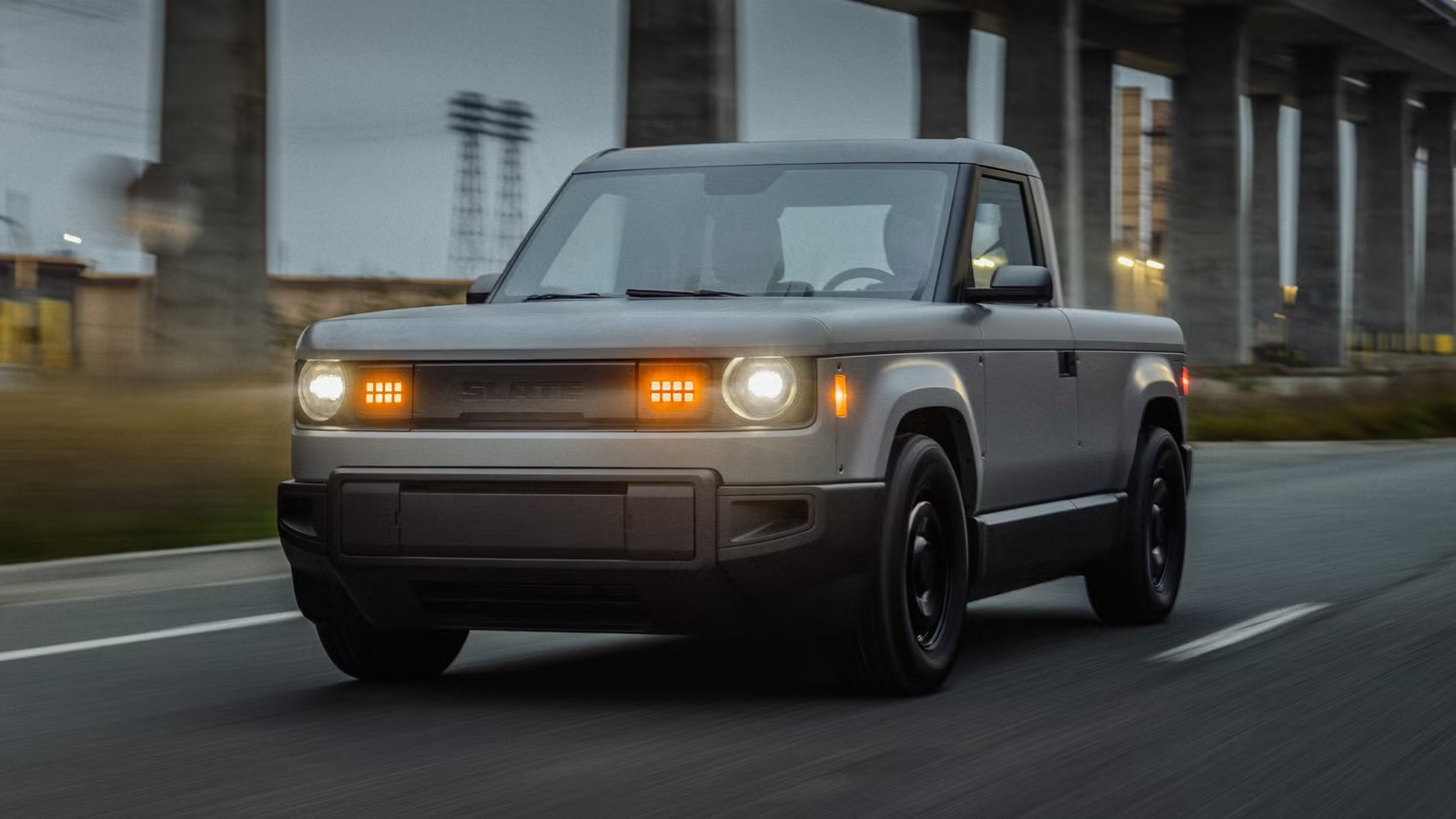
The American pickup truck has become increasingly capable, increasingly luxurious, and, unfortunately for budget-conscious buyers, increasingly expensive. Slate Auto wants to challenge that formula with something radically simpler: a small electric pickup that starts at a hair under $25,000, can be transformed into a five-seat SUV, and lets buyers decide how much equipment they actually want.

That alone would make the Slate Truck worth watching. Add backing from Amazon founder Jeff Bezos, a modular design intended to keep ownership costs down, and a projected 205-mile range, and Slate’s first vehicle becomes one of the more intriguing new entries in the electric-vehicle market.
There is an important caveat, though. The $24,950 figure is a starting price rather than an all-in transaction price, while the 205-mile range is still a projection rather than an official EPA rating. The truck is also in preproduction, meaning specifications and availability can still change.
So, what exactly is the Slate Truck, what do you get for the money, and can this minimalist EV actually make sense as an everyday pickup?

What Is The Slate Truck And Who Is Behind It?
Slate Auto’s Unusual Approach To The Electric Truck
Slate Auto was established in 2022 with a straightforward idea: instead of building an increasingly complicated vehicle packed with features, screens and expensive trim levels, build one simple platform and allow the owner to decide what gets added.
That philosophy is immediately obvious when looking at the Slate Truck. It is a two-door electric pickup with a deliberately minimalist cabin, rather than another technology showcase designed to compete with the likes of the Rivian R1T on luxury and performance.
Slate calls it a “Blank Slate” for a reason. The company offers more than 200 accessories, allowing customers to add equipment as required rather than forcing them into traditional trim packages. More than 80% of those accessories are priced below $500, according to Slate. The vehicle can also be configured as a five-seat SUV, giving the underlying platform a level of flexibility that most conventional pickups simply don’t offer.
The minimalist approach extends to the cabin. Slate has deliberately avoided the enormous central touchscreen and built-in infotainment systems that have become commonplace in modern vehicles. Instead, the company expects owners to use their own devices for functions that other manufacturers would typically integrate into the vehicle.
That may sound like a compromise, but it is actually central to the Slate Truck’s business case. Every feature a manufacturer has to engineer, manufacture and support adds cost. Slate’s argument is that buyers shouldn’t have to pay for equipment they don’t want.
It is a distinctly different philosophy from that of Rivian, Ford and Chevrolet. Rather than asking how much technology can be packed into an electric truck, Slate is asking how little can be built while still delivering a useful vehicle.
Jeff Bezos’ Investment And The 2027 Launch
The other reason the Slate Truck has attracted so much attention is the name behind its funding. Jeff Bezos is an investor in Slate Auto, giving the startup considerably more financial credibility than an unknown EV company attempting to launch a vehicle from scratch. Slate subsequently raised $650 million in a Series C funding round led by TWG Global in April 2026 as it prepared to launch its first vehicles. Reuters reported that Slate had already accumulated more than 160,000 bookings at the time.
Slate is planning to assemble the truck in Warsaw, Indiana, at a reindustrialized factory into which it says it will invest nearly $400 million. The company says the facility will create more than 2,000 jobs.
The timeline has also moved forward from the original expectations surrounding the truck. Slate currently says first deliveries are expected in late 2026, while current preorder windows shown by the company extend into 2027.
That makes the Slate Truck considerably more than a concept or distant startup promise. But it also means the next major test is execution: turning a compelling product strategy into a vehicle that can actually be built at scale and delivered at its promised price.
Slate Truck Price And Specs: What’s Really Included?
The $25,000 Slate Truck Price Has An Asterisk


The headline number is $24,950. That makes the Slate Truck’s price one of its most important selling points, but it is also where prospective buyers need to read the fine print. Slate’s advertised $24,950 price excludes taxes, title, registration, governmental fees, documentation fees, optional equipment and a $1,450 destination charge. In other words, this isn’t a $24,950 drive-away price. Slate’s own ordering information makes clear that the final out-the-door price will be calculated when the buyer gets closer to completing the purchase.
The other important distinction is that the federal EV tax-credit calculation previously associated with the truck should not simply be applied to today’s advertised price. Federal EV purchase incentives have changed, and the former $7,500 federal credit is no longer something buyers should automatically subtract from the sticker price.
That makes the current $24,950 starting price particularly significant: Slate is now presenting the truck as a sub-$25,000 vehicle before applicable taxes, fees and options, rather than relying on a tax-credit-adjusted headline. And then there are the accessories. A buyer can keep the truck extremely basic or add wraps, wheels, technology, lighting, interior equipment and other accessories. Slate’s own configurator demonstrates how quickly the price can rise once buyers start building a vehicle around their preferences. That isn’t necessarily a weakness. In fact, that’s the entire point. Slate doesn’t want every customer to buy a heavily equipped truck. It wants customers to start with the essentials and spend money only where they see value.
Slate Truck Specs, Powertrain And Battery Options

Underneath the minimalist styling, the Slate Truck is a relatively straightforward electric vehicle. The current published specifications call for a single rear-mounted electric motor driving the rear wheels. Output is rated at 181 horsepower, with 195 lb-ft of torque. Slate estimates a 0-to-60-mph time of around eight seconds and a top speed of 90 mph.
Those numbers won’t impress anyone expecting a high-performance electric pickup. But that’s not what Slate is trying to build.
The company’s objective is a lightweight, affordable utility vehicle, and the modest performance figures make sense in that context.
The current technical information lists a single 65-kWh LFP battery, while earlier specifications had proposed a 52.7-kWh standard battery and an 84.3-kWh larger battery as an accessory. Earlier specifications put those batteries at approximately 150 and 240 miles of range respectively, although Slate has since increased the projected range of the standard configuration to 205 miles without increasing its starting price.
The truck itself is also relatively compact. It measures 174.6 inches long and has a 108.9-inch wheelbase, making it substantially smaller than full-size American pickups. That smaller footprint is important. The Slate isn’t trying to replace an F-150 for buyers who regularly haul heavy trailers. It is aimed at people who want the usefulness of an open cargo bed without the physical size, cost and complexity of a conventional full-size truck.
Slate Truck Range, Charging And Real-World Capability
How Far Can The Slate EV Truck Actually Go?

Slate currently advertises a projected range of 205 miles for the Blank Slate Truck. The word “projected” matters. Slate says the figure is based on an approximation of the EPA test cycle, and an official EPA-estimated range will be provided when available. Real-world range will also vary according to temperature, driving habits, accessories, charging and battery condition.

For an urban commuter, 205 miles could be more than adequate. Slate itself points out that the average American drives roughly 37 miles per day, meaning a full charge could theoretically cover several days of normal commuting and errands. The situation changes when the truck is used like a truck. Highway speeds, cold temperatures, heavy loads, large accessories and towing can all reduce an EV’s range. That’s particularly relevant here because the Slate’s projected range isn’t enormous by modern EV standards.
The larger battery option therefore becomes important for buyers who regularly travel longer distances. The earlier specification target of approximately 240 miles for the 84.3-kWh battery suggests that additional range will come at the expense of the Slate’s low starting price.
For everyday local driving, however, the standard battery may be perfectly reasonable. The Slate’s proposition isn’t about eliminating range anxiety through a gigantic battery; it is about avoiding the cost and weight of a battery that many owners may not need.
Charging, Towing And Everyday Truck Duty
Charging performance is similarly focused rather than spectacular. The Slate uses an 11-kW onboard charger and supports NACS charging. Slate says DC fast charging can take the battery from 20% to 80% in around 30 minutes, while a 240-volt Level 2 connection can charge the battery from 20% to 100% in less than five hours. A standard charging cable is included for use with a conventional 120-volt outlet. That makes home charging the natural environment for the Slate. Plug it in overnight and most owners are unlikely to need to think about charging during their daily commute.
The truck’s physical capabilities are more modest. Published specifications list a maximum payload of 1,550 pounds and towing capacity of 2,000 pounds. The bed is 60 inches long with the tailgate closed and 81.6 inches with it lowered. Those numbers put the Slate firmly in the light-duty category. You won’t buy one to tow a large camper, horse trailer, or heavy construction equipment. But that’s not necessarily a problem. Carrying bicycles, camping equipment, gardening supplies, furniture or weekend-project materials falls comfortably within the kind of use for which a compact pickup makes sense. In other words, the Slate is a truck for people who need a truck occasionally, rather than a truck designed around the demands of professional towing.
Is The Slate Truck Actually Good Value?
Slate Truck Vs. Used Gas Trucks And Other EVs
This is where the Slate Truck becomes particularly interesting. A $24,950 new vehicle is competing in a part of the market where buyers have historically had very few choices. The average new pickup has moved far beyond the reach of many budget-conscious buyers, leaving used trucks as the obvious alternative. The Slate’s advantage is that it offers something a used gas truck cannot: a new vehicle with an electric powertrain, a factory warranty and a deliberately simple mechanical package.
There are trade-offs, of course. A used Ford Ranger, Toyota Tacoma or similar pickup can offer greater towing capability, longer highway range and an established service network. But it also comes with an internal-combustion engine, transmission, exhaust system and other components that the Slate doesn’t need.
Against other new EV pickups, the price gap is even more obvious. Vehicles such as the Rivian R1T and Ford F-150 Lightning occupy a completely different part of the market, with significantly greater power, size, range and towing capability, but also substantially higher purchase prices. The Slate isn’t trying to beat those trucks at their own game. It is trying to make the basic concept of an electric pickup accessible to buyers who don’t need 800 horsepower, a luxury interior or the ability to tow thousands of pounds.
Customization, Repairability And Five-Year Ownership
Perhaps the Slate’s cleverest idea is that the truck doesn’t have to remain the same vehicle throughout its life. Owners can add and change accessories after purchasing the truck, allowing it to evolve as their needs change. A basic pickup could eventually become a five-seat SUV, while accessories can be added or swapped without replacing the entire vehicle.

Slate is also making repairability part of its pitch. The company says it will provide free repair manuals and diagnostics, offer fair parts pricing, and support a nationwide network of service locations. It currently advertises a 10-year/110,000-mile battery and powertrain warranty, along with a four-year/50,000-mile bumper-to-bumper warranty. That could become one of the Slate’s biggest long-term advantages, if the company delivers on it.
Electric vehicles already eliminate many traditional maintenance requirements, including oil changes, spark plugs, fuel systems and exhaust systems. A simpler vehicle could potentially reduce costs even further. But the real five-year ownership picture will ultimately depend on insurance, electricity prices, depreciation, replacement parts and the actual cost of Slate’s accessories. And that is the larger gamble.
The $24,950 starting price is real as Slate’s current advertised MSRP, but the least-expensive possible configuration won’t necessarily be the one most buyers want. Add the equipment required for your lifestyle, factor in destination and other fees, and the final price could climb considerably.
Still, that doesn’t undermine the concept. It may actually prove that Slate has identified a different way of selling a vehicle: start with an affordable blank canvas and let customers spend according to their priorities.
The Slate Truck is interesting not because it is the fastest, longest-range or most technologically advanced electric pickup on the market. It is interesting because it questions whether a truck needs to be any of those things. At $24,950 before destination, taxes, fees and options, the Slate has an unusually aggressive starting price. Its projected 205-mile range is enough for many daily drivers, while its 181-hp rear-wheel-drive powertrain, 1,550-pound payload and 2,000-pound towing capacity give it genuine, if limited, utility.
The customization strategy could be just as important. Instead of buying a truck loaded with equipment you may never use, the Slate lets you start with the essentials and build from there. Its repairability philosophy and long battery and powertrain warranty could further strengthen its ownership proposition. But buyers should resist treating the Slate as a miracle $25,000 replacement for every pickup on the market. It is small, relatively slow, limited in towing capability and still a preproduction vehicle. Its projected range is not yet an official EPA figure, and its long-term reliability, resale value and service experience remain unproven.
Jeff Bezos’ backing and Slate’s substantial funding give the project credibility, but they don’t eliminate the risks that come with launching a new vehicle from a new automaker. Ultimately, that’s what makes the Slate Truck worth watching. If Slate can turn its minimalist design, modular accessories and low starting price into a reliable production vehicle, it could do something the EV industry has struggled to achieve: make electric transportation genuinely affordable without simply making it feel cheap. For buyers who don’t need a full-size workhorse, that could be a very compelling proposition.

Related posts




Latest Post


No Comments