
2027 Kawasaki Ninja 650 First Look: Suspension and Tech Upgrades
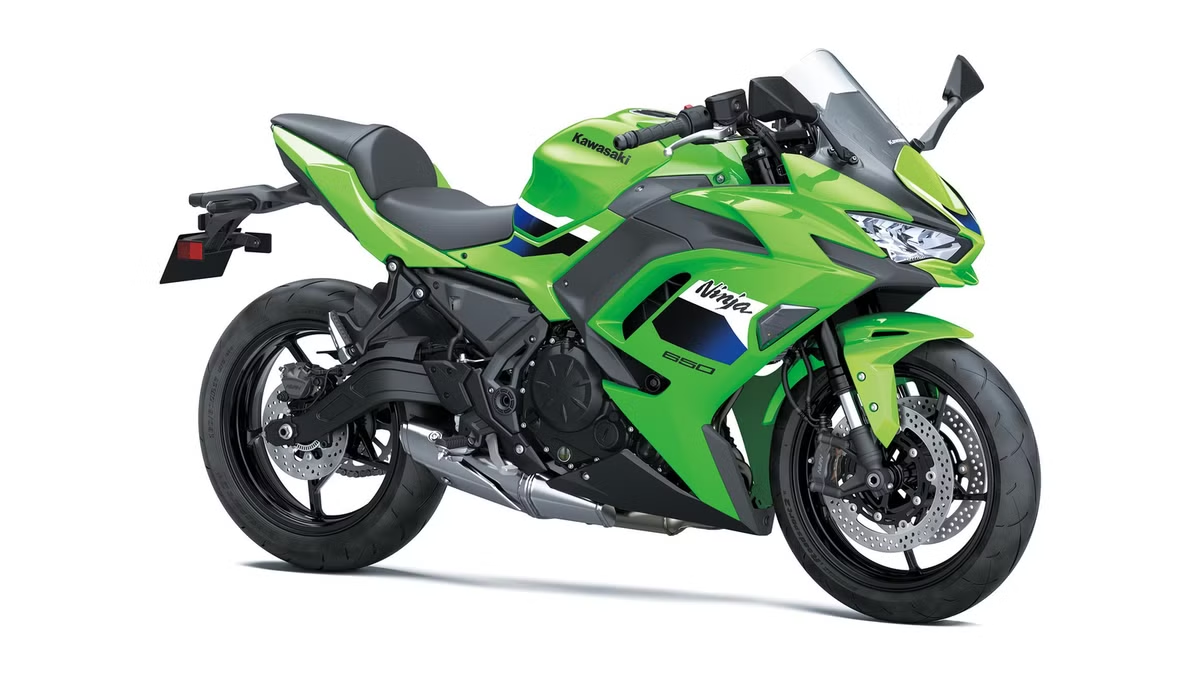
The middleweight sportbike category is easily one of the most hotly contested segments in motorcycling right now, and Kawasaki just announced significant updates to its longstanding mid-sized Ninja entry. Meet the 2027 Kawasaki Ninja 650, which sees the most significant chassis updates to the Japanese brand’s popular parallel-twin-powered sportbike in years.

The headline changes include a modern inverted fork that replaces the old-school traditional unit, radial-mounted four-piston brakes, and a 4.3-inch TFT display with a new layout that incorporates several additional tech features unavailable on prior generations. What’s more, the Ninja 650 is keeping up with the rest of the mid-sized sport segment and is offering an optional factory upshift-only quickshifter for the first time ever.
The news comes to us via Kawasaki UK, which has updated the subsidiary’s landing page. Kawasaki Motors Corp., U.S.A. has not yet announced the 2027 Kawasaki Ninja 650 for the United States, though we are hopeful that this model will arrive Stateside. Whether the same updates, pricing, and color options will arrive in America is unknown at this time.
What’s New for 2027? Chassis and Tech Upgrades

The biggest change for 2027 is what’s up front: a 37mm Showa SFF-BP USD fork boasting 4.9 inches of travel. Until now, the Ninja 650 was a holdout in the class, still using a traditional, non-inverted fork. Equipping a modern USD fork should prove beneficial in terms of handling, as the new Showa fork will provide improved stiffness over its predecessor’s 41mm conventional fork and potentially increase confidence while on the edge of the tire.
Another benefit of an inverted fork is that the lighter inner tubes are placed closer to the axle, which shaves unsprung weight from the package and allows the wheel to track along the road surface better. Basically, a modern USD fork flexes less and provides better grip, whether you’re braking or cornering.

That isn’t the only upgrade: Radial-mount Nissin four-piston calipers will provide better feel and control than the previous-generation machine’s axial-mounted calipers. Taken together, these upgrades mean riders can expect far more front-end confidence out of the latest Ninja 650 when compared to the existing model.
Moving on to the technology aspects, we’ll note that the 4.3-inch full-color TFT display is sporting a redesigned UI. The instrument panel still relies on the Kawasaki Rideology App for smartphone pairing, which offers several features such as riding logs, call and message notifications, and other Bluetooth-supported features. What’s interesting to see added to this list are navigation and voice command functions, which we hope to see become available in our market as well (Kawasaki notes voice command requires a separate license).
Carrying on with the technology items, Kawasaki has announced the Ninja 650 is now able to be equipped with an optional factory upshift-only quickshifter. It’s a feature that is becoming common in the class and one that is appreciated.
What’s The Same

At a quick glance, the 2027 Ninja 650 looks quite familiar. The current Ninja-family styling carries over, as does the 4-gallon fuel tank, tail section, and other related bodywork. All are consistent with the current middleweight Ninja. The only obvious giveaways that something has changed is the USD fork poking out from beneath the plastics and a set of radial-mount calipers.
Found at the heart of the Ninja 650 is none other than the tried-and-true 649cc liquid-cooled, DOHC, eight-valve parallel twin, still featuring an 83mm x 60mm bore and stroke. Kawasaki Motors Corp., U.S.A. cites 67 horsepower at 8,000 rpm and 48.5 lb-ft of torque at 6,700 rpm for the current-generation 2026 model sold in the United States, which we don’t anticipate any major deviations from. That ample amount of performance goes through the six-speed gearbox featuring an assist-and-slipper clutch. Two-mode traction control and dual-channel ABS are standard in the UK, though ABS remains optional on the 2026 U.S. model.

The casual yet sporty riding position that has made the Ninja 650 so accessible over the years hasn’t changed too much, either. Separate, clip-on-style riser handlebars help maintain the Ninja’s relatively upright posture, balancing the needs of an everyday rider against sportier desires. According to the UK specifications, the seat height measures 0.2 inches lower at 30.9 inches for the 2027 model, which could be an additional help to riders with shorter inseam lengths.
The steel trellis frame carries over as well. Chassis geometry remains somewhat similar to the potentially outgoing model, with the same sporty 24-degree rake and 3.9 inches of trail. The exception is the wheelbase figure, which shrank by 0.6 inches to 54.9 inches, down from 55.5 inches on the 2026 model. Perhaps with the stiffer front end, Kawasaki was able to make the Ninja 650 even more agile than before with a tighter wheelbase. However, the brand made no mention of how the shorter wheelbase was achieved. Kawasaki’s horizontal back-link shock is still in play, offering spring preload adjustment only.
Pricing and Availability

U.S. pricing and availability for the 2027 Kawasaki Ninja 650 have not been announced yet. Though for context, UK pricing starts at £7,499. Furthermore, we cannot comment on whether all these updates will be made available should Kawasaki Motors Corp., U.S.A. bring this upgraded middleweight Ninja to the United States. Current colors offered in the UK include Lime Green and Metallic Matte Graphenesteel Gray/Metallic Spark Black.
We will update this story as soon as Kawasaki Motors Corp., U.S.A. confirms availability within the North American market.
2027 Kawasaki Ninja 650 Photo Gallery:
2027 Kawasaki Ninja 650 Specifications:
Engine:
|
Type |
Liquid-cooled four-stroke parallel-twin, DOHC |
|
Displacement |
649cc |
|
Bore x stroke |
83.0mm x 60.0mm |
|
Maximum horsepower |
67.3 horsepower @ 8,000 rpm, claimed (UK) |
|
Maximum torque |
47.2 lb-ft @ 6,700 rpm, claimed (UK) |
|
Compression ratio |
10.8:1 |
|
Valve train |
DOHC; 4 valves per cylinder |
|
Fueling |
Electronic fuel injection w/ dual throttle valves; 36mm throttle bodies (x2). Octane requirement: 91 |
|
Exhaust |
2-into-1 |
|
Cooling |
Liquid |
|
Transmission |
6-speed return shift; Kawasaki Quick Shifter (KQS) available as an accessory for the first time, clutchless upshifts only |
|
Clutch |
Wet multi-disc Assist & Slipper Clutch. Cable actuated. |
|
Final drive |
Chain, 15/46 ratio (3.067:1) |
Chassis:
|
Frame |
Steel frame and swingarm |
|
Front suspension; travel |
Showa 37mm Separate Function Fork-Big Piston (SFF-BP) inverted fork; 4.9 inches |
|
Rear suspension; travel |
Spring-preload-adjustable Horizontal Back-link monoshock; 5.1 inches. |
|
Wheels |
Cast aluminum |
|
Front wheel |
17-inch diameter |
|
Rear wheel |
17-inch diameter |
|
Tires |
Radial, ZR-rated |
|
Front tire |
120/70ZR17 M/C (58W) |
|
Rear tire |
160/60ZR17 M/C (69W) |
|
Front brake |
Dual 300mm semi-floating discs w/ radial-mount opposed 4-piston calipers |
|
Rear brake |
220mm disc w/ 1-piston caliper |
|
ABS |
Standard (UK). Standard ABS; not cornering ABS. |
|
Electronic rider aids |
Kawasaki Traction Control (KTRC), 2 modes plus off; Economical Riding Indicator; 4.3-inch color TFT w/ new display layout; Rideology The App Motorcycle smartphone connectivity, newly adding navigation and voice command (voice command requires a separate license; availability varies by market). Ride modes and TPMS |
Dimensions & Capacities:
|
Wheelbase |
54.9 inches (1395mm) |
|
Rake |
24.0 degrees |
|
Trail |
3.9 inches (100mm) |
|
Seat height |
30.9 inches (785mm) |
|
Ground clearance |
4.9 inches (125mm) |
|
Fuel capacity |
4.0 gallons (15.0 liters) |
|
Curb weight |
428 pounds (194 kg) UK |
Pricing & Warranty:
|
Website |
kawasaki.com |
|
Price |
U.S. MSRP TBA |
|
Warranty |
TBA |
|
Service interval |
Oil 7,500 miles; valve clearance inspection every 15,000 miles |
|
Color |
Lime Green, Metallic Matte Graphenesteel Grey/Metallic Spark Black (UK) |
Source: Kawasaki UK

Related posts


Latest Post


No Comments