
Royal Enfield’s New 750cc Twin Engine Explained
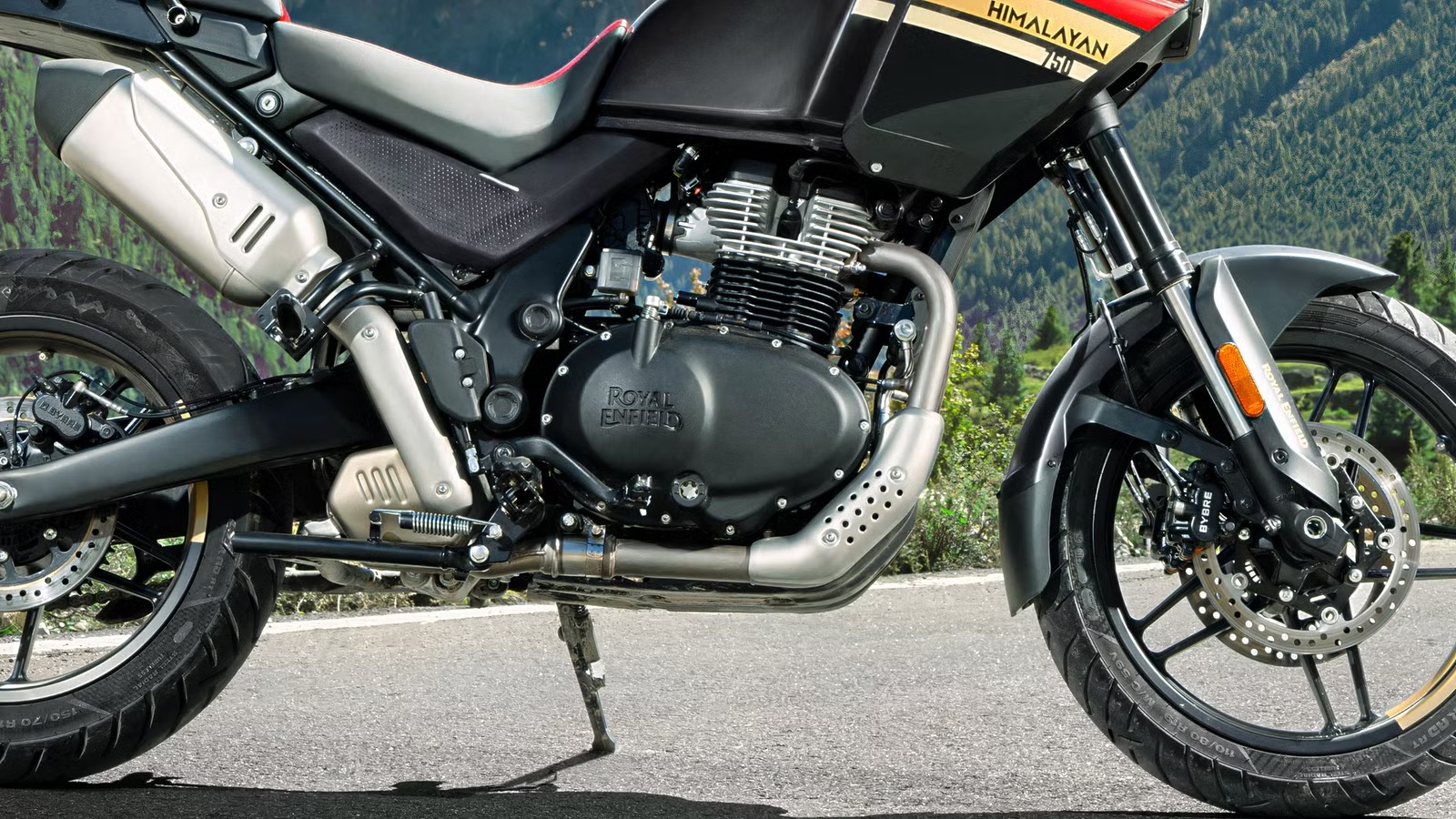
Now that the official specifications are out, riders appear divided over the new Royal Enfield Himalayan 750’s engine. Some expected considerably more power, while others see a torquey adventure bike built for the real world. However, the headline numbers only tell part of the story, because Royal Enfield has made several genuinely interesting changes underneath them.

This engine is not exclusive to the Himalayan, either. Royal Enfield also revealed the Continental GT 750 café racer, which will probably use an uprated version of the same 743cc parallel twin. Its final output has not been announced, but a different configuration would suggest the Himalayan’s 54-hp tune is focused on low-end control rather than revealing everything this new engine can produce.
The Royal Enfield 750cc Twin Prioritizes Torque Over Horsepower
Royal Enfield’s new engine is a 743cc air-and-oil-cooled parallel twin producing around 55 hp at 7,000 rpm. Maximum torque stands at 46.5 lb-ft at 5,000 rpm. Those figures represent a 17-percent power increase and a 21-percent torque increase over the company’s familiar 648cc twin.

Admittedly, 54 hp does not sound terrifying besides middleweight adventure bikes making 80, 90, or even 100 hp. Nobody is going to confuse the Himalayan 750 with a KTM wearing hiking boots. However, Royal Enfield was clearly chasing usable grunt instead of a dyno-chart victory. The company says 90 percent of maximum torque is available from 3,500 rpm, giving riders approximately 42 lb-ft without having to wring the engine’s neck. That should make steep climbs, slow technical sections, two-up touring, and highway overtakes seem effortless.
The engine has a relatively low 7,500-rpm maximum speed and a 9.5:1 compression ratio. Those numbers reinforce its relaxed, torque-focused character. This is not an engine designed to suddenly wake up near the redline and fire you toward the next county. It should produce a broad, predictable shove that is far more useful when the rear tire is trying to find grip on dirt.
Royal Enfield also developed specific ratios for the six-speed constant-mesh gearbox instead of simply borrowing the old 650 transmission setup. A larger wet multiplate assist-and-slipper clutch helps manage the extra torque while reducing lever effort and controlling rear-wheel hop during aggressive downshifts.
This Is More Than A Bored-Out Royal Enfield 650

Royal Enfield calls the 743cc twin an all-new engine, although its dimensions reveal a clear connection to the existing 648cc platform. Both engines use the same 67.8mm stroke and 9.5:1 compression ratio, but the new twin increases bore diameter from 78mm to 83.5mm. That larger bore creates the additional displacement without turning the engine into an excessively long-stroke tractor motor.
The real changes go well beyond larger cylinders. Royal Enfield developed a twin-side intake that feeds the airbox from both the left and right sides. The intake tract is also 14 percent longer, specifically to strengthen low and midrange torque. That is another clue that this engine was designed around adventure riding instead of chasing an impressive peak figure.
Its improved port-injection system reportedly reduces fuel wall wetting by 33 percent. In less nerdy language, less fuel sticks to the intake-port walls before entering the combustion chamber. That allows cleaner atomization, more consistent combustion, sharper response, and lower emissions.
Royal Enfield also attacked weight wherever possible. The barrel is slimmer and coated, the cooling fins on the cylinders and head are shorter, and the pistons have been lightened. Magnesium side and top covers are claimed to be 35 percent lighter, while the new single-bore throttle body cuts 42 percent from that component’s weight. A single-skin two-into-one exhaust pipe is reportedly 45 percent lighter than the comparable part used with the 650 twin.
Those percentages apply to the individual components rather than the entire engine, so the Himalayan has not suddenly discovered anti-gravity. However, they show that Royal Enfield understood the danger of fitting a bigger engine into an already substantial adventure motorcycle and simply allowing the pounds to pile up.
Ride-By-Wire Brings Royal Enfield Into A New Era

The new single-bore throttle body also introduces ride-by-wire control, allowing the Himalayan 750 to offer five riding modes. Riders can choose Road, Road Sport, Rain, Trail, or Custom, with each mode altering the bike’s response and electronic intervention.
The engine works with a six-axis inertial measurement unit, cornering ABS, lean-sensitive traction control, and cruise control. Road Sport should provide the sharpest response, while Rain can soften delivery when grip disappears. Trail mode is intended for loose surfaces, and Custom allows riders to select their own preferred settings.
Perhaps the most interesting detail is that the Himalayan may not reveal this engine’s full potential. Royal Enfield has already revealed the Continental GT 750 and this new model will most likely use an uprated version and become its most powerful production motorcycle. That suggests the Himalayan’s 54 hp tune was a deliberate choice rather than the engine’s absolute limit.
The new 750 twin will not win a horsepower bar fight, but that was never its job. It was designed to produce accessible torque, survive long journeys, behave predictably off-road, and move Royal Enfield into a far more sophisticated mechanical era. Once you look beyond that modest peak number, the engineering begins to make much more sense.

Related posts


Latest Post



No Comments