
Porsche Already Pulled The Taycan Sport Turismo And Cross Turismo From US Showrooms, The Denial Only Goes So Far
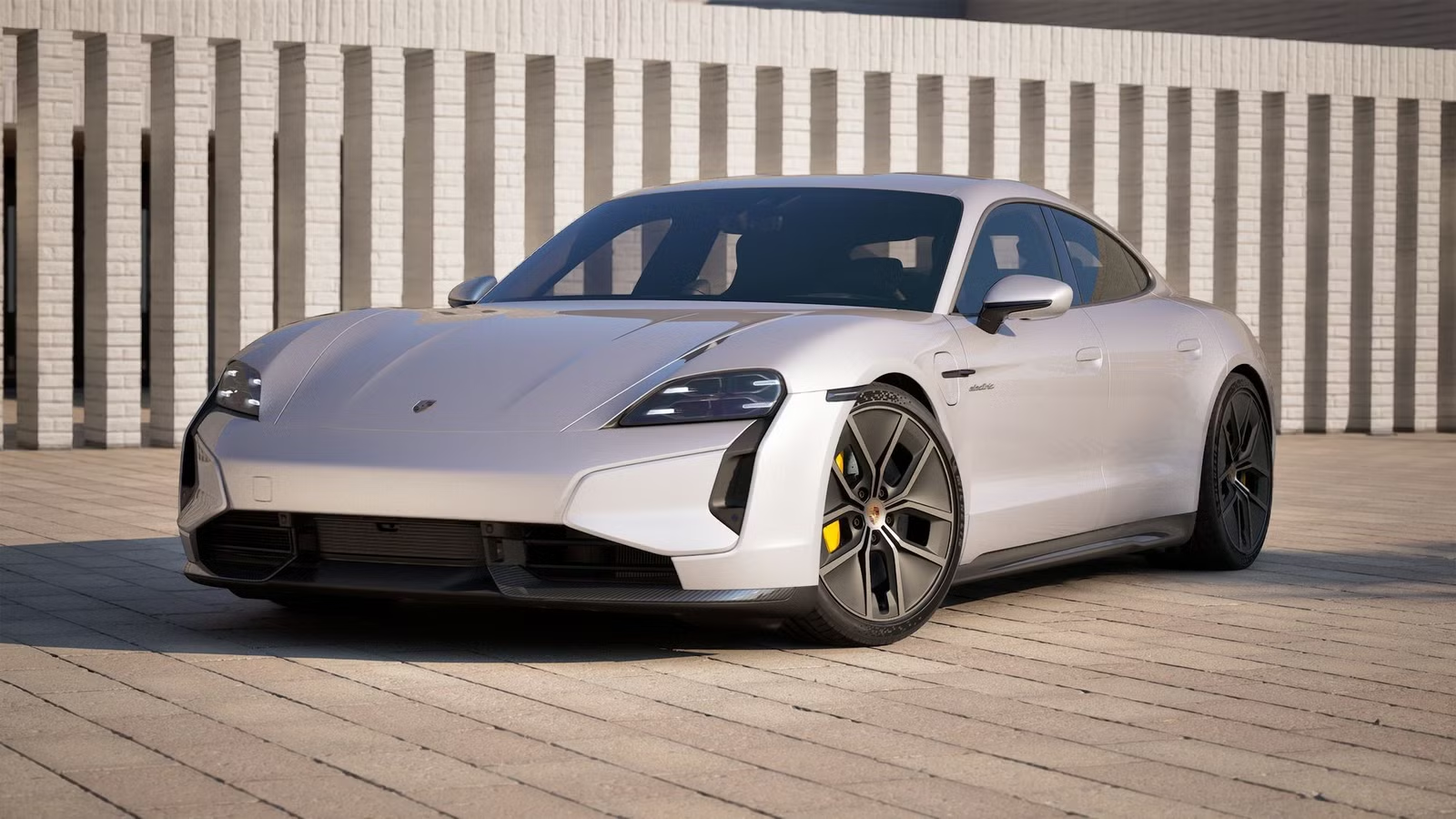
Porsche CEO Michael Leiters went on record this week to deny that the Taycan is being discontinued — a flat, unambiguous statement that the company has invested heavily in the electric sedan and has no short-term plans to pull it. What he didn’t say is that two of the three body styles American buyers could choose from have already quietly vanished from US showrooms after the 2026 model year. The Sport Turismo wagon and the Cross Turismo crossover are gone from US dealers. The denial is real, but so is the disappearing act.

For buyers who were weighing a Taycan purchase, that gap between corporate messaging and actual availability is the story. Porsche frames the removals as “streamlining” rather than cancellation — and technically, that’s accurate. But if the variant you wanted is no longer sold here, the distinction doesn’t do you much good on a dealer lot.
What Porsche Has Actually Confirmed
Porsche’s official line, delivered to multiple outlets including Robb Report and Carscoops, is careful and consistent: “Streamlining the model range does not necessarily mean discontinuing entire model lines. In many cases, it also involves reducing the number of variants. We currently have no plans to discontinue the Taycan in the short term. We have invested significantly in the model and will continue to monitor how demand develops.”

That statement leaves the long-term future conspicuously open. Porsche did not confirm the Taycan will receive a second generation. It did not address whether the nameplate survives beyond the end of the decade. And it did not dispute the core finding of a WirtschaftsWoche report — citing unnamed sources inside the company — that Porsche management and the works council have informally discussed a gradual wind-down of Taycan production by 2030. That report remains unconfirmed, but Porsche has not denied it directly. CEO Leiters is also exploring a possible future convergence between the Taycan and the Panamera, which could mean an electric version of the four-door grand tourer eventually absorbs the Taycan’s role rather than replacing it outright.
The Numbers Behind the Lineup Cuts

The delivery trajectory explains why Porsche is trimming rather than expanding. Global Taycan sales peaked at 40,629 units in 2023, then dropped to 16,339 in 2025 — a 22 percent decline from 2024 alone. In the first half of 2026, Porsche delivered just 6,219 Taycans worldwide, down roughly 25 percent from the same period in 2025. The US market has felt that contraction sharply: American buyers took delivery of only 1,079 Taycans in H1 2026, compared to 2,083 in H1 2025. Second-quarter US deliveries fell from 1,064 cars to 472.
That kind of volume decline — more than halved in the US over a single year — makes a three-body-style lineup hard to justify. Porsche built the Sport Turismo and Cross Turismo to broaden the Taycan’s appeal beyond the sedan, but neither found enough traction in the US to survive the rationalization. The sedan remains, and the 2027 model introduces E-Shift, an optional system that simulates combustion-engine gear changes, as Porsche tries to keep the car feeling fresh without a full redesign.

The practical read for buyers is straightforward: if you wanted a Sport Turismo or Cross Turismo, that window has closed in the US. The sedan is still available, and the 2027 model — starting at $111,900 — is the most technically current version Porsche has sold. Roughly 180,000 Taycans have been built since the model launched for 2020, so the used market offers options, and the recent depreciation curve has made second-hand examples genuinely compelling value for performance-per-dollar.
For anyone considering a new purchase, the honest advice is to buy the car you want now rather than wait for promises about future variants or a potential second generation that Porsche has not committed to building. The “no short-term discontinuation” language is real, but “short-term” is doing a lot of work in that sentence. Porsche has already shown it will trim body styles without much advance notice to the market. The sedan survives for now. What comes after it — whether a next-generation Taycan, an electric Panamera, or something else entirely — remains genuinely unclear.

Related posts
Latest Post


No Comments