
Porsche 911 GTS Hybrid Manual Incompatibility Explained
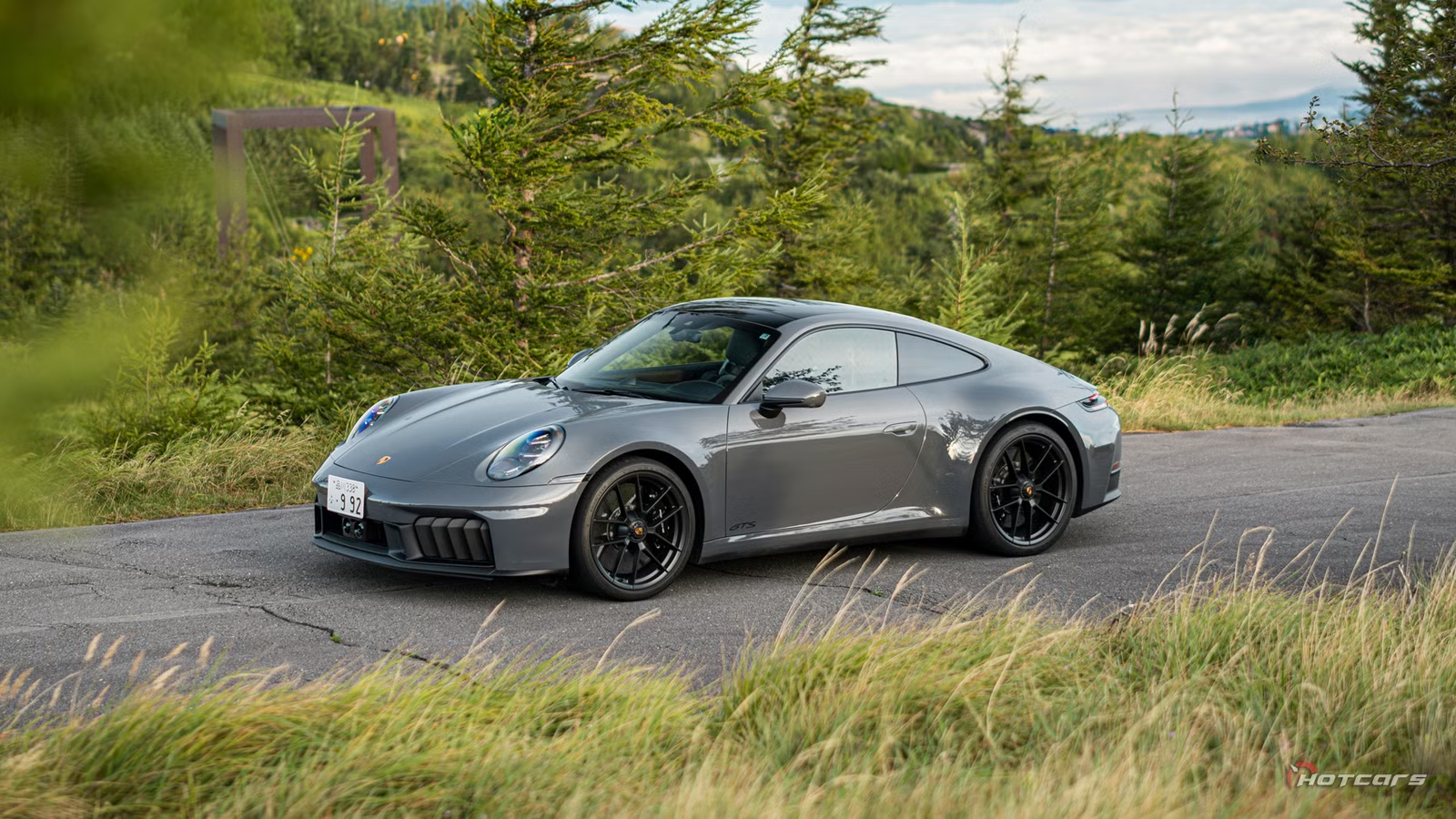
PorscheCEO Timo Resch confirmed at Monterey Car Week this week that the 992.2 911 GTS’s T-hybrid powertrain and a manual gearbox are fundamentally incompatible — not as a matter of preference, but as a hard engineering constraint. The current GTS ships exclusively with an eight-speed PDK, and Resch was direct about why that isn’t changing anytime soon: the hybrid architecture has no room for a clutch pedal in its present form.

For buyers who were holding out hope that the GTS’s electrified performance gains might eventually come paired with a third pedal, Resch’s comments at Monterey are a reality check. The good news is that he didn’t close the door entirely. The engineering challenge he described, though, makes clear that any fix is a ground-up effort — not a parts-swap — and the timeline reflects that.
Two Motors, One Fundamental Problem
911 GTS’s T-hybrid setup is more deeply integrated than a simple bolt-on electrification. A small electric motor sits directly on the turbocharger shaft, acting as both a generator and a lag eliminator — it spins the turbo up before exhaust gases can do the job, which is a large part of why the GTS feels so immediate off the throttle. A second electric motor is embedded inside the eight-speed PDK itself, adding a direct performance boost through the transmission.

That second motor is the core of the problem. A manual gearbox has no equivalent housing for an integrated electric motor, and the PDK-mounted unit isn’t something you can relocate without rethinking the entire drivetrain layout. Resch put it plainly in his conversation with The Drive at Monterey: “The technology setup that we have in place right now and a manual transmission… they are not compatible. That’s something that we see right now.” He was careful not to say it’s impossible — just that the current hardware configuration rules it out.
What a Fix Would Actually Require

Resch’s framing of a potential solution was notable for what it implied. “I wouldn’t be surprised if at some point they come up with a solution,” he said of Weissach’s engineers, “but it probably will not be a combination that you see here.” That last clause matters. “Not a combination you see here” signals that any manual-compatible hybrid GTS would require a meaningfully different architecture, not a reconfiguration of existing parts.
One direction the engineering logic points: retain the electrically assisted turbocharger — which provides the genuine, measurable performance benefit — while eliminating the PDK-integrated motor that blocks manual compatibility. That trade-off would likely reduce total system output compared to the current dual-motor setup, and it would still require substantial development and validation time. Porsche has not confirmed any such approach; this is where the engineering constraints lead, not an announced program.
Product-cycle reality adds another layer. Even adding a transmission option that already exists in production typically takes around a year to implement across a model line. A hybrid-compatible manual would be a ground-up engineering effort with no existing template. The 992.2 generation is already in production, making a mid-cycle introduction of a manual hybrid GTS unlikely. The more realistic window, if Weissach finds a workable solution, is late in the 992.2 run — or the generation that follows.
Where Porsche Stands on the Manual More Broadly

The GTS situation exists against a backdrop of Porsche actively fighting to keep the manual alive elsewhere in the lineup. The 992.2
Carrera S is getting a six-speed manual option back for the 2027 model year — packaged as the MT Package, which adds rear-axle steering, center-lock wheels, and PASM Sport suspension alongside the stick shift. The Carrera S remains the 911 variant where manual advocates should be shopping today, without any hybrid complications in the way.
On the broader question, Resch was unambiguous: “You can be assured that we will try to offer manual transmissions as long as we are legally allowed to and as long as there’s customer demand — and we see customer demand for the optional manual transmission also lasting well into the next decade.” That’s a meaningful commitment, and Resch credited strong demand for the manual 911 GT3 as the signal that made the Carrera S manual return possible.
The GTS is a different conversation. It delivers a genuinely different kind of performance — the T-hybrid’s turbo-mounted motor makes the car feel nearly lag-free in a way that’s difficult to replicate mechanically, and the PDK is exceptionally well-matched to that powertrain. Resch treated the manual question seriously rather than dismissing it, which is itself telling. The tension between electrification and driver engagement isn’t going away, and the GTS is currently the clearest example of where that tension produces a real trade-off with no easy resolution.

Related posts
Latest Post


No Comments