
Pontiac’s Underrated Six Had 1.920-Inch Intake Valves But Couldn’t Fit The 1970 Firebird
Detroit spent the 1960s chasing bigger engines, louder exhausts, and horsepower figures that could settle arguments at stoplights. One American automaker took a different approach, though, developing an unusual powerplant inspired by European sports cars. It promised strong performance, better handling, and advanced engineering without needing eight cylinders. Its specifications looked impressive, and its technology stood apart from almost everything else in American showrooms. Unfortunately, buyers had other priorities.
Detroit’s V8 Obsession Left Little Room For A Different Kind Of Performance

During the mid-1960s, American performance cars followed a simple recipe: add cubic inches, increase horsepower, and advertise the V8 badge. The Pontiac GTO had helped ignite the muscle-car craze, while Ford, Chevrolet, and other manufacturers competed for buyers who measured performance through quarter-mile times and engine displacement. Six-cylinder engines generally occupied the bottom of the lineup. They offered affordable transportation, but few people considered them exciting.
European manufacturers had different ideas. Jaguar demonstrated the appeal of smooth, powerful inline-six engines, while Mercedes-Benz used sophisticated six-cylinder designs in its premium models. These engines showed how careful engineering and higher operating speeds could deliver satisfying performance without enormous displacement. Pontiac wanted to bring that thinking into affordable American cars. The challenge was creating a six-cylinder that offered something genuinely appealing instead of simply asking customers to accept less power.
Massive Valves And A Belt-Driven Camshaft Made This Six Different


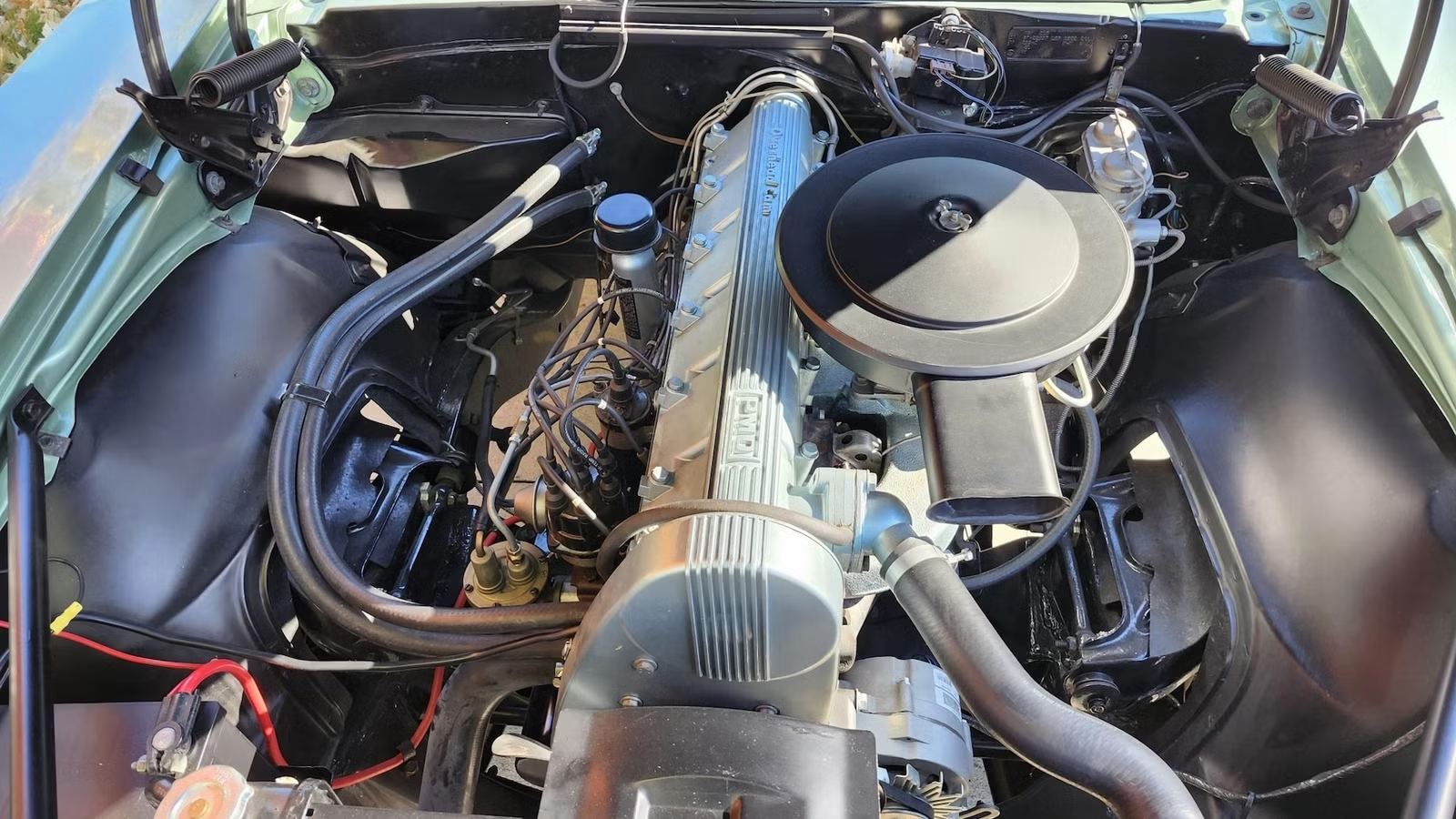
The engine’s cylinder head revealed how seriously its designers approached performance. Its intake valves measured an impressive 1.920 inches, while the exhaust valves measured 1.600 inches. Those dimensions were unusually generous for a 230-cubic-inch inline-six. In fact, the intake valves matched the diameter of those in Pontiac‘s much larger 389- and 421-cubic-inch V8s. The large valves helped the engine breathe at higher rpm, allowing it to maintain power where conventional six-cylinder engines often struggled.
The bigger breakthrough sat above those valves. Instead of using a conventional pushrod arrangement, Pontiac mounted a single overhead camshaft above the cylinder head. A fiberglass-reinforced rubber timing belt developed with Uniroyal drove the camshaft, making this the first belt-driven overhead-cam system in an American mass-produced passenger car. The belt also operated more quietly than conventional chain or gear drives. Pontiac combined this design with hydraulic valve-lash adjustment, reducing maintenance while delivering technology that would become common decades later.
Pontiac’s Sprint Six Brought European-Style Performance To The Firebird

The engine reached showrooms as Pontiac’s overhead-cam inline-six, developed under John Z. DeLorean with engineering contributions from Malcolm “Mac” McKellar. Its high-performance version carried the Sprint Six name. Pontiac introduced the 230-cubic-inch Sprint in the 1966 Tempest and LeMans, producing 207 horsepower. Compared with the standard engine, it featured a Rochester Quadrajet four-barrel carburetor, hotter camshaft, stronger valve springs, and 10.5:1 compression. When the Firebird arrived in 1967, the Sprint joined its lineup with 215 horsepower and 240 lb-ft of torque.
Pontiac continued improving the engine. In 1968, displacement increased to 250 cubic inches through a longer crankshaft stroke. Horsepower remained at 215, but torque rose to 255 lb-ft. For 1969, the Sprint produced 215 horsepower with an automatic transmission or 230 horsepower with a manual gearbox. These were SAE gross ratings, rather than the stricter net figures introduced later. Pontiac also advertised the engine’s ability to reach 6,500 rpm, an unusual selling point when American buyers generally preferred engines delivering maximum punch at lower speeds.

Its lighter inline-six layout reduced weight over the front wheels compared with Pontiac’s larger V8s, improving weight distribution and steering response. However, its modest low-end torque meant drivers needed to use the gearbox and keep the engine spinning to enjoy its performance. The larger V8s delivered easier acceleration and the unmistakable soundtrack American buyers loved. Pontiac had effectively built something genuinely different, but technical sophistication couldn’t guarantee success.
Why The Redesigned 1970 Firebird Couldn’t Accommodate Pontiac’s Clever Six

The Sprint’s biggest obstacle eventually involved something considerably less exciting than horsepower: hood clearance. Pontiac’s redesigned second-generation Firebird, introduced in February 1970, featured lower, sleeker bodywork. Unfortunately, the tall overhead-cam engine couldn’t fit beneath its intended hood profile without a noticeable bulge. That didn’t make installation impossible – Pontiac had already demonstrated custom hood solutions on experimental cars. However, changing the design to accommodate a relatively unpopular engine made little commercial sense. The advanced overhead-cam arrangement that made the Sprint special had become a packaging disadvantage.

Production costs presented another problem. The specialized cylinder head, camshaft arrangement, and timing belt made the engine more expensive to manufacture than a conventional pushrod six. Demand remained limited, with fewer than 14,000 Firebird Sprints built between 1967 and 1969, although Sprint-equipped Tempest and LeMans models increased the overall total. For perspective, Pontiac sold nearly 97,000 GTOs in 1966 alone. General Motors saw little reason to keep funding an expensive engine with a small customer base. Pontiac discontinued its overhead-cam six after 1969 and switched to Chevrolet‘s simpler pushrod inline-six for 1970.
Pontiac’s Forgotten Six Was More Advanced Than Its Sales Suggested

The production Sprint never reached its full potential. Pontiac engineers experimented with overhead-cam cylinder heads featuring hemispherical combustion chambers, and historical accounts suggest these experimental Hemi-head sixes reportedly produced as much as 325 horsepower. Although they never entered production, those figures hinted at what further development might have achieved. The production engine also featured a sturdy seven-main-bearing bottom end and hydraulic cam followers, combining durability with reduced maintenance. Its belt-driven overhead camshaft anticipated technology that manufacturers would widely adopt in later decades.

Just four years after the Sprint disappeared, the 1973 oil crisis pushed fuel economy into the spotlight. Smaller engines and more efficient designs became increasingly important as emissions rules tightened and fuel prices climbed. Pontiac had already explored some of those ideas, although the Sprint’s high compression, premium-fuel requirements, and manufacturing costs meant it wasn’t an instant answer to the challenges of the 1970s. Its lasting achievement was proving that Detroit could build a sophisticated, high-revving six-cylinder with genuine enthusiast appeal. Unfortunately, the market had little interest in rewarding Pontiac for getting there early.
Source: Pontiac

Related posts



Latest Post


No Comments