-
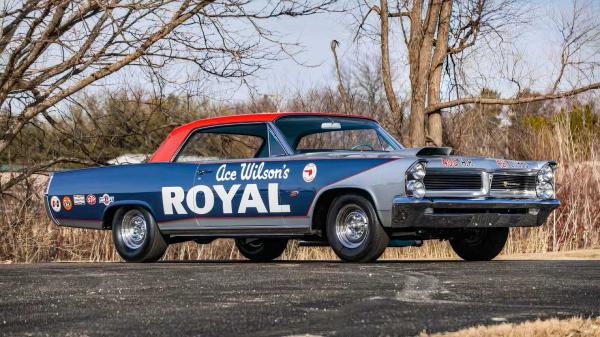
Front 3/4 shot of 1963 Pontiac Catalina “Swiss Cheese” parked Mecum -
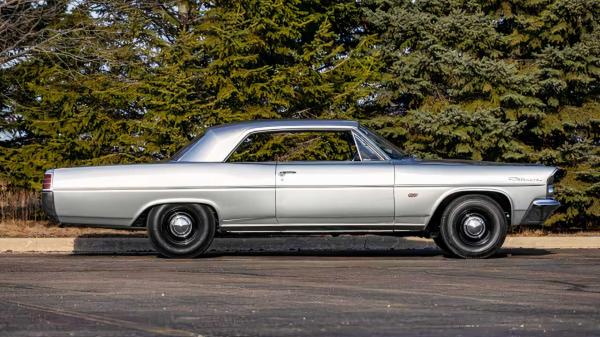
Profile shot of 1963 Pontiac Catalina Swiss Cheese Mecum -
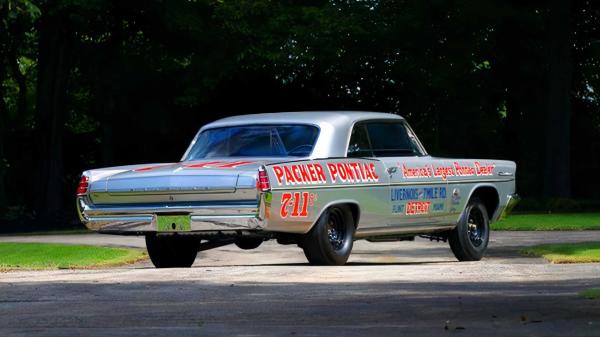
Rear 3/4 shot of 1963 Pontiac Catalina “Swiss Cheese” parked Mecum

Pontiac’s Rare Drag Car Had Holes Drilled Into Its Frame
7 minutes reading
Saturday, 31 Oct 2026 12:00 0 8 autotech
Pontiac may be long-gone from the current U.S. market, but in its time, it turned out some of the most interesting, controversial, and celebrated vehicles. Take the Pontiac Aztek: it may be one of the strangest-looking crossovers ever, but attacking it based on looks is only half the point, and we are all still fascinated by it.

101 autotech
Then there are the more obvious legends, like the ’64 GTO, the ’69 GTO Judge, the Firebird Trans-Am, and the LeMans Can-Am. All of them hit the scene at a time when something new was needed to get results, and this rare Pontiac from the early ’60s did just that.
Detroit’s Drag-Racing Arms Race Got Serious
The early 1960s mindset in Detroit was win on Sunday, sell on Monday, and it is safe to say that the likes of Chevy, Ford, Dodge, Chrysler, and Plymouth were all taking this seriously. Chevy had its 409-powered Impala and the lightweight Z11, Ford was designing its 427-powered Galaxie, and Chrysler’s Dodge 330 and Plymouth Savoy were making everyone’s life difficult with the 413 Max Wedge V8.

59 autotech
These weren’t showroom cruisers with a few bolt-ons either; the Dodge and Plymouth lightweights had a head start thanks to their lighter bodies and massive V8s, while Ford and Chevy were developing dedicated racers to show their American counterparts how it was done.
Pontiac Needed To Lose Weight To Keep Up With Ford, Chevy, And Chrysler

When it came to power, Pontiac was not lagging. Its 421 Super Duty V8, as found in the Catalina and Grand Prix, was built for factory-backed drag racing and NASCAR, kicking out over 400 horsepower. The issue was weight. The Catalina and Grand Prix are both full-sized cars and have some serious weight to them, so some, if not all, of the effort from the 421 was wasted compared to the lighter yet still powerful builds of the mega-rare Impala Z11 and the Galaxie.
The 1963 Pontiac Catalina Super Duty Went On A Radical Diet

If you want to go faster, go lighter. And to get a real foothold in the early ’60s NHRA (National Hot Rod Association) Super Stock and Factory Experimental Classes, this is exactly what Pontiac attempted with the 1963 Pontiac Catalina. What resulted is one of the rarest and most harebrained yet clever ways of modifying a factory car for drag racing.
120 Holes Helped Earn It The “Swiss Cheese” Nickname
Before Pontiac did anything with it, the ’63 Catalina tipped the scales at a healthy 3,725 pounds, or roughly the same as the 2026 BMW M2 CS, but without all the gadgets to get it moving. To start, Pontiac drilled some 120–130 holes into the vertical sides of the steel frame rails, which earned it the obvious nickname, but that’s not where it ends.
Aluminum Body Panels And Deleted Parts Cut More Weight

To shed even more weight, Pontiac swapped out most of the front end (the hood, inner and outer front fenders, the bulkhead, and bumper mounting brackets) for lightweight aluminum parts. The cast-iron exhaust manifolds were changed to aluminum ones, the rear diff case was also changed to an aluminum one, and the engine was equipped with lightweight valves and a lightweight flywheel.
Then there was the stripping of almost everything not needed in drag racing. That meant the radio, the heater, the clock, the armrests, and glass windows were removed (plexiglass side windows were added, though).
Pontiac also removed the sound insulation from the cabin, the front anti-roll bar, and cut away the bottom plates and parts of the top plate of the frame, all in a bid to shave as much weight off as possible. It worked; the Catalina Swiss Cheese ended up weighing around 3,300 pounds.
Pontiac Traded Street Manners For Quarter-Mile Speed

Everything Pontiac did had to follow the NHRA rulebook to race in the Stock or Factory Experimental (FX) classes, and this meant that cars had to be based on active factory assembly line models, not just custom jobs. However, like most brands at the time, Pontiac used some dark arts to get the Swiss Cheese out on the strip.
The 421 Super Duty V8 Made A Conservative 405 HP… Kind Of

Pontiac used every trick in the book to get the Swiss Cheese competing, and one of the biggest things they did, literally, was using the 6.9-liter (421-cubic-inch) Super Duty V8 as the powerplant.
Officially rated at 405 horsepower, though actual horsepower is somewhere near 470, and torque at 425 pound-feet, the Super Duty has dual Carter AFB four-barrel carbs, high-flow heads with 2.02-inch intake and 1.76-inch exhaust valves, a high-lift camshaft, a 4.09-inch bore, and a four-inch stroke. Power is sent through a BorgWarner T-10 close-ratio four-speed manual transmission to the Safe-T-Track differential rig, and then down to the rear wheels via 4.30:1 to 4.56:1 rear axle gearing.
How The Catalina Swiss Cheese Got On
Bearing in mind this is 1963, the Catalina was recorded hitting 60 mph in four to five seconds. The Swiss Cheese was also recorded by the NHRA running the quarter-mile in 12.27 seconds, when driven by Howard Maselles. That means it beat the Savoy Max Wedge (11.8 to 12.4-second quarter-mile), but was still behind the likes of the Ford Fairlane Thunderbolt (11.4 to 11.8 seconds) and the Impala Z11 (10.8 to 11.5 seconds).
Removing Parts And Lightening The Frame Came With Compromises

It may be obvious, but all that weight-saving and parts deletion made the Catalina Swiss Cheese effectively useless as an everyday driver. Because the Catalina Swiss Cheese was gutted so comprehensively, the frame was very flimsy. Without the rigidity of the body bolted on top, the frame rails would just twist under the weight of the 421 V8.
To get around this, factory workers reportedly wedged wooden blocks under the chassis to keep it straight. To sneak it past strict audits monitoring high-performance engine limits, the Catalina Swiss Cheese models were first logged with standard 389-cubic-inch V8 paperwork before officially getting the 421 Super Duty.
Just 14 Swiss Cheese Catalinas Escaped The Factory
The speed was impressive, and it resulted in one of the best drag-racers of the 1960s, but despite the 50-build rule from the NHRA, Pontiac built just 14 of these unique muscle cars. By ’62, GM was the market leader in the U.S., with a market share of around 54 percent, but this had its downsides. Alongside the horsepower wars, GM was facing growing antitrust scrutiny from the government, and the Swiss Cheese was hardly keeping a low profile.
In ’63, GM banned factory-sponsored racing across all of its brands, killing the Catalina Swiss Cheese project. It is reported that one model was completed after the ban, but that’s where it ended. According to Classic.com, the average auction price for a ’63 Catalina is just $30,800. However, Catalina Swiss Cheese models are exceptionally rare, with nine known models left in existence. The most recent model to cross the block was in 2025, and it sold for $742,500.
It’s Not All Bad News

GM’s racing ban may have shut down Pontiac’s drag program, but it didn’t kill the appetite for performance. John DeLorean and Jim Wangers took the Swiss Cheese thinking and put it on the road, by putting a 389-cubic-inch V8 into the smaller Tempest. The result: the Pontiac GTO.
Launched in ’64, the GTO sold over 32,000 units in the first year and became one of the most iconic Pontiacs ever made. The Catalina Swiss Cheese may have met an untimely end, but it led the way for something much bigger.
Sources: Classic.com and Pontiac.

Related posts


Latest Post

12 minute ago
3 autotech


No Comments