
The Obscure 1962 Prototype That Predicted The Mustang Two Years Early
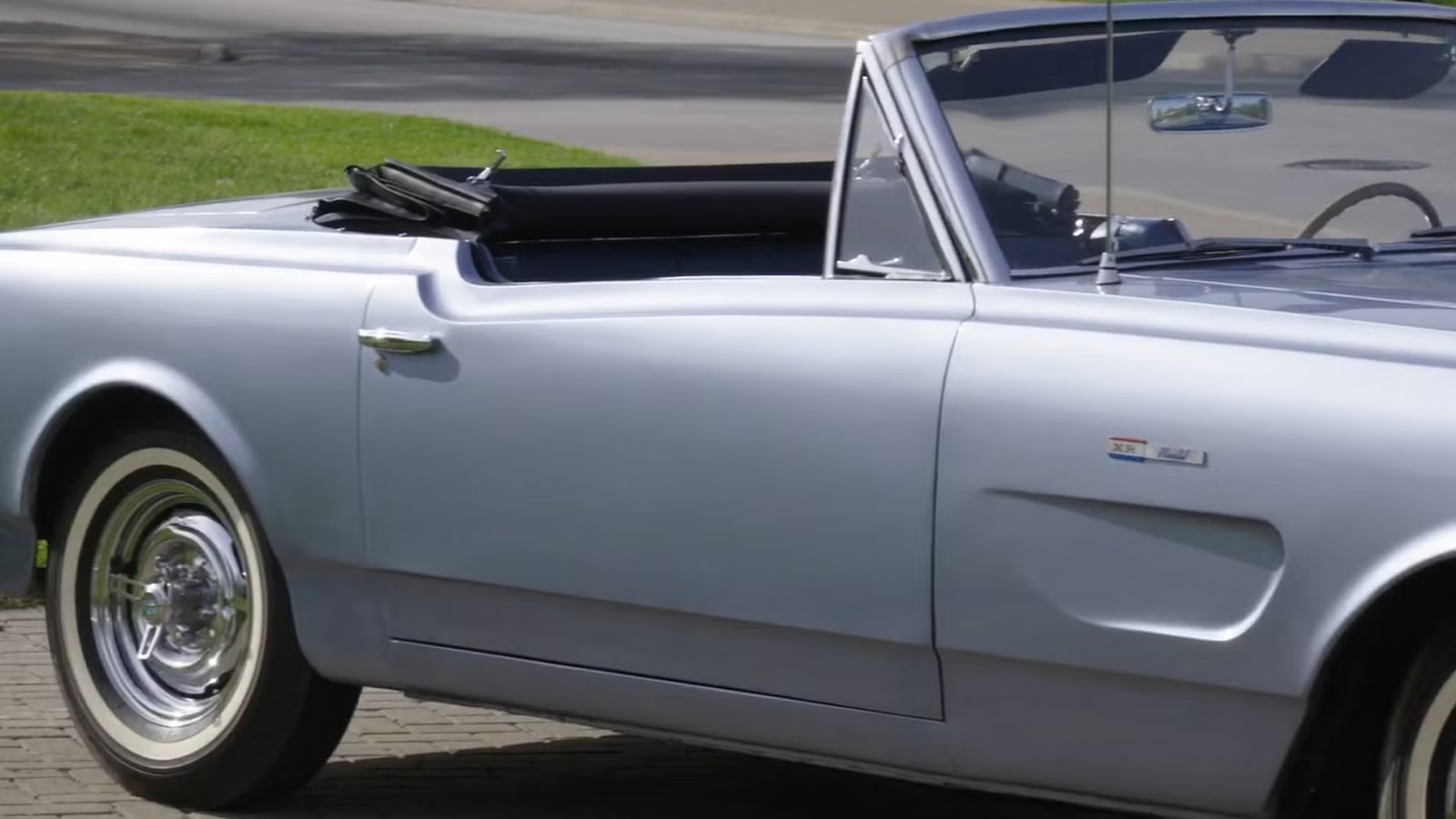
The iconic Ford Mustang launched the pony car segment in 1964, and has been a cornerstone of it ever since. But for all the success of the Mustang, there was one car that came two years earlier, had all the Mustang hallmarks yet never saw the mainstream. And while this car was the Mustang before the Mustang, it is forgotten today.
America Was Ready For A New Kind Of Performance Car

The American auto market was in a period of transition in the early 1960s. Chrome-heavy, finned land yachts were still popular, but buyers were beginning to look beyond ever-larger cars as operating costs rose, and compact alternatives became increasingly attractive. At the same time, a strong economy meant that families could afford a second car, while new drivers wanted something that wasn’t the same as their parents’ cruisers.
Whatever came next would need to have power. Performance had become an important marketing point throughout the 1950s, and while cars like the 1960 Chrysler 300F, Pontiac Catalina, and Ford Starliner had enormous V8s under their hoods, these were all still full-size cars. Smaller cars were also becoming popular, with vehicles like the Ford Falcon and Chevrolet Corvair proving that consumers could be persuaded, but there wasn’t yet a car to fill a growing gap in the market.

Ford’s Forgotten Fairlane Was A Factory Drag Weapon Before The Mustang
The Mustang wasn’t Ford’s only performance car of the early ’60s.
Detroit Was Searching For The Next Automotive Trend

With the traditional big car, big engine route no longer working as well as it once had, Detroit was searching for the next winning formula. The European import market was gaining a loyal following and, on the lightweight, agile front, cars like the MG MGA, Triumph TR3, and Porsche 356 were gaining momentum. Chevrolet’s Corvette also targeted sports car buyers, although, unlike many European rivals, it relied on V8 power rather than lightweight engineering.
On the practical and reliable front, Volkswagen’s Beetle had already proven there was a market for smaller, economical cars. The Chevrolet Corvair and Ford Falcon were Detroit’s answer. The Corvair would get a sportier version in the 1960 Corvair Monza, which was a bucket-seat, more exotic-looking trim available for those who wanted something that looked more exciting. This hinted at what the public wanted, providing a clue about what the next trend could be.
Despite these successes, Detroit was still refining existing ideas rather than creating an entirely new segment. Manufacturers had economy cars, sports cars and full-size performance models, but there was nothing that combined affordable pricing, sporty styling, and everyday practicality into one package. That would change in 1962, though, when the Budd company unveiled a car that would go on to influence one of the most American cars in the world — the Ford Mustang.
The Budd XT-Bird Predicted The Mustang Before It Ever Existed

Founded in 1912 by inventor and businessman Edward G. Budd, the Budd company was known for making all-steel automobile bodies, railway cars, and aircraft components. While this might sound like a strong start for an automobile manufacturer, Budd’s contribution to the auto market at that point was in making steel bodies for cars like the Dodge Touring Car and Oakland Model — big, early automotive designs that were competitors to the Ford Model T.
Budd had more recently provided the bodies of the 1955 Thunderbird, and so, with Ford trying to find something with which to plug the gap in the market, it tasked Budd with designing a new car to send to market. What it came up with was the Budd XT-Bird — a two-seater that took the design of the Ford Thunderbird and placed it on the smaller Ford Falcon frame.
Relying so heavily on existing Ford parts meant that costs would be remarkably low, at an estimated $1.5 million (or one-sixth of the cost of a completely new car design). This, Budd hoped, would help to present the XT-Bird as an affordable, compact car that Ford could test the waters with for comparatively little outlay. It seemed like a good fit, but Ford disagreed.
Ford’s Forgotten Fairlane Was A Factory Drag Weapon Before The Mustang
The Mustang wasn’t Ford’s only performance car of the early ’60s.
But Neither Ford Nor AMC Wanted It

Ford rejected the car. It felt that the design was too close to the existing Thunderbird, and its own market research had found that a 2+2 or four-seater would be more practical for a larger market. It was an understandable blow to the company, but it was not to be the end of the car’s story.
Budd went back to the drawing board and retooled the design into the XR-400. This car was based on AMC’s 1962 Rambler Ambassador, and featured a new steel body for AMC rather than the reworked Ford one the XT-Bird had used. It also incorporated Ford’s market research, turning the car into a true 2+2 layout more in line with what consumers were believed to want.
The XR-400 did play with the dimensions slightly, moving the engine two inches lower, the radiator 3.5 inches lower, and redesigning some other under-the-hood parts to allow the hood to sit much lower than the Ambassador, giving it a sleeker silhouette. The engine, however, remained the same, using the AMC Rambler Ambassador’s 327 cubic-inch, 5.4-liter V8, good for 250 hp, as the powerplant.

Budd reportedly told AMC that the XR-400 targeted a market that was “presently untapped by any other manufacturer”, and was “unlike anything else on the road — it would attract widespread attention, provide [its] dealers with both a new profit area and a morale-builder, and offer unusual advertising and sales opportunities”. While certainly true with hindsight, AMC didn’t bite.
For a start, the XR-400 targeted a market that the Mustang had not yet had a chance to prove existed. This made it a considerable risk for AMC which, at the time, was much smaller than the likes of Ford and could ill afford to gamble and lose. AMC had also built a reputation on practical, economical cars like the Rambler, Rambler American, and Rambler Ambassador rather than sporty cars like the XR-400.
The 500-HP Mustang That Became The Benchmark Every American Muscle Car Now Chases
Ford redefined what a modern muscle car was, pushing the genre forward in one fell swoop
The XR-400 Became A Museum Piece, But Its Ideas Lived On
With the XR-400 project having been declined twice, Budd cut its losses and renamed it the XR-Budd, using it as a marketing tool to display its disc brakes and allowing it to fulfill the “unusual advertising opportunities” promise it had made in 1962.
Ford would actually buy Budd’s XR-400 in 1997, though it was the prototype car that was bought, and it was the Henry Ford Museum that bought it. The car remains on display in the museum today, occupying a space as a car that helped to define what the Mustang would become.
The Mustang Proved Budd Was Looking In The Right Direction

Budd put all the pieces of the puzzle together, but nobody wanted to buy what it was selling. Whether the XT-Bird, or the XR-400, would have set the world alight in the same way that the Mustang did is debatable, and not something we’ll ever know the answer to. It was also likely little solace for Budd, which went bankrupt in 2014, that the car it designed and turned down helped to spawn Ford’s most successful sports car, but the Mustang will always be able to trace its roots back to that XT-Bird concept.
Sources: How Stuff Works, Retro Hotrod

Related posts


Latest Post


No Comments