
Pontiac’s Forgotten Sports Coupe No One Bought
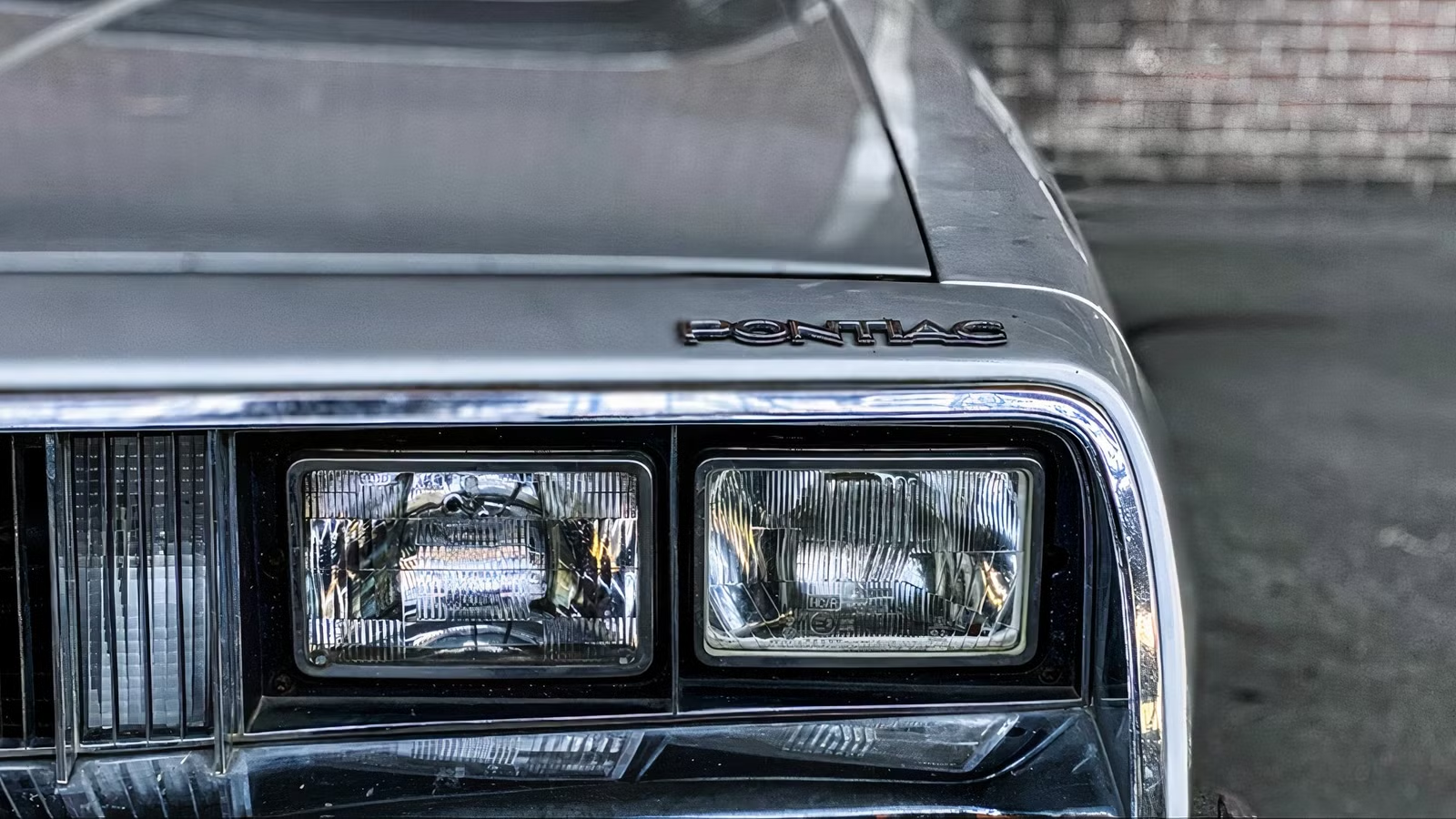
Few automotive cautionary tales are as quietly compelling as a car that looked the part but never played it. The 1980 Pontiac Sunbird Sport Hatch arrived at exactly the wrong moment — a would-be hot hatch dressed in sporty graphics and fastback sheetmetal, competing in a market that was rapidly wising up to what real performance felt like. Pontiac had the styling brief more or less right. Everything else, unfortunately, was another story.

As any serious gearhead knows, a sharp body and a bold badge can only carry a car so far. Beneath the surface, the engineering simply didn’t match the hype, the performance falls flat, and buyers quietly move on. These are the kinds of machines that slip through the cracks of history — cars that aimed high but never lived up to the dream. One of Pontiac’s biggest flops fits that description perfectly, and the truth might just surprise you.
The 1980 Pontiac Sunbird Sport Hatch Flopped Spectacularly
When you hear “Pontiac flop,” you might immediately think of the Aztek or even the Fiero with its fire-prone reputation. But in terms of a genuine sporty hatchback gone wrong, the 1980 Pontiac Sunbird Sport Hatch is a very underrated candidate for Pontiac’s biggest misstep.

The Sunbird nameplate first appeared in 1976 on Pontiac’s H-platform subcompact, essentially as a badge-engineered counterpart to the Chevrolet Monza, Buick Skyhawk, and Oldsmobile Starfire. Over time, Pontiac layered on more performance cues — “Formula” trims, sporty graphics, and the hatchback body style — in an effort to carve out a sportier identity for the Sport Hatch.
By 1980, Pontiac was positioning the Sport Hatch as its fun, compact answer to rising Japanese hatchbacks and “hot hatches.” But 1980 was also the end of the first-generation Sunbird run. Pontiac dropped the V8 option that year, leaving the largest engine choice as the Buick-sourced V6. Meanwhile, the wagon version was eliminated, and styling tweaks were minor. That made the 1980 Sport Hatch feel like a half-hearted send-off rather than a confident evolution.

Total unit numbers for the final production model year are a bit murky. However, we do know that during the first-generation Sunbird line, produced from 1976 to 1980, 479,967 total units were built across all body styles. And, according to the Automobile Catalog, only 52,952 units of the 2-door Hatchback Coupes were produced in 1980, with even fewer of those being the Sport Hatch variation.
Sadly, while the final 1980 model year was supposed to be a capstone, it felt more like an afterthought. Buyers were already shifting toward better-engineered imports like the Volkswagen Rabbit and Toyota Celica, and Pontiac’s Sport Hatch couldn’t keep up in performance, refinement, or build quality. The result was a car that failed to make an impression in its own time and has been largely erased from memory today. The 1980 Sunbird Sport Hatch was marketed as Pontiac’s bold compact coupe for a new era, but it ended up as one of the brand’s biggest flops off the production line.
A Look Under The Hood Of The 1980 Pontiac Sunbird Sport Hatch

Under the hood of the 1980 Pontiac Sunbird Sport Hatch, the mechanical reality was always more modest than the sporty marketing would suggest. Pontiac was chasing the hot-hatch crowd, but the Sunbird’s engine options and drivetrain layout betrayed its budget compact roots. According to Hemmings, as part of the GM H-body family — shared with the Monza, Skyhawk, and Starfire — the Sunbird used a rear-wheel-drive layout.
1980 Pontiac Sunbird Sport Hatch Specs
|
Engine |
2.5 L “Tech IV” I4 / 3.8L Buick V6 |
|
Horsepower |
90 hp (I4) / 115 hp (V6) |
|
Torque |
134 lb-ft (I4) /188 lb-ft (V6) |
|
Transmission |
4-speed manual or 3-speed automatic |
|
Driveline |
Rear-wheel drive |
In the 1980 Sunbird models, the V8 option was dropped entirely, leaving the engine palette thin. The base engine was a 2.5-liter Tech IV inline-4 rated at around 90 hp. Gearheads who wanted more torque could opt for the 3.8-liter Buick V6, rated at around 115 hp, which served as the top engine across most trims.
What made the Sport Hatch underpowered — and ultimately contributed to its flopping — was the mismatch between style and substance. The sporty graphics, spoilers, and fastback form promised something more aggressive than what you actually felt when you pressed the gas pedal. Without a V8 and with only mediocre output from the V6, it couldn’t deliver real performance. Factor in an unrefined, noisy ride and the build compromises that came from sharing so many components with economy GM compacts, and the “sport” label felt hollow.

At the end of the day, beneath the styling enhancements, the Sport Hatch was still the same rear-drive compact package, with engines that were never quite able to tip the balance toward excitement. The Sunbird Sport Hatch looked like it could run — but under the hood, it simply didn’t have the chops to stand out.
How Much Does A 1980 Pontiac Sunbird Sport Hatch Cost Today?

With very few Sport Hatch trims produced during the Sunbird’s run, there simply aren’t many floating around on the open market today. If you do spot a 1980 Sunbird Sport Hatch up for grabs, you’ll want to have your wallet ready.
When it hit the market, the Sport Hatch carried a starting sticker price of $4,731. Even rarer in the lineup was the Sport Hatch with the Formula Package, which featured a V6 engine and a four-speed manual transmission, along with a front air dam, rear spoiler, blacked-out grille, and 13-inch cast-aluminum rally wheels. This special edition started at $5,630. The Sport Hatch with the Formula Package was ultra-rare, constituting just one percent of the Sunbird’s total production.

According to Classic.com, the average auction price for a 1980 Pontiac Sunbird is around $6,000 — though that figure covers all body styles, not just rare editions like the Sport Hatch. Likewise, J.D. Power lists the average retail price of a 1980 Sunbird at $4,775. But don’t fret — for gearheads who genuinely want to get behind the wheel of a Sunbird, regardless of body style, there are options.
Just take a look at this 1986 Pontiac Sunbird Turbo Convertible with only 72,000 miles on the clock. Finished in a flashy red and black paint scheme, this ’86 Sunbird sold for just $5,995 via Streetside Classics in March 2025.
Another strong Sunbird example is this silver 1980 Pontiac Sunbird Coupe. With just 26,000 miles on the odometer, this 1980 model sold for $6,000 via Hemmings in January 2025.
At the end of the day, finding a Sport Hatch on the used market or at auction will be a challenge. If you really want to experience an ’80s Sunbird, your best bet is to opt for a more common body style, such as a sedan, coupe, or wagon.
Other American Machines That Flopped Big Time
While the Pontiac Sunbird Sport Hatch stands as one of Pontiac’s most notable misfires, it is far from the only major flop in automotive history. Two other cautionary tales every gearhead should know are the Cadillac Cimarron and the Ford Edsel.
Cadillac Cimarron (1982–1988)

If there’s one car that can rival the Sunbird Sport Hatch for flop status, it’s the Cadillac Cimarron. Launched in 1982, the Cimarron was Cadillac’s attempt to downsize and capture younger buyers flocking to BMW and Mercedes. The problem, however, was hiding in plain sight: the Cimarron was nothing more than a dressed-up Chevrolet Cavalier. With a 1.8-liter four-cylinder pushing out around 88 horsepower at launch, buyers quickly figured it out. The Cimarron was underpowered, overpriced, and a total mismatch for Cadillac’s luxury image.
Cadillac managed to sell about 132,499 models across six production years. That might sound decent until you consider how far short it fell of expectations. Cadillac wanted a true import fighter, but the Cimarron became a punchline instead — often cited as one of the worst examples of badge engineering in history. Even GM executives later admitted it was a mistake. For Cadillac, the Cimarron wasn’t just a flop. It was a scar that hurt the brand’s prestige for decades.
Ford Edsel (1958–1960)

No discussion of automotive flops is complete without mentioning the Ford Edsel. Billed as an entirely new brand to slot between Ford and Mercury, the Edsel was supposed to revolutionize the mid-market. Instead, it became a disaster of timing, styling, and marketing. Introduced in 1958 with its now-infamous “horse collar” grille, the Edsel was polarizing from the start. Add in a recession, dealer resistance, and quality issues, and Ford’s big gamble quickly spiraled.
According to Hemmings, production lasted just three years — 1958 to 1960 — with a total of 118,287 units built. That was a fraction of what Ford had banked on after investing hundreds of millions into the launch. By 1960, the Edsel name was dead, living on only as the textbook example of how not to launch a new car.
In the end, both the Cimarron and the Edsel joined the Sunbird Sport Hatch in the history books as cars that promised plenty but delivered disappointment, each in their own uniquely unforgettable way.
Sources: Classic.com, Eighties Cars, Hemmings, J.D. Power, Mac’s Motor City Garage

Related posts




Latest Post


No Comments