
Pontiac Finally Got It Right With The Final Trans Am
There is an old joke that whenever General Motors engineers finally get a car just right, the company kills it. The final Firebird Trans Am arrived after 33 years of Pontiac using every performance trick it knew to build a balanced muscle car. A pony car that could do more than make a lot of noise in a straight line. We’re talking bigger V8s, smaller cars, better suspension, lower weight, Corvette engine technology, and even turbocharging. But by the time Pontiac finally assembled the perfect recipe, the clock was already at midnight.
Pontiac’s Firebird Trans Am Was A Ready-Made Muscle Car Legend
Detroit settled on the ingredients of a muscle car long before Pontiac made a chicken-flavored version. A screaming chicken, to be exact. In 1959, Dodge offered the D-500 performance package across its full-size lineup, including station wagons, with a 383-cu-in V8 rated at 320 horsepower. The hotter Super D-500 added dual four-barrels and raised output to 345 hp. Five years later, Pontiac made the GTO a package on its midsize 1964 Tempest LeMans, swapping in a 389-cu-in V8 rated at 325 hp, or 348 hp with Tri-Power. Then Ford unveiled the 1965 Mustang on April 17, 1964, inventing the pony-car segment: an affordable, compact, sporty car with the long-hood, short-deck proportions that soon became the class template. Pontiac’s next move was obvious. Put its winning muscle-car engine philosophy into a pony car.
Pontiac was the perfect automaker to take the pony car segment to the next level. When the 1967 Firebird arrived, it was almost exactly Mustang-sized, riding on a 108.1-inch wheelbase (versus the original 1965 Mustang’s 108.0 inches). But the Firebird carried more meat on those bones. A 326 four-speed Firebird coupe is listed at about 3,267 lb curb weight, versus roughly 2,860 lb for a representative 289-powered 1965 Mustang coupe, a difference of about 407 lb. Pontiac countered with bigger V8 hardware: the 326 made 250 hp, while the Firebird 400 was rated at 325 hp; Ford’s 1965 High Performance 289 Mustang topped out at 271 hp. The Firebird therefore arrived as the heavier pony car, but one built from day one around the big-V8 formula Pontiac pioneered for its midsize muscle cars.

Then Pontiac went one step further. For 1969, it turned the Firebird’s top performance package into the Trans Am, borrowing its name from the SCCA’s Trans-American Championship and loading the car with considerably more than an engine upgrade. There was special suspension and steering hardware, functional performance equipment, and Pontiac’s Ram Air 400s under the hood. Only 697 were built that first year. The Trans Am wasn’t a straight-line drag racer; it was a car engineered to use its power in the corners. Pontiac was taking a stab at a truly balanced road car. But it wouldn’t fully perfect the formula for decades.

Pontiac Never Gave Up On The Trans Am

The Trans Am’s first real test was not finding more horsepower. It was figuring out how to maintain performance while the rules were changing across the industry. By 1971, compression ratios and emissions requirements tightened around Detroit. Pontiac’s answer was the 455 H.O., the new standard in the Trans Am, which used big displacement and bigger valves to maintain low-end torque for maximum drivability. While other car companies gave up on performance, Pontiac doubled down for 1973. The SD-455 was a heavily reinforced “Super Duty” 455 with specialized high-flow cylinder heads and competition-minded hardware.
When Pontiac fully redesigned the Firebird for its third generation in 1982, it attacked mass as aggressively as it once pursued torque. A 1982 Trans Am with the 165-hp Cross-Fire-injected 5.0-liter V8 rode on a 101-inch wheelbase and was listed with a curb weight around 3,119 lb. That was roughly 380 lb lighter than the 3,499-lb 1969 Trans Am coupe from the first generation, and roughly 545 lb lighter than the 3,664-lb 1981 Turbo Trans Am that closed out the second generation. Pontiac wrapped that diet in a much more aerodynamic body and a modernized chassis. The embarrassing part was that the top 1982 V8 still made only 165 hp. But the car’s superior power-to-weight ratio was a preview of what would come next.

Pontiac got even less sentimental for the 1989 model year. The 20th Anniversary Turbo Trans Am ditched the V8 entirely for a 3.8-liter turbo V6 from the same engine family that powered the 1986–1987 Buick Regal Grand National and culminated in the 1987 GNX. Pontiac did not simply drop a GNX engine between the Firebird’s fenders: the Trans Am used different cylinder heads, a cross-drilled crankshaft, revised hardware, and a larger GNX-style intercooler to make the Buick turbo package work in the F-body. Factory-rated at 250 hp and 340 lb-ft, it served as the 1989 Indianapolis 500 pace car, and Pontiac built 1,555 examples.
2002 WS6: “The Best Version” Of Pontiac’s Trans Am

It wasn’t until the 21st century that Pontiac arrived at a car some enthusiasts consider the best version of the badge: the 2002 Pontiac Firebird Trans Am WS6. Jay Leno owns this Trans Am, and he thinks it was “the best one they ever built.” The 2002 model year was the Firebird’s last, making this WS6 the Trans Am’s swan song and the culmination of Pontiac’s 33 years spent changing engines, weight, aerodynamics, and chassis hardware to constantly improve the balanced road-car formula.
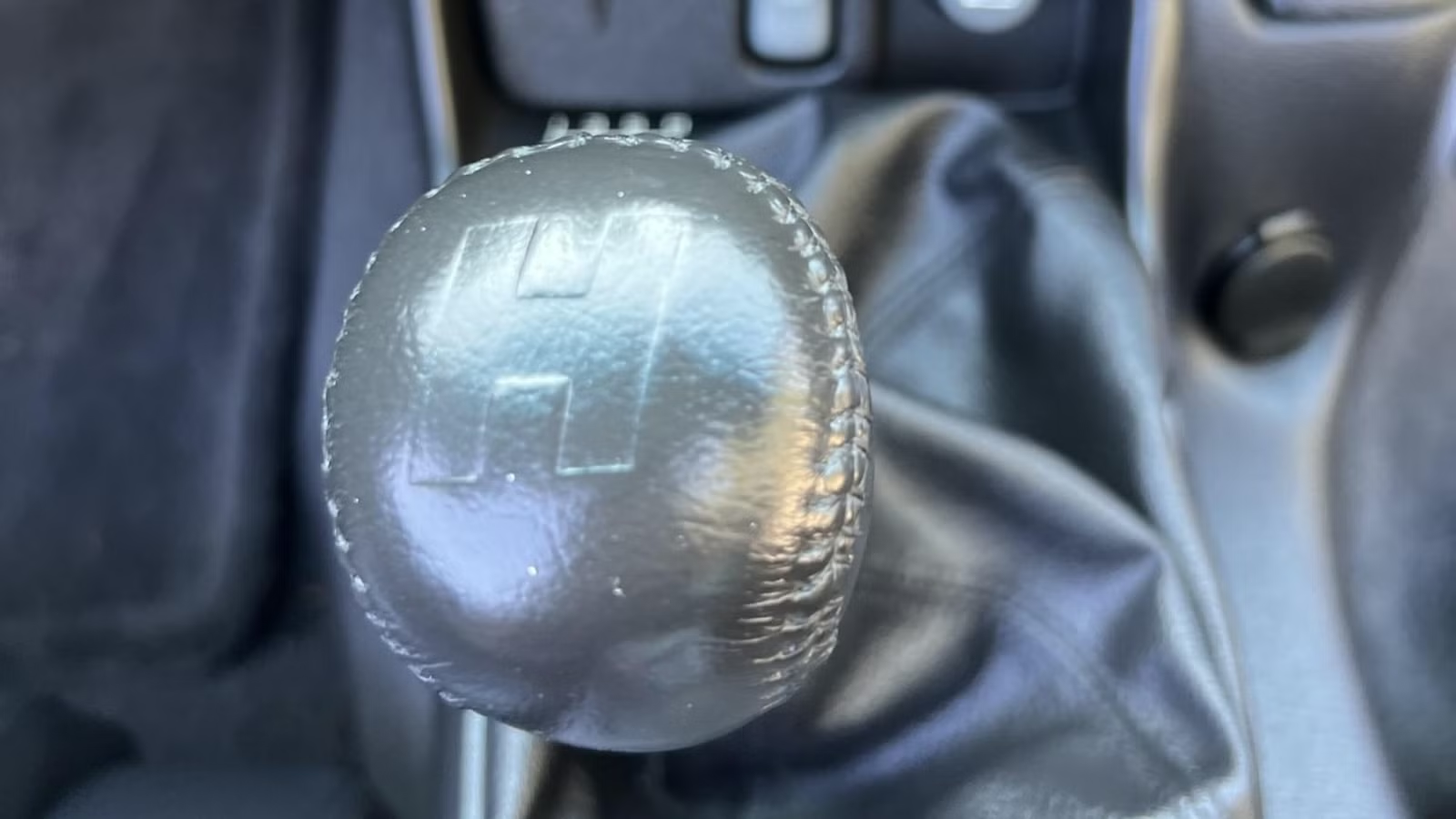
Under the hood was GM’s 5.7-liter LS1, sending 325 horsepower and 350 lb-ft of torque through a six-speed manual. The WS6 badge was no longer just a suspension package. It came with Ram Air induction, a specific performance package, a short-throw shift linkage, and a 3.42 rear axle, while the car rode on Goodyear Eagle performance tires. It weighed in at around 3,500 pounds, making it the second-lightest generation of the badge, but it trounced the slightly lighter third-gen Trans Am on its power-to-weight ratio. On paper, it was still an old-fashioned American formula: V8, rear drive, and manual transmission. The difference was how much engineering had accumulated around that formula by 2002.

By this point, the Trans Am’s recipe had become almost comically comprehensive. The fourth-generation Firebird brought a much more modern platform, Corvette-related small-block technology evolved into the aluminum LS1, and the WS6 package could combine that engine with functional Ram Air upgrades, specific suspension tuning, big wheels and tires, and serious braking hardware.
Pontiac Made A Muscle Car Statement With Its Final Trans Am

The important hardware was underneath. Leno explained that his 2002 has four-wheel disc brakes, a performance suspension, thicker springs and sway bars, power rack-and-pinion steering, high-performance tires, and the gearing to make all that hardware useful. His particular car was incredibly original: he says it was 100 percent stock apart from its Optima battery, had never been in an accident, and had spent its entire life in California, miles from the nearest raindrop. Unlike modified examples, this car showcases the balance Pontiac achieved from the factory.

That is the element Pontiac finally got right: balance. Not the kind of balance that means splitting the difference until nobody is happy, but the much harder kind, where the engine, tires, suspension, brakes, steering, and gearing all let one another do their jobs. Earlier Trans Ams could be brutally fast and capable road cars. The final WS6 surpassed them while still being civilized enough that it’s comfortable for a daily commute.
The original MSRP for a 2002 Trans Am WS6 coupe was $30,780, while a surviving WS6 window sticker shows a total vehicle price of $31,855. A 2002 Corvette coupe carried a $41,680 base MSRP, or $42,350 including its $670 destination charge. So the Pontiac undercut the Corvette by roughly $9,800 to $10,900, depending on equipment, while adding the two rear seats that Leno specifically praises. The Corvette made 350 hp and was the purer two-seat sports car. But if “balance” includes the invoice and the people you can bring with you, the final Trans Am had a distinct advantage.
Track Tests Proved The Final Trans Am Handled High Speeds Better Than Any Other Firebird

Jay Leno is not shy about his opinion of the final Trans Am. He calls it the fastest and best-handling Firebird ever. His evidence: when he picked up his WS6, he drove every Trans Am generation on the track at Daytona. Years later, he still remembered why the WS6 was best.
Leno said the final Trans Am “stuck like glue” while driving it on Daytona’s high banks at roughly 135 mph. That is not an official skidpad number or a braking-distance test, but it is exactly the kind of firsthand impression that explains why the final WS6 feels so different from the big-engine Firebirds that came before it.
Leno remembers driving a stock 455 Firebird built in the 1970s on the same Daytona banking. He claims it could barely maintain 110 mph. By his account, emissions restrictions had strangled that car’s performance. The final Trans Am was doing roughly 135 mph on the same high banks and felt planted at that speed. Three decades earlier, Pontiac had started with the idea that a Firebird Trans Am should be a proper sports car with enough engine to make people pay attention. In 2002, it finally built a Trans Am where the rest of the car was good enough to make all that power useful.
Sources: General Motors, Ford Motor Company, SAE International, and Jay Leno’s Garage.

Related posts






Latest Post




No Comments