
8 Best Classic Cars To Buy Now Before Prices Skyrocket
Investing in cars usually ends up in one of two ways. Either you jump on the train way too late, or you’re too broke to get in on the big-money cars in the first place. From JDM to American muscle and Euros, every car market is as tricky as it ever has been. But today, we try to eliminate the mess as best as we can.

We are going to cover eight classic cars that aren’t wildly expensive, and still have huge potential for increasing in value. In this article, we look at desirability, market trends, and how each car is special relative to the current car industry. Simply, these cars offer things that new cars can’t and won’t be able to deliver on in the future.
Dodge Magnum SRT-8
Current Market Value: $24,967
Starting at the highest end in terms of current value, we have the Dodge Magnum SRT-8. Built on the Chrysler LX Platform from 2005-2008, this was a full-size Dodge station wagon that received the special SRT treatment. A 6.1-liter V8 powered the Magnum SRT-8, making a healthy 425 horsepower and 420 pound-feet of torque, sent to the rear wheels via a five-speed automatic transmission.

According to Hagerty’s data, this is one of the best investments for 2025. Why? Well, performance wagons are something America has missed out on for the most part. Aside from the Cadillac CTS-V wagon (which is extremely valuable now) and the occasional German five-door (M5 Touring, RS6 Avant), the U.S. market is sorely free of cool wagons. So a Mopar wagon from the 21st century is bound to get hot on the market very soon.
Additionally, the 6.1-liter Hemi and rear-wheel drive configuration make this a timeless and evergreen formula for enjoyment and value inflation. Right now, average values are right around $25,000, according to average sale pricing from Classic.com, but prices will likely shoot up significantly over the next several years.
Volvo P1800
Current Market Value: $22,000 – $35,000

The P1800 is one of the most slept-on classics out there. Funny enough, this Swedish car was designed by the Italian-based design house Frua, but the man who finalized the car was a Swedish man named Pelle Petterson. Under the hood of the early cars from 1961 to 1968 was a 1.8-liter inline-four that produced just 100 horsepower, but for 1969, displacement was upped to 2.0 liters and horsepower was also boosted by 30 ticks. Both were typically offered with a four-speed manual transmission.
There are two major factors with the P1800 that position it for a large increase in value. First, the gorgeous, yet unique Italian styling. Going unappreciated by older generations for years, it is the Millennials who are now loving these cars for what they are, according to Hagerty. Secondly, but just as important, is the famous reliability. The 1.8-liter motor, in particular, is incredibly robust, with one example owned by Irv Gordon reaching 3.25 million miles with regular maintenance – truly the most bulletproof classic there is.
Currently, prices range from about $22,000 up to $35,000 depending on year, spec, and condition. The early P1800s have already grown in value, but we also expect the 1800S, E, and ES models to follow suit.
BMW M3 Sedan (E36/Manual)
Current Market Value: $21,223

It seems almost every single BMW M-Division product has risen to outrageous values except the E36 M3. It’s often said how the U.S.-spec E36 M3 wasn’t a “real” M car because it didn’t receive the Euro cars’ M-Division S50 engine. This was all made worse by the fact that the later 3.2-liter Euro-spec M3s now made 321 horsepower while the North American cars’ updated 3.2-liter S52 still made just 240 horsepower.
But trust us, the U.S. M3 and the sedan variant we are featuring weren’t any worse. The lack of power compared to the Euro cars was noticeable, but didn’t ruin the experience in any way; you still got a rear-wheel drive, manual transmission (five-speed) sports sedan with a singing BMW straight-six and some of the best handling dynamics in the world. Every gearhead should drive an E36 M3 at least once and see what we’re talking about.
Considering the rarity of the North American E36 M3s, coupled with the incredible driving experience and BMW M-Division cache, we think that the E36 M3 will jump up in price from its current $21,000 average and become just as appreciated as the other expensive-as-hell M cars.
Datsun 280ZX
Current Market Value: $19,418 – $21,356

The 280ZX was an interesting middle point of the Nissan-Datsun sports car saga. After the original line of Z cars (240Z,260Z,280Z) had gone away, and before the run of the S chassis cars of the 1990s (240SX, etc.), the 280ZX marked the switch towards the modern era. Under the hood of the base model car was a 2.8-liter inline-6 producing 132 horsepower and 144 pound-feet of torque, though for 1981, the base model received a bump up to 145 horsepower and around 150 pound-feet of torque.
The 1981 model year also saw the introduction of the Turbo model, which used the same 2.8-liter engine but with a Garret TB03 turbocharger, pushing the power rating up to 180 horsepower and 202 pound-feet of torque. The 280ZX’s calling card is its classic sports car layout and sweet inline-6 engines – something we rarely see nowadays outside of an $80,000 BMW M3. Additionally, the Nissan sports cars before and after the 280ZX have all shot up in price, which is why the ZX is now poised to do the same very soon.
The Turbo models, while more desirable, are still only about $2,000 more expensive on average than the base model cars ($19,418 vs. $21,356). Thus, our suggestion is to pick up a good-condition Turbo and watch those prices rise in a few years.
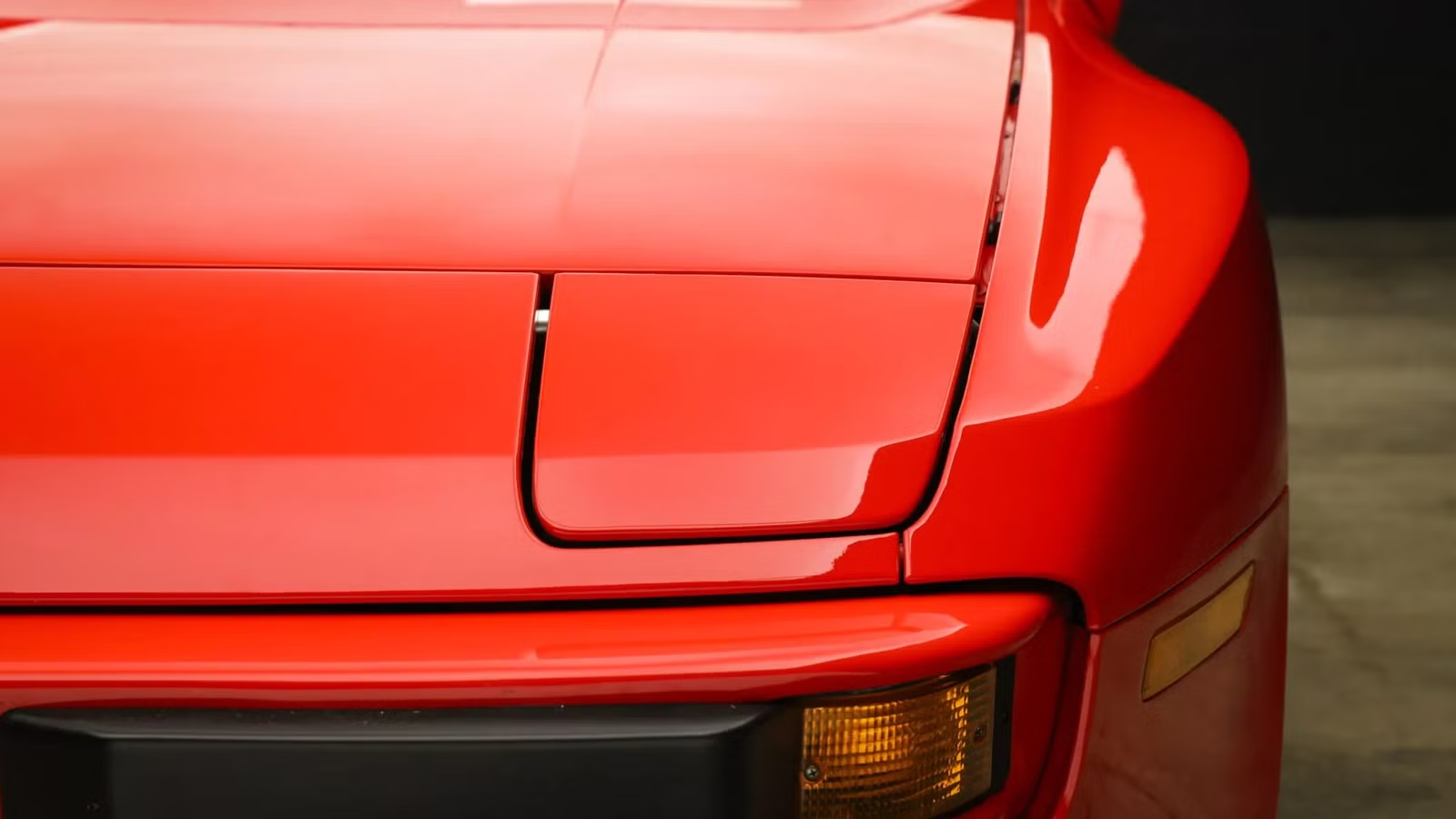
Porsche 944 S
Current Market Value: $16,926

We’ve seen the Porsche market rise over and over again in past years, specifically for cars like the 911 and 928, but now, looking back at the 944, it seems like only a matter of time before these little sports cars shoot up in price, too. In our opinion, the 944 was the most well-sorted front-engined Porsche, as the 928 was a little too heavy (and rarely came with a manual) to deliver the true Porsche experience. And the 924, while cute, was too underpowered and sober to excite enthusiasts.
We’ve chosen the 944 S model, specifically, as the Turbo and Turbo S models have already gone up quite a bit in value, and the base models are too common to expect significant change. Built for just two years before being replaced by the S2 trim, the 944 S used a 2.5-liter naturally aspirated inline-four producing 190 horsepower and 170 pound-feet of torque, mated to a five-speed manual transaxle.
For money in the mid-teens, a stunningly styled, rear-wheel drive, manual transmission, near-200-horsepower Porsche seems too good to be true, and in a few years, it likely will be. Aside from a Miata or GR86, there aren’t many entry-level sports cars that deliver such fun (and decent reliability), so get yours if you can.
Lexus LS400 (XF20)
Current Market Value: $13,543

The Lexus LS400 is one of the most reliable cars of all time. It also happens to be one of the greatest luxury sedans ever built, beating Mercedes-Benz at their own game in the late 1980s and 1990s.
We haven’t seen these luxury barges shoot up in value quite yet; however, there has been a steady increase in value over the last five years, according to Classic.com. The XF20, in particular, is the refreshed generation of the original LS and has higher potential for low-mileage examples. It featured the famous 1UZ-FE V8 that, depending on year, made between 260 and 290 horsepower and between 270 and 300 pound-feet of torque.
These legendary saloons combine smooth V8 power with unrivaled reliability and timeless styling, all of which are becoming rarer in the modern industry. We predict these will have their day in the coming years, as fewer examples retain low mile readings on the odometer.
Toyota MR2 (AW11)
Current Market Value: $13,509

The second-generation Toyota MR2, the SW20, has already had its big increase in value recently. The Turbo models, especially, have become extremely desirable to sports car collectors and enthusiasts. But the car we’re featuring is the first-gen MR2, the quintessentially ’80s mid-engine sports car that we predict will climb up the ladder of value.
The 1.6-liter in the base model cars produced around 112 horsepower and 102 pound-feet of torque, sent to the rear wheels via a five-speed manual or four-speed automatic transmission. The MR2 was praised for its incredible balance and engaging handling characteristics, as well as the refined, yet fizzing nature of the 1.6-liter engine, landing itself on Car and Driver’s 10 Best list for 1985.
We think the AW11 will go up in value because of a few things: its styling, reliability, driver engagement, and mid-engined layout. The only other cars that offer these are the second-gen MR2, which is already expensive, or a mid-engined exotic, making the AW11 a rare breed at its current $13,509 average value (about the same as a fully optioned MR2 was in 1985).
Ford Bronco II
Current Market Value: $11,674

Prices for the original first-gen Bronco are ridiculously high nowadays ($80,000 on average according to Classic.com), but if you can forget the lovable body style of the early trucks, the Bronco II will deliver the same pleasant sport utility experience. At the time of its launch in 1984, there was significant controversy surrounding the Bronco II (rollover safety lawsuits), but sales were nearly double that of the outgoing Bronco over a single year.
It was initially powered by a 115-horsepower 2.8-liter Cologne V6, but was swapped out for a much better 140-horsepower 2.9-liter unit in 1986. There was also a turbo-diesel four-banger option that debuted in 1987. Among the surviving 1980s SUVs, the Bronco II remains the most affordable option, and has been rising in popularity with younger buyers, according to Hagerty. And with prices currently sitting at just around $12,000 on average, that popularity will soon see the Bronco II skyrocket.
Sources: Hagerty, Car and Driver, Classic.com

Related posts

Latest Post


No Comments