
The Baja-Winning Nissan 4×4 That Still Costs Half A Toyota Pickup
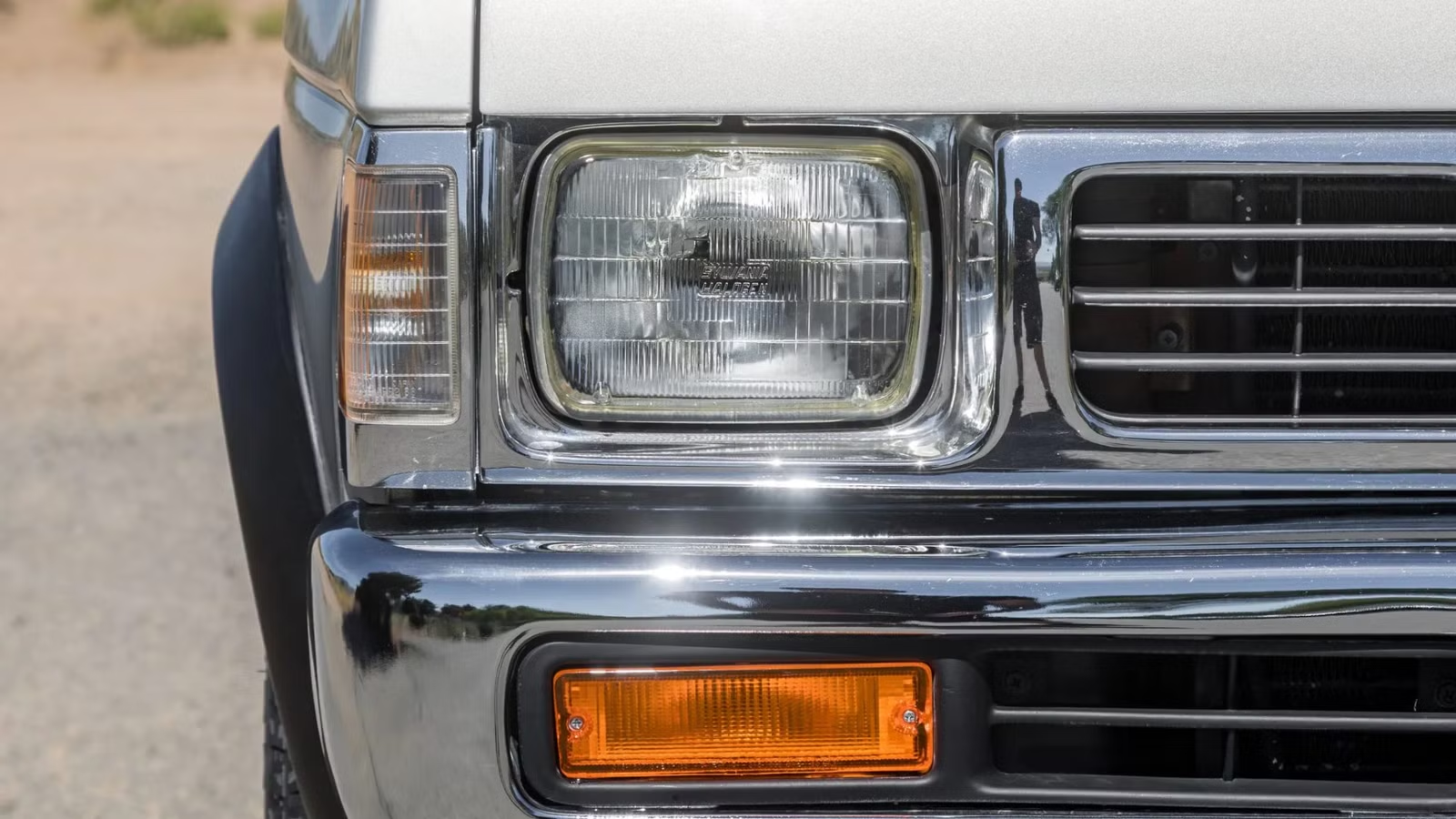
A compact 4×4 pickup truck with factory class wins at the Baja 1000, the Mint 400, and the Gold Coast 300 currently sells for less than half of what a comparable Toyota pickup commands. Same decade, same size class, arguably the deeper racing résumé — and a fraction of the price. Nobody ever made a movie about the truck that actually won the races.

Today, this Japanese truck costs a fraction of a pickup built by Toyota, so we investigate why it’s undervalued.
Why Clean ’80s Toyota Pickups Cost A Fortune Now
Toyota’s compact pickups from the 1980s and ’90s are the undisputed kings of the used-truck collector market. Much of that reputation comes from pop culture as much as from engineering, with films like Back to the Future turning the trucks into an aspirational symbol long before anyone cared about torsion-bar suspension. That image has a price tag attached.

The average Toyota Pickup now sells for $18,823, and clean fourth-generation trucks average $19,773, with the priciest example — a Back to the Future tribute truck — going for $110,000. Buyers aren’t just paying for a reliable old 4×4. They’re paying for the legend built around it.
The trucks earned real reliability cred over the decades. But reputation and rarity have pushed prices well past what the mechanicals alone would justify. Somewhere in that same era, though, sits a truck with an even stronger claim to fame. One that never got the Hollywood treatment.
The Nissan Hardbody D21 — The Truck Nobody Made A Movie About

The Nissan Hardbody D21 was produced from model year 1986.5 through 1997 at Nissan’s Smyrna, Tennessee plant. Hardbody referred to its double-walled bed, firm paneling, and aggressive styling, and it ran alongside a whole range of similarly tough compact trucks: the Toyota pickup, Chevy S-10, Ford Ranger, and others of that era. It never got a movie franchise, but kept working when Monday came along.
The D21 was also one of the first Nissans designed at the company’s American studio in La Jolla, California, rather than back in Japan. Nissan’s own press materials at the time described the design brief as a “Human Oriented Pickup,” built around large windows and a roomier-feeling cabin than the truck it replaced. That American input showed in the finished product.

The truck ditched the slab-sided look of its 720 predecessor for bulging fenders and flush body panels that felt genuinely modern for the mid-1980s. It came in regular cab and extended King Cab configurations, with six-foot and seven-foot bed options, and could be ordered with rear- or four-wheel drive.
That styling also won the Hardbody the Industrial Design Excellence Award. A real industry honor, not just enthusiast nostalgia talking. It’s a small detail most people wouldn’t guess about a truck mostly associated with mud and gravel.

The base DX regular cab started at $7,999 when new, and by 1986 more than 100,000 Hardbodies were already on US roads. Sales peaked in 1988 at 140,000 units for the year, the truck’s best-selling year in the US.
Nissan sold roughly 1.2 million Hardbodies over 11 years before tightening emissions regulations finally forced the model out of production in 1997. That’s a massive run for a truck most people don’t talk about today. It sold well because it worked well. Reliable, simple, and tough enough to survive decades of hard use with basic maintenance.
Born To Win The Baja, Built To Work Mondays

Nissan’s factory-backed Hardbody race trucks won their class across the Baja 1000, Mint 400, and Gold Coast 300 in the mid-to-late 1980s, and the company celebrated those wins with a special-edition Desert Runner model. This wasn’t a marketing team inventing a story after the fact. The racing came first.
A D21 also set a class land speed record at the Bonneville Salt Flats, and its distinctive desert-racing livery became popular enough that Nissan carried the look over to the production Desert Runner. The factory race trucks themselves showed up everywhere from the Mojave 250 to the Baja circuit, and Nissan promoted them heavily in period magazine ads and even in campaigns with tire maker Bridgestone. That motorsport identity ran deeper than one special edition. It showed up on salt flats, in desert races, and eventually in showrooms.

Just 1,000 Desert Runners were built for the 1988 model year, sold exclusively in the United States. Each one came loaded with race-inspired gear: a bed-mounted roll cage with spotlights, a spare tire carrier, driving lights, a front bash plate, 31-inch tires, tubular bumpers, and even an ice-chest holder built into the bed.
That 1,000-unit production run makes surviving examples genuinely rare, and clean ones now command a premium over a standard Hardbody. The Desert Runner didn’t get a secret drivetrain the regular trucks lacked, though.
It rode on the same ladder frame, the same torsion-bar front suspension, and the same 3.0-liter V6 that any V6 4×4 Hardbody could be ordered with. The class wins that inspired the Desert Runner came from that same basic engineering, not from parts nobody else could buy. Anyone who wanted the underlying truck that actually won those races could just buy a regular 4×4.
Simple, Overbuilt, And Built To Outlast Everything

The Hardbody’s ladder frame was engineered more robustly than a typical compact pickup needed, and both engine options were deliberately understressed. A design choice that tends to mean a longer-lasting motor. The double-walled bed added further reinforcement.
The 4×4 models added real off-road hardware. Four-wheel drive could be shifted on the fly at up to 25 mph, an electric winch was available as an option, and the cabin included a pitch-and-roll display, so drivers could see how far they were leaning on a trail.

The base engine started as a 106-hp 2.4-liter four-cylinder called the Z24i, growing to 134 hp with the KA24E in 1990. The V6 launched in 1986 as a 140-hp 3.0-liter VG30i, then rose to 154 hp with the fuel-injected VG30E in 1990. Every combination could be paired with a five-speed manual or an automatic transmission, depending on the year.
Nissan brought that 3.0-liter V6 to the compact-truck segment before Toyota did, and it reportedly took Toyota a year or two to catch up with its own V6 option. For a brief window, the “cheap Japanese truck” had more power under the hood than the truck everyone assumed was more powerful.
The Common Issues Reported By Hardbody D21 Owners

No truck this age is flawless, and there are some caveats to D21 ownership, like timing chain failure, the single most-reported problem across D21 model years, worst on 1994 trucks specifically. RepairPal also lists it as a recurring issue on both the four-cylinder and VG30 V6. The V6’s exhaust manifold is also prone to warping and cracking, which can snap its mounting studs at the cylinder head.
Later trucks have a smaller quirk: 1992–1997 models can develop a faulty dash cluster voltage regulator, throwing gauges and incorrect warning lights. It’s more annoyance than hazard. Cheap to diagnose, and nothing that touches the drivetrain that actually won those Baja classes.
Why This Is Still The Best-Kept Secret Among Tough Pickup Trucks

The average Nissan Hardbody D21 sale price sits at $11,736, with the single highest recorded sale, a 1994 Land Speed Promotional Truck, reaching $30,000. Pull the timeframe in tighter, and the picture gets sharper: Classic.com’s one-year market average for the D21 currently runs closer to $9,900.
The average Toyota Pickup sale sits at $18,823 overall, and clean fourth-generation trucks average $19,773. Run the numbers, and a Hardbody costs roughly half of what an equivalent Toyota does, for a truck with class wins across some of the toughest desert races in North America.
Those who cross-shopped a used Hardbody against a Toyota Tacoma years ago paid roughly 75% of the Tacoma’s price for a comparable D21. That discount has followed this truck for years, not just since the collector market caught on.

The V6 4×4 King Cab is the configuration worth chasing. It carries the drivetrain that actually won those desert races, plus the extra cab space that makes a compact truck livable day to day. Rust is the real threat to any surviving example, not the drivetrain underneath it. The engines and frames were built to handle far worse than a daily commute.

Trucks that spent their lives in drier climates — the Southwest or inland West — tend to have healthier frames and cab corners than coastal or rust-belt survivors. A truck with a documented Baja pedigree, a factory racing history, and a price tag under $10,000 isn’t going to stay a secret forever. Right now, though, it still is one.
Sources: Nissan, Classic, RepairPal, Japanese Nostalgic Car

Related posts

Latest Post


No Comments