
Nissan’s Two Cheapest Cars Go Head-to-Head and One Wins Easily
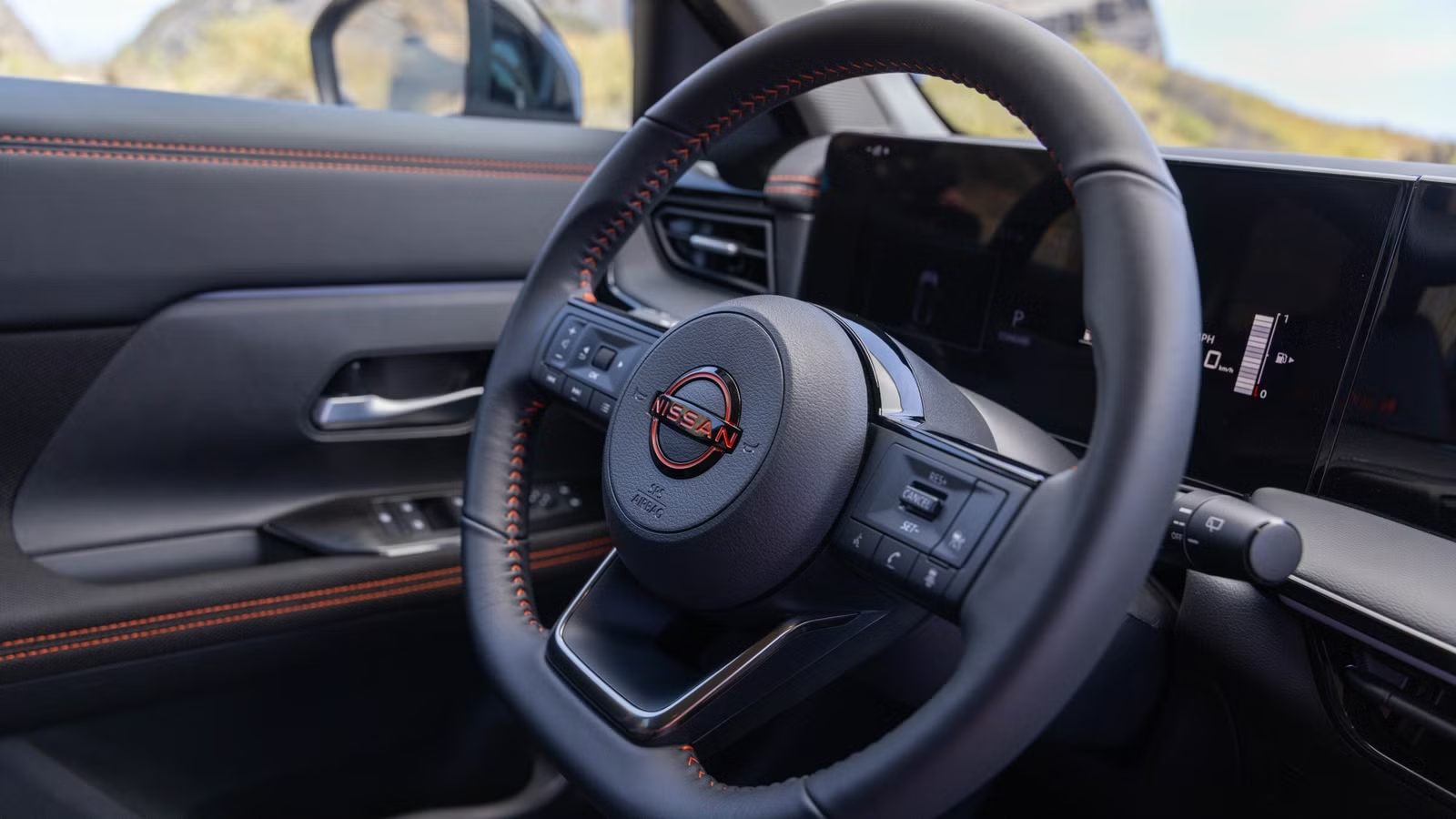
Nissan sells the cheapest sedan in America and the cheapest SUV in America — and they share the same engine, the same transmission, and nearly the same base price. That setup makes the 2027 Sentra versus 2027 Kicks comparison unusually clean: strip away the powertrain variables and what you’re really choosing between is a body style. One of them makes a much stronger case.

Autoblog published a direct comparison of both vehicles today, and the verdict isn’t particularly close. The Sentra is slightly quicker and slightly more fuel-efficient, but the Kicks counters with more than double the cargo space, better headroom, a shorter footprint that’s easier to park, and the option of all-wheel drive. At a base price difference of just $100 — with the Kicks actually coming in cheaper — the SUV’s practical advantages are hard to argue against.
Same Powertrain, Two Very Different Packages

Both vehicles run Nissan’s MR20DD 2.0-liter naturally aspirated four-cylinder, paired with an X-Tronic CVT and standard front-wheel drive. The Sentra squeezes out a modest edge in output — 149 hp and 146 lb-ft of torque versus the Kicks’ 141 hp and 140 lb-ft — which translates to slightly quicker 0-60 times in the 8.3- to 9.7-second range compared to the Kicks’ 8.6- to 10.4-second spread. Neither car is going to win any stoplight races, and the CVT’s tendency to hold the engine at high revs under hard acceleration is a shared frustration in both.

Fuel economy tips toward the Sentra, too. Its lower, more aerodynamic sedan body earns EPA combined ratings of 32–33 mpg, while the taller Kicks manages 30–31 mpg in FWD trim and 30 mpg combined with AWD. That 1-to-3-mpg gap is real but modest — both vehicles clear 30 mpg in everyday driving, which is a reasonable result for a naturally aspirated engine in this price class.
Where the Kicks Pulls Away: Space and Versatility
The numbers tell the story plainly. The Sentra’s trunk holds 14.3 cubic feet — a respectable sedan figure, but a fixed one. The Kicks, in FWD configuration, offers 30.0 cubic feet behind the rear seats and 60.0 cubic feet with them folded. That’s more than four times the Sentra’s maximum usable cargo volume, and the hatchback opening makes loading bulky items far more practical than working through a sedan trunk lid.
Headroom follows the same pattern. The Kicks’ height advantage — it stands more than seven inches taller than the Sentra despite being 12 inches shorter overall — translates directly into cabin space. Rear passengers get up to 1.8 inches more headroom in the Kicks, and front occupants gain nearly an inch as well. Legroom is close enough to call a wash. The Kicks also carries a 3.5-inch ground clearance advantage (8.4 inches versus 4.7–4.8 inches), which matters in winter conditions or on rougher roads.
Only the Kicks offers AWD, available on SV, SR, and Rock Creek trims. The Rock Creek is worth a mention: it adds adventure-oriented styling, standard AWD, and an off-road driving mode, though ground clearance stays the same as other Kicks trims. It’s a capable enough package for light trail use and gives the Kicks a personality the Sentra simply can’t match.
Features and Pricing: Nearly Identical at the Base Level
Both cars start with a genuinely solid feature set for their price points. The Sentra S and Kicks S both include LED headlights and taillights, a 12.3-inch touchscreen with wireless Apple CarPlay and Android Auto, a 7.0-inch digital gauge cluster, adaptive cruise control, automatic emergency braking, blind-spot monitoring, rear cross-traffic alert, and lane-departure warning. Cloth upholstery and regular air conditioning round out the base spec on both.
Pricing at the base S trim is almost comically close: the Kicks S FWD starts at $22,790, and the Sentra S comes in at $22,890 — a $100 gap in the SUV’s favor. Higher trims add alloy wheels, leatherette seating, heated front seats, a power-adjustable driver’s seat, upgraded audio, and wireless charging on both models. The Kicks SR AWD tops out at $28,790, while the Rock Creek AWD sits at $28,840. The Sentra SL reaches $27,990 at its peak.
Which One Should Budget Buyers Choose?
The Sentra has two genuine advantages: it handles with a bit more engagement thanks to its lower center of gravity and sportier stance, and it returns slightly better fuel economy. For a buyer who does mostly highway miles, values a traditional sedan profile, and doesn’t need to haul much, it’s a perfectly reasonable choice.
But the Kicks wins the broader argument. It’s shorter and easier to maneuver in tight spaces, offers dramatically more cargo room, provides better visibility from the driver’s seat, and is the only option if AWD is a priority. At essentially the same price, the Kicks delivers more of what most buyers actually use a car for day to day. The Sentra’s handling edge is real but marginal at these performance levels; the Kicks’ space advantage is significant and constant.
The comparison also illustrates why compact SUVs have displaced sedans as the default choice for mainstream buyers. When two vehicles from the same brand cost the same and share the same drivetrain, the one with more headroom, more cargo space, and an AWD option tends to win — and here, it does.

Related posts





Latest Post


No Comments