
New Mercedes C-Class Revealed Ahead Of BMW 3 Series G50
Article Summary
- Mercedes gives the C-Class a long-overdue mid-cycle facelift with starry headlights.
- Both the sedan and wagon have gone under the knife, packing more technology onboard.
- There aren’t any performance versions at launch, but an inline-six AMG C53 is likely coming soon to take on the upcoming BMW M350.
While we’re patiently waiting for BMW to roll out the new 3 Series, archrival Mercedes is giving the C-Class a substantial makeover. Stuttgart is updating its best-selling car with more technology, electrified engines, revised styling, and a much smarter cabin.
That’s hardly surprising considering how much Mercedes has been investing in new software and hardware. The C-Class is one of the company’s core models, so it was never going to be left behind as the three-pointed star prepares a massive wave of new and refreshed products.

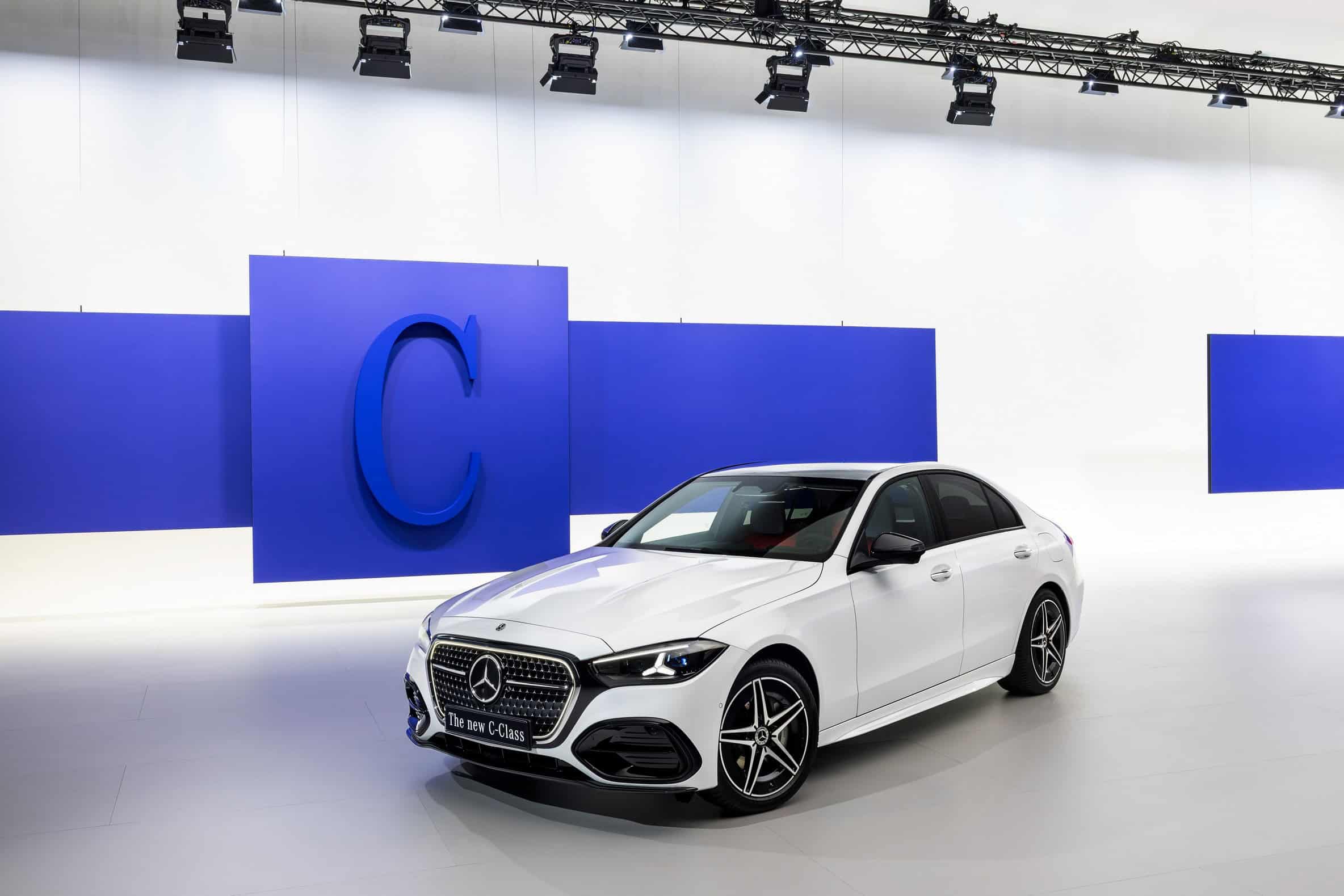
The exterior changes are relatively subtle. Mercedes has given the C-Class a new grille with a more prominent vertical pattern, while the available contour lighting can illuminate the grille itself. The headlights now feature star-shaped daytime running lights, and the taillights get their own star motif. Curiously, the latter statement is only applicable to the sedan, as the wagon doesn’t get the starry treatment at the back.
There are also new colors, including Lavender Silver Metallic and Moody Sky Grey Metallic. Those wanting a more aggressive appearance can opt for the AMG Line Plus package, which adds black exterior accents, sportier seats, red stitching, and red seat belts.

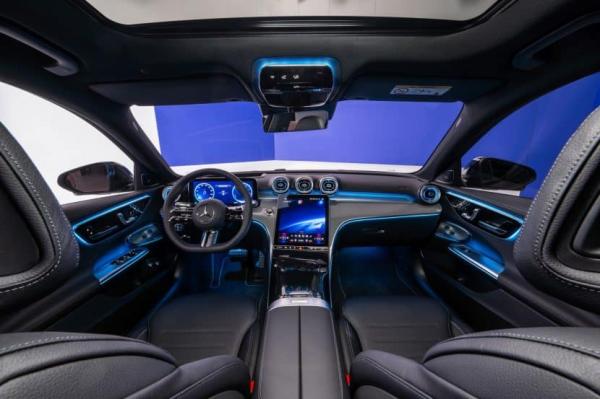
Inside, the new-ish C-Class retains its familiar 12.3-inch digital instrument cluster and portrait-oriented central touchscreen. Still, Mercedes is bringing its latest-generation software to the sedan and wagon duo. It now runs MB.OS and gets the newest version of MBUX, giving the C-Class considerably more computing power than before. And yes, artificial intelligence is part of the package.
AI Galore
Mercedes’ upgraded virtual assistant taps into ChatGPT, Microsoft Bing, and Google Gemini. Rather than simply responding to basic commands, it can maintain context during a conversation and handle more complicated requests. It can also help find charging stations, parking spaces, points of interest, and other information. Google is getting involved as well. Mercedes is integrating Google’s Automotive AI Agent with Google Maps, making navigation more conversational. Why? Well, because apparently asking your car where to go wasn’t complicated enough already.
The C-Class can also be equipped with multi-contour seats featuring massage functions and four-way lumbar adjustment. An upgraded Burmester 3D Surround Sound system brings Dolby Atmos, 15 speakers, and a 710-watt amplifier. The Estate, aka T-Modell, remains available for buyers who need more practicality. It offers 490 liters of cargo capacity with the rear seats up and up to 1,510 liters with them folded.
Four-Cylinder Engines, But An Inline-Six Should Follow
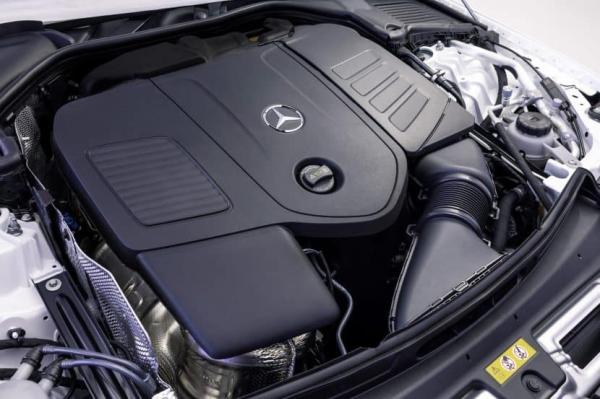
Under the hood, Mercedes is sticking with four-cylinder engines, but virtually every version gets some form of electrification. The 48-volt mild-hybrid system uses a second-generation integrated starter-generator that can provide up to 17 kW (23 horsepower) and 205 Nm of electric assistance.
The gasoline lineup includes the C200 with 177 hp, the C250 with 218 hp, and the C300 with 258 hp. The two-liter M254 EVO engine also gets an electric auxiliary compressor designed to improve low-end response before the turbocharger builds boost. Diesel isn’t dead at Mercedes, either. The updated OM654 EVO remains a four-cylinder unit and is offered with 163 hp or 200 hp. It supports HVO100, B10, and B20 fuels, giving customers who aren’t ready to abandon combustion engines a few more options. Similarly, BMW is likely to keep the diesel engine alive for the next 3er.
The plug-in hybrid lineup continues with the C400 e 4Matic. It combines a four-cylinder gasoline engine with an electric motor for a total of 395 hp and 650 Nm. A 19.53-kWh usable battery provides up to 100 kilometers (62 miles) of electric range under the WLTP cycle.
It can also DC fast-charge at up to 55 kW, which isn’t exactly groundbreaking by today’s standards but is certainly more useful than the slow charging rates offered by older plug-in hybrids.
An AMG-flavored C53 hasn’t been announced, but it’s likely coming to take on the future BMW M350. We’re making this assumption because an X3 M50-fighting AMG GLC 53 has already been revealed with a 3.0-liter engine.
Mercedes hasn’t ignored the chassis, either. The revised suspension is designed to reduce body movements while making the car more responsive. Rear-wheel steering remains available, turning the rear wheels by up to 2.5 degrees and reducing the turning circle to 10.64 meters.
Tech-Laden Luxury Sedan
The driver-assistance technology is also getting a major upgrade. Depending on the configuration, the C-Class can have up to 10 cameras, five radar sensors, and 12 ultrasonic sensors. The optional MB.Drive package can assist with steering, braking, acceleration, lane changes, and parking.
There’s even a new Reverse function that can retrace part of a route the car previously traveled forward under certain conditions. Lighting technology hasn’t been forgotten. The optional next-generation Digital Light system uses micro-LED technology to increase the illumination field by around 40 percent while cutting energy consumption by up to 50 percent compared with the previous setup.
So while this may look like another C-Class facelift at first glance, there’s considerably more going on underneath the familiar sheet metal.
Orders open in Germany today, August 18, with the C200 sedan starting at €48,844 including VAT. The more practical wagon is also available from day one, which won’t be the case for the new BMW 3 Series. The G50 will lead the way later this year, with the long-roof G51 to follow in 2027 or later.

Related posts



Latest Post


No Comments