
The Honda Engine That Helped Create A Generation Of Enthusiasts
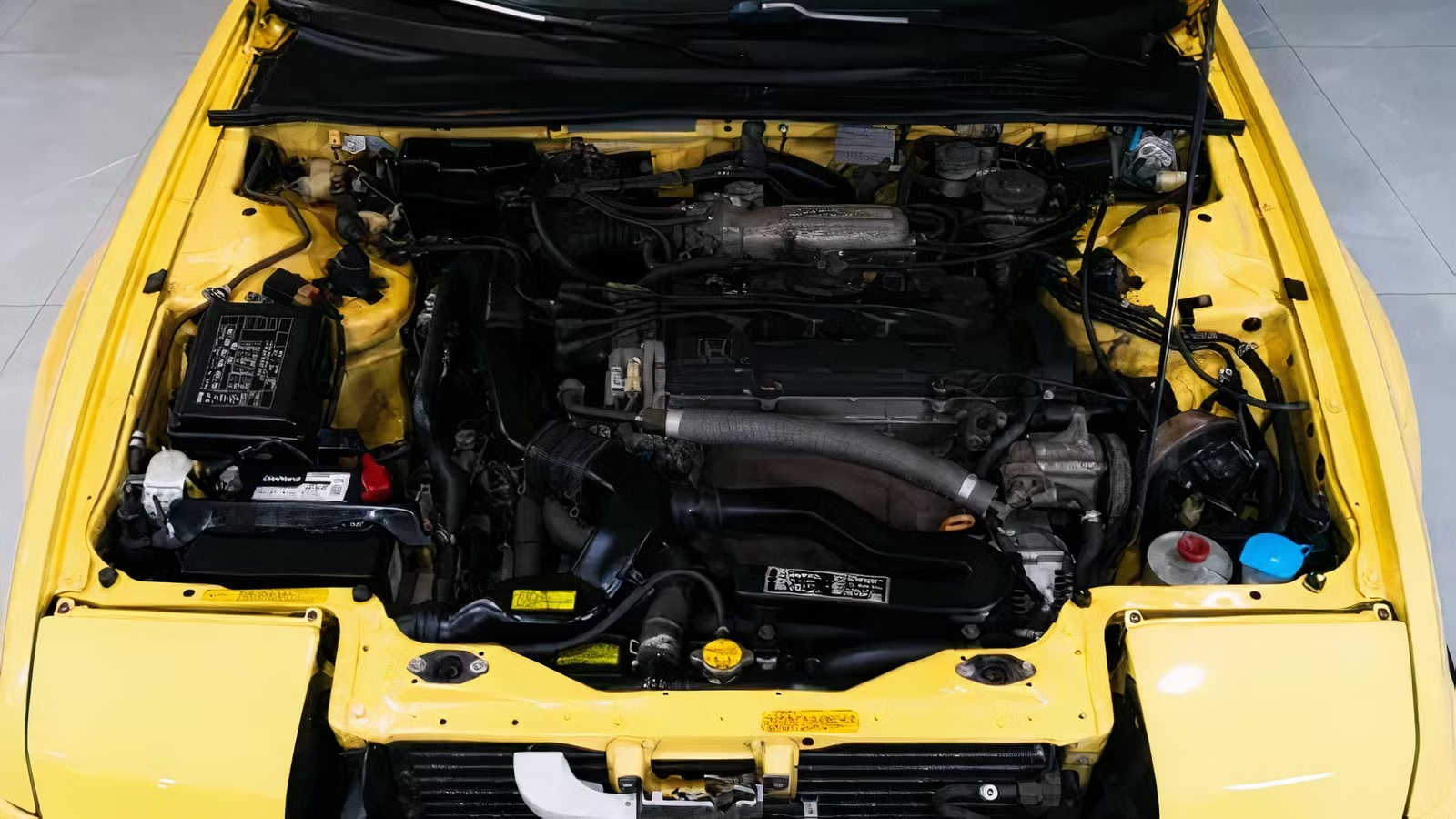
Back in 1989, Honda put a naturally aspirated 1.6-liter inline-four into production that would become the gold standard of automotive engineering at the time: 100 horsepower per liter. Before this engine, achieving this level of power density in such a compact unit was considered extremely difficult, particularly while maintaining the street manners expected from a production engine.

Yet Honda broke through conventional technological barriers by providing the desirable high-rpm performance of a racing engine without sacrificing the smooth low-load and partial-throttle manners required for everyday driving. This engine platform would lay the foundation for an entire revolution of high-rpm Honda models, from the Honda Civic to the Acura Integra, and remains one of the defining engines of the golden era of 1990s JDM performance.
Honda Challenged The Limitations Of Engine Building
Building an economical four-cylinder engine isn’t difficult. Building one that functions like an economy engine at low rpm but comes to life in the higher rpm range is a completely different story, however.
Why High-RPM Performance Never Worked On The Street


Wanting an engine that has smooth low-rpm drivability and maximum performance in the high-rpm range creates an inherent conflict that has challenged engine designers for decades. An aggressive cam profile may help an engine breathe better at high rpm, but those same characteristics that allow it to produce more power can compromise the smoothness of low-speed operation. A conservative cam profile keeps idle and low-rpm behavior smooth but restricts airflow at higher engine speeds. It was a difficult engineering trade-off, yet Honda was determined to solve the problem with pioneering technology.
The Magical And Elusive 100 HP/L Goal

One man played a major role in breaking through this engineering barrier, and his name was Ikuo Kajitani. Kajitani had worked as an R&D engineer at Honda since the early 1970s, but in 1984, he was tasked with figuring out how to create a system that could provide variable valve timing and lift. More than 100 Honda engineers worked on the project, and after three months of dedicated effort, they concluded that approximately 30 new technologies would be required to make the idea a reality.

Kajitani’s team set a target of 400,000 switching events for rocker-arm durability, and even then, he believed the engine could reliably produce only 90 horsepower per liter. However, Kajitani’s boss and Honda R&D president Nobuhiko Kawamoto suggested raising the target to 100 horsepower per liter. It took several more years of development, but that target was achieved in April 1989. By 1991, almost five percent of Honda engines utilized the innovative technology that had become known as VTEC.
The B-Series Revolutionized Performance Engines

The first production application of VTEC appeared in Honda’s B-Series engine family, a compact inline-four that would immortalize the company’s high-revving philosophy. The first-generation B16A was the breakthrough engine that achieved the elusive 100-horsepower-per-liter goal with the help of VTEC, cementing the new power unit as a landmark in performance-engine development.
The B16A Put 160 Horsepower Into A 1.6-Liter Package

The first production VTEC B-Series engine was the B16A, introduced in the JDM 1989 Honda Integra XSi. This 1.6-liter inline-four produced 160 horsepower, officially achieving the 100-horsepower-per-liter benchmark. It featured an oversquare design suited to high-rpm operation, while its all-aluminum construction helped keep weight down. The B16A’s 8,000-rpm redline was extraordinary for a mass-produced street engine at the time, making its unique character a clear standout compared with conventional economy four-cylinders.
VTEC Let One Small Engine Behave Like Two Different Engines

With the addition of VTEC in the B16A, the engine used one cam profile optimized for lower-rpm operation and switched to a more aggressive profile at higher rpm. At lower engine speeds, the outer cam lobes controlled the valves, prioritizing drivability and efficiency. At higher rpm, hydraulic pressure locked the rocker arms together, engaging the more aggressive center cam profile. Essentially, Honda figured out how to make two distinctly different cam profiles work seamlessly within a single engine.
Everything felt relatively docile until roughly 4,500 rpm, when VTEC engagement produced a dramatic transition that drivers could both hear and feel. The beauty of VTEC was that Honda considered the entire rpm range rather than simply chasing peak power. VTEC might not seem like cutting-edge automotive technology today, but at the time, it represented one of the most significant advances in production-engine design.
The B-Series Offered Near-Limitless Potential

The B16 was only the beginning, because Honda gradually created a family of engines that gave enthusiasts different combinations of displacement, power, and tuning potential. That variety helped make the platform useful far beyond the original high-revving 1.6-liter application.
The B18 Added Much-Needed Displacement

While the B16A laid the foundation for the VTEC revolution, it was only a stepping stone for further development of the platform. In the U.S., our first taste of the larger 1.8-liter B18C1 arrived with the 1994 Acura Integra GS-R, producing 170 horsepower at 7,200 rpm and 128 pound-feet of torque at 6,200 rpm. Eventually, the ultra-rare North American Acura Integra Type R debuted with the B18C5, which increased output to 195 horsepower at 7,800 rpm and 130 pound-feet of torque at 7,500 rpm. With its higher-revving nature and additional displacement, the B18C5 quickly became one of the most desirable and capable tuner engines of its era.
The B20 Frankenstein Formula

While the B18 and B16 excelled at high-rpm power, displacement remained a limiting factor when it came to torque. Some ingenious solutions addressed this issue with the introduction of the non-VTEC 2.0-liter B20 in the Honda CR-V, which soon became a popular bottom-end solution among Honda tuners. Combining the larger-displacement B20 bottom end with a high-revving VTEC B-Series cylinder head created what enthusiasts came to call a Frankenstein build.
This solved a limitation of Honda’s factory lineup and allowed tuners to access the best of both worlds: greater torque from increased displacement combined with the high-rpm power potential of a VTEC cylinder head. These custom engines existed because of the modular nature of B-Series components, allowing tuners to mix parts that Honda never intended to be used together. Frankenstein builds demonstrated how the B-Series became a platform for experimentation and pushing the boundaries of what was possible rather than simply accepting the engines in their factory configurations.
The B-Series Still Hasn’t Lost Its Charm

The B-Series was eventually succeeded by Honda’s K-Series around the turn of the millennium, but its influence never disappeared from the Honda tuning community. Its combination of durability, compact dimensions, plentiful aftermarket support, and compatibility with lightweight Honda chassis gave an entire generation an accessible way into performance-car culture.
The Lightweight Honda Recipe Still Works Today

Once you regularly start going to the racetrack, you’ll often see some of the fastest cars there built around lightweight Hondas, including Civics, CR-Xs, Integras, and Del Sols. Many of these featherweight front-wheel-drive legends are powered by some version of the B-Series. Sure, 160 horsepower doesn’t sound like much by modern standards, but in the right setting, it can be the perfect amount of power.
Some Hondas, such as the1988-1991 EF Civic hatchback, weighed less than 2,000 pounds depending on configuration, demonstrating just how much performance could be extracted from a relatively modest power figure. That’s why the appeal of a B-Series-powered lightweight Honda hasn’t faded, with the combination still providing an excellent foundation for a street car, autocross build, track-day machine, or drag racer.
Few modern platforms can replicate that combination of low weight, simplicity, and aftermarket support. The B-Series effectively gave an entire generation access to a relatively sophisticated high-performance engine without requiring a rear-wheel-drive chassis, a six-cylinder engine, or a turbocharged powertrain.
The Treasure Trove Of Modification Potential

That’s why peak horsepower isn’t always the primary focus of lightweight Honda builds. What matters more is versatility. The B-Series provided nearly everything enthusiasts wanted: strong reliability, a compact and lightweight design, extensive aftermarket support, widespread availability and compatibility, and substantial tuning potential.
B16 and B18 swaps still attract plenty of interest, but there are simply fewer clean VTEC B-Series engines available than there once were, and desirable examples have become increasingly valuable. Yet in terms of relevance, the B-Series remains one of the defining platforms in the tuning world, and compared with many modern performance engines, it still offers a relatively accessible path into experimentation.

So, if you have an old non-VTEC Civic or Integra, and you’re wondering whether it’s still worth turning your dream B-Series swap into a reality, there’s a good argument for doing it sooner rather than later. The longer these engines and clean donor cars continue to disappear from the market, the harder and more expensive they become to build. Time, effort, and some cash are still non-negotiable, but the result can provide something increasingly rare in modern performance cars: an approachable platform that encourages enthusiasts to learn, experiment, and build something of their own.
Sources: Honda, Acura, Hagerty

Related posts
Latest Post




No Comments