
Toyota’s GR Yaris Is The Ultimate Sleeper America Can’t Have
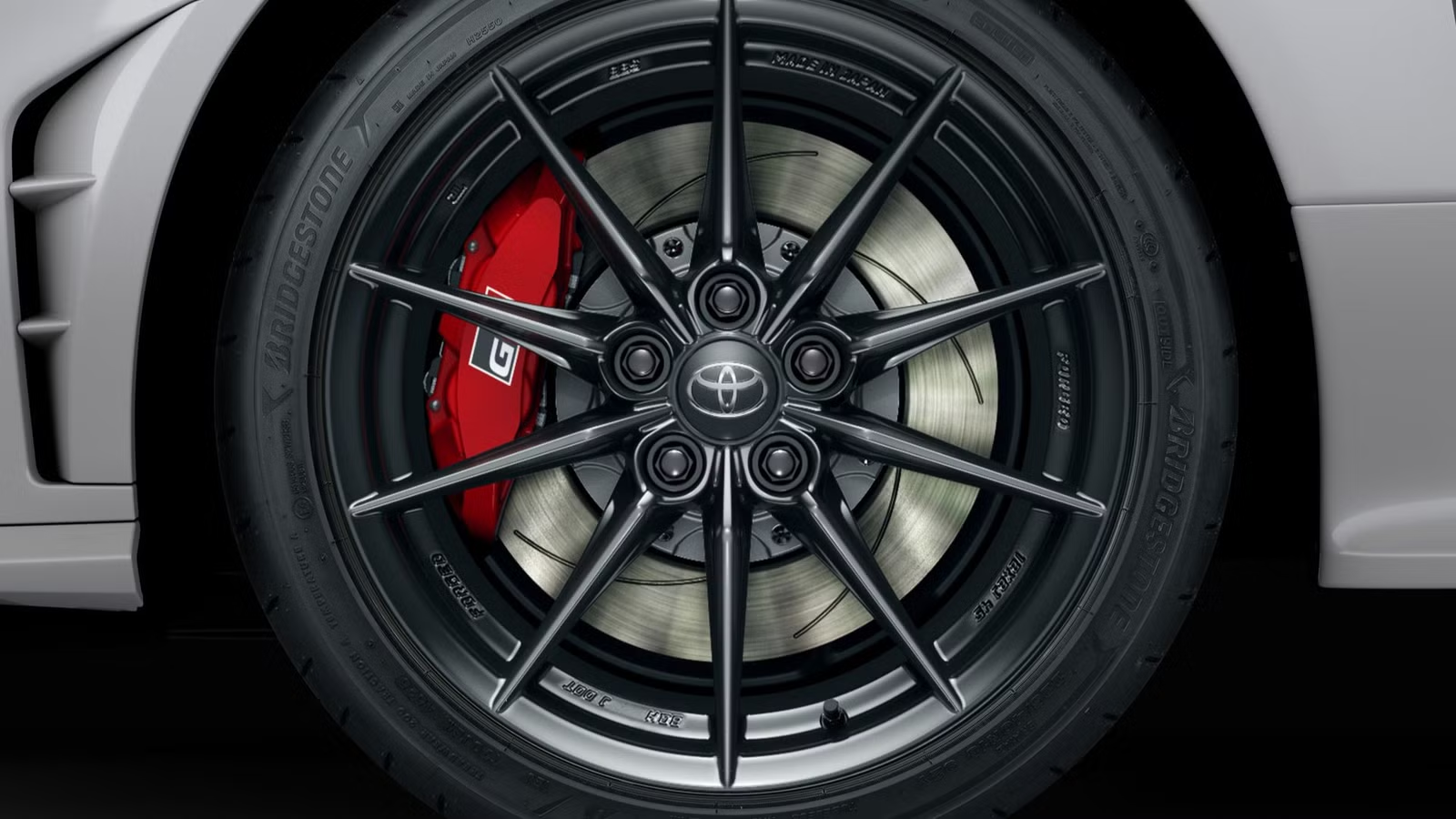
Pull up alongside a GR Yaris at a stoplight and you’d probably look right past it. It wears a Yaris badge. It’s small. It looks like something a college student parks outside a dorm. What you’re actually looking at is a 272-horsepower, turbocharged, all-wheel-drive rally sleeper car built to satisfy FIA homologation rules — a category of car that puts it in the same conversation as the Ferrari 288 GTO and Porsche 911 RS. Americans can’t buy one.

AutoSpies renewed attention this week to the GR Yaris’s US exclusion, and the frustration it surfaces among enthusiasts is entirely justified — not because Toyota is withholding a hot hatch, but because they’re withholding a genuine homologation special. There’s a meaningful difference, and it’s worth understanding exactly what makes this car so dangerous before lamenting that it’ll never show up at a domestic Toyota dealership.
What Homologation Actually Means — And Why It Matters Here
The term gets thrown around loosely, but homologation has a precise definition in motorsport: to compete in a regulated class, a manufacturer must build a minimum number of road-legal versions of the competition car. The GR Yaris exists because Toyota needed it to. To campaign a Yaris-based platform in FIA Group N rally competition, Toyota had to produce road cars that shared the fundamental architecture — not just the badge.

That’s the lineage the GR Yaris belongs to. The Ferrari 288 GTO was built to homologate for Group B. The Porsche 911 RS 2.7 was built to satisfy GT class requirements. The Lancia Stratos, the Subaru Impreza 22B, the Mitsubishi Lancer Evolution VI Tommi Mäkinen Edition — all homologation specials, all built because the rulebook demanded it. The GR Yaris follows that exact template. Every road car Toyota sold is, structurally, a de facto rally machine with a license plate.

Toyota Just Tweaked Its Hardcore Hot Hatch—Here’s What Changed
Step inside to a proper race inspired cockpit in the new GR Yaris.
The Engineering Behind 272 Horsepower From 1.6 Liters

The powertrain is the most striking part of the GR Yaris story. Toyota’s G16E-GTS engine displaces just 1.6 liters across three cylinders and produces 272 horsepower and 370 Newton-meters (273 lb-ft) of torque. That’s a specific output — horsepower per liter — that rivals purpose-built sports car engines from manufacturers charging three times the price.
The GR-Four all-wheel-drive system was developed specifically for WRC competition, not adapted from an existing platform. Drive distribution is adjustable: 60/40 front-to-rear in normal mode, 30/70 in sport mode, and 50/50 in track mode. The gearbox is a six-speed manual. The body structure uses a unique roof panel — formed from carbon fiber and resin composite — to lower the center of gravity in a way that a standard Yaris body couldn’t achieve. Toyota didn’t modify an existing Yaris. They built a different car and gave it a familiar name.

The Chevy Engine So Powerful It Came In A Plain-Looking Car
The 2014-2017 Chevrolet SS packed a 415-hp Corvette V8 in a boring-looking sedan that fooled everyone on the road.
Why Toyota Won’t Certify It For The US Market

The reasons are straightforward, if frustrating. Federal Motor Vehicle Safety Standards and EPA emissions certification are expensive processes — costs that make economic sense when you’re selling tens of thousands of units, not the limited volumes a homologation special commands. The GR Yaris was never designed with American crash structures, bumper heights, or emissions thresholds in mind. Retroactively engineering compliance would require significant rework and testing investment that Toyota has no commercial incentive to pursue for a car it would sell in modest numbers.
Market positioning compounds the problem. Toyota already sells the GR Corolla in the US — a car that shares the G16E-GTS engine family and the GR-Four AWD concept, adapted to a platform Americans can buy. From Toyota’s perspective, the GR Corolla is the answer to the GR Yaris question in this market. Whether that answer is satisfying is another matter entirely.
The Sleeper Angle Is Real — And That’s What Stings

The GR Yaris doesn’t look the part. That’s intentional in the homologation-special tradition — the 288 GTO looked like a 308 with wider hips, the Impreza 22B looked like a slightly aggressive sedan. The GR Yaris looks like a Yaris with a wider stance and a subtle rear spoiler. Most people on an American street wouldn’t clock it as anything special.
That anonymity is exactly what makes the exclusion sting for enthusiasts who understand what they’re looking at. This isn’t a car that’s fast because of a marketing budget. It’s fast because FIA regulations demanded a road car capable of surviving the same conditions as a WRC stage car. The engineering specificity — the bespoke roof panel, the purpose-built AWD system, the 272-hp three-cylinder — exists for competitive reasons, not brand-image reasons. That’s rare. And American gearheads who appreciate the difference between a performance car and a homologation special will keep watching the GR Yaris from a distance, knowing they’re looking at something genuinely dangerous that the US market will never officially receive.
Source: Carbuzz, Autospies

Related posts



Latest Post


No Comments