
The Land-Yacht That Combined Cadillac Comfort With Corvette Power
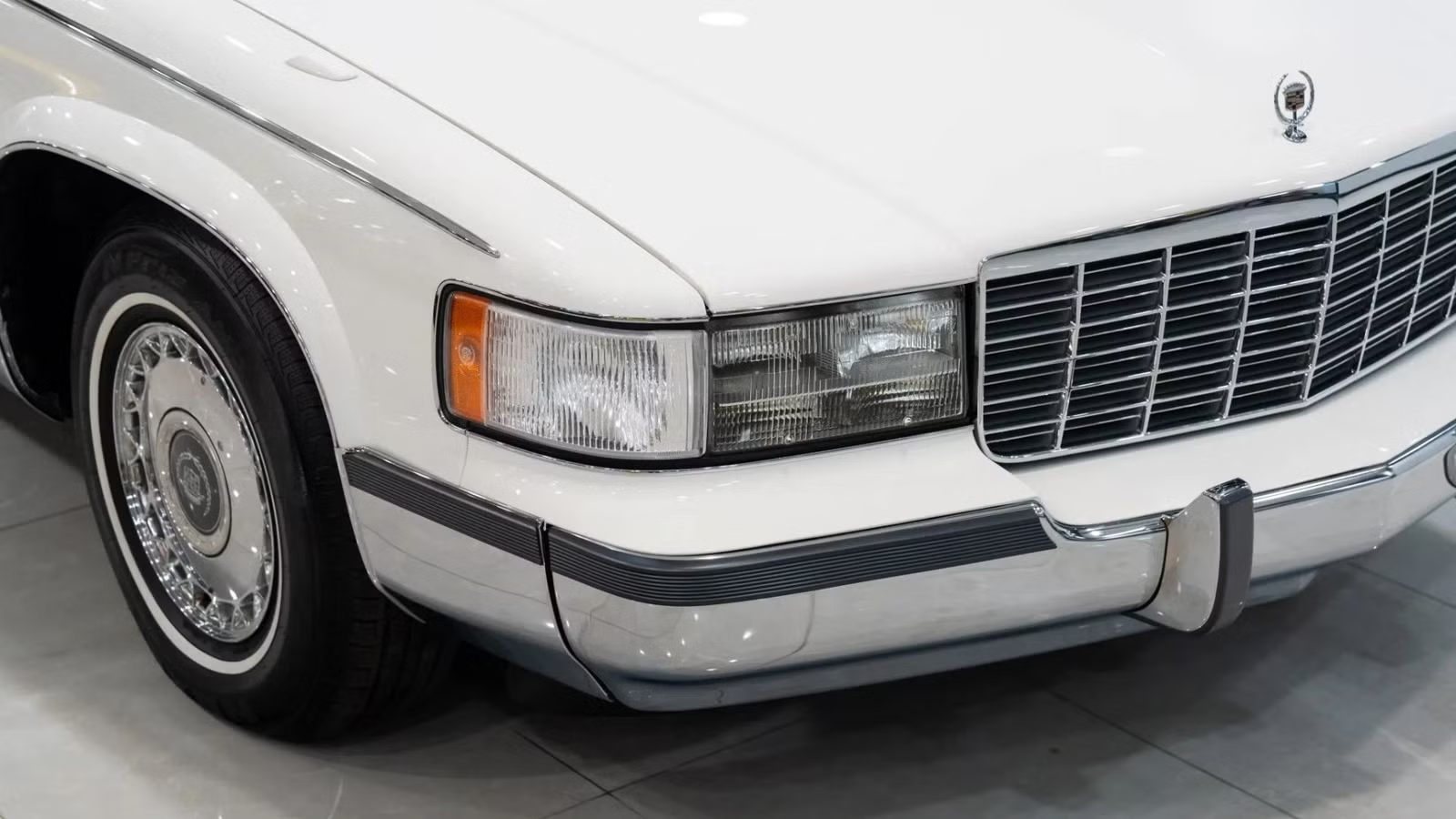
Some of the automotive industry’s most fascinating performance cars are simply hiding in plain sight. In the case of American luxury sedans, the potent engine that lies under the hood is concealed beneath a gargantuan, chrome-clad design that would suggest a tame, wafty driving experience rather than respectable straight-line speed. In the middle of the 1990s, one unsuspecting sleeper machine from Cadillac perfected this clever method at a time when old-school luxury four-doors were fading into obscurity.
Cadillac’s Last RWD Land Yacht

Over the course of the 1990s, the automotive landscape was changing rapidly. Unibody construction, front-wheel drive, smaller dimensions, and more efficient powertrains had become the industry’s focus. During this period, Cadillac‘s traditional identity was being threatened. For decades, the American luxury brand had been known for building enormous sedans that floated down the freeway with ease, meaning that the inevitable transition to new-age sedans with smaller frames and European-inspired handling had to be made carefully.
At first, Cadillac decided to resist the strong tide of modernization. A fully redesigned flagship sedan debuted for the 1993 model year, and it would ultimately serve as the final gasp for the gigantic, body-on-frame, rear-wheel drive land yachts that had been the American automotive standard for decades. Built on GM’s ancient, full-sized D-body platform, it measured over 18 feet in length. It wafted and rolled through corners in the same vein as its predecessors, and it cosseted its passengers the traditional way with massive, plush leather seats and deep-pile carpeting.
A Luxury Sedan With A Corvette Engine


The Cadillac Fleetwood rolled into the 1994 model year with a substantial upgrade. The reintroduction of the Brougham nameplate came with a 5.7-liter LT1 V8 dropped under the hood, and it was the same unit as the engine found in the C4 Corvette. While slightly detuned, the eight-cylinder engine was not watered down. It continued to feature reverse-flow cooling, sequential fuel injection, and aluminum cylinder heads, and it delivered an immense 260 horsepower and 330 lb-ft of torque.
As a result, this upgraded model was noticeably more powerful than the Fleetwood from the previous model year, which produced 185 hp and 300 lb-ft of torque from a 5.7-liter L05 V8. The LT1 made itself known during everyday driving, delivering abundant low-end torque that allowed the Brougham to glide effortlessly onto highways with relatively minimal throttle input.

While the Brougham was shockingly powerful for a body-on-frame sedan, it was still no sports car. It tipped the scales at well over two tons, and its four-speed automatic transmission was tuned for comfort rather than visceral speed. The C4 Corvette blew it out of the water in a straight line, reaching 60 mph in 5.5 seconds. This was roughly three seconds faster than the Cadillac, thanks to its lightweight build, performance-oriented gearing, and dramatically more nimble handling.
However, cornering performance and blistering acceleration were not the intention of the Fleetwood Brougham. Instead, it was meant to remain as reserved as its predecessors, and its sharp increase in power was used for a smoother powerband and effortless charisma instead of a shock factor.
Why the Fleetwood Brougham Flew Under the Radar

Despite its potent Corvette powertrain, the Fleetwood Brougham never managed to reach the enthusiast spotlight. Simply put, the luxury sedan entered the market at the wrong time. Industry standards were changing, and Cadillac’s final nod to its body-on-frame tradition was simply dismissed as outdated.
The Fleetwood also faced stiff competition among the few traditional full-sized sedans that remained on the market. Chevrolet introduced the Impala SS during the same year as Cadillac’s updated Fleetwood, and it featured an identical LT1 V8 under the hood. With its more contemporary styling, performance-oriented suspension tuning, and significantly lower pricing, the Impala SS quickly won the approval of enthusiasts, and it particularly gained popularity among younger, budget-conscious buyers. While the Impala SS still rode on an aging body-on-frame platform, the Cadillac Fleetwood’s older customer base, tame styling, and softer suspension tuning left it in the shadows.
General Motors itself reinforced the Fleetwood’s outdated, comfort-oriented image, despite the fact that its LT1 V8 shared identical output with the Impala SS. While Chevrolet’s marketing material framed the Impala SS as a menacing “stealth” performer draped in black paint, Cadillac continued to promote the Fleetwood as a comfortable cruiser for retirees, resulting in few consumers realizing that it packed the same potent V8 engine as the Impala SS.
A Quiet Enthusiast Favorite Today

In the modern age, appreciation for the bygone era of traditional American luxury is steadily growing. Enthusiasts are beginning to recognize the Fleetwood Brougham not only as a shining example of body-on-frame, rear-wheel drive motoring, but also as the exceedingly powerful, final evolution of the classic full-sized sedan. Its boat-like handling, wide leather seats, and massive trunk result in a charmingly old-school experience that modern sedans no longer offer. The Brougham’s LT1 powertrain delivers far more low-end torque than its older counterparts, and the engine has developed a reputation for remarkable longevity when properly maintained.
Perhaps most importantly, the Fleetwood Brougham has faced a steep depreciation curve over the years, transforming it into a far more affordable alternative to the Chevrolet Impala SS. According to Classic.com, the second-generation Fleetwood can be attained for $17,625 on average. One particular Brougham example with roughly 41,000 miles was listed at $19,500. Meanwhile, the more popular Chevrolet Impala SS averages at $28,906, and one example with around 43,000 miles is currently asking $39,995.
Owning A Fleetwood Brougham in 2026

Ownership costs for the Fleetwood Brougham remain relatively reasonable, mostly thanks to its robust powertrain and body-on-frame architecture shared with decades worth of classic sedans. Its LT1 V8 benefits from widespread aftermarket support, as it was found under the hood of a variety of General Motors models. Routine maintenance costs remain low, as parts are inexpensive and widely available. It is recommended that prospective buyers carefully inspect the suspension bushings, interior electronics, and electric windows for age-related issues, and the cooling system requires regular maintenance.
While the Fleetwood Brougham may still not attract as much attention as the C4 Corvette or Impala SS with which it shares its powertrain, that is exactly what makes this old-school luxury sedan appealing. With its unassuming styling hiding its potent LT1, it remains one of the best-kept secrets of the automotive world.
Sources: Cadillac, Chevrolet, Classic.com

Related posts




Latest Post


No Comments