
Lexus GX 550: The Luxury SUV That Actually Off-Roads
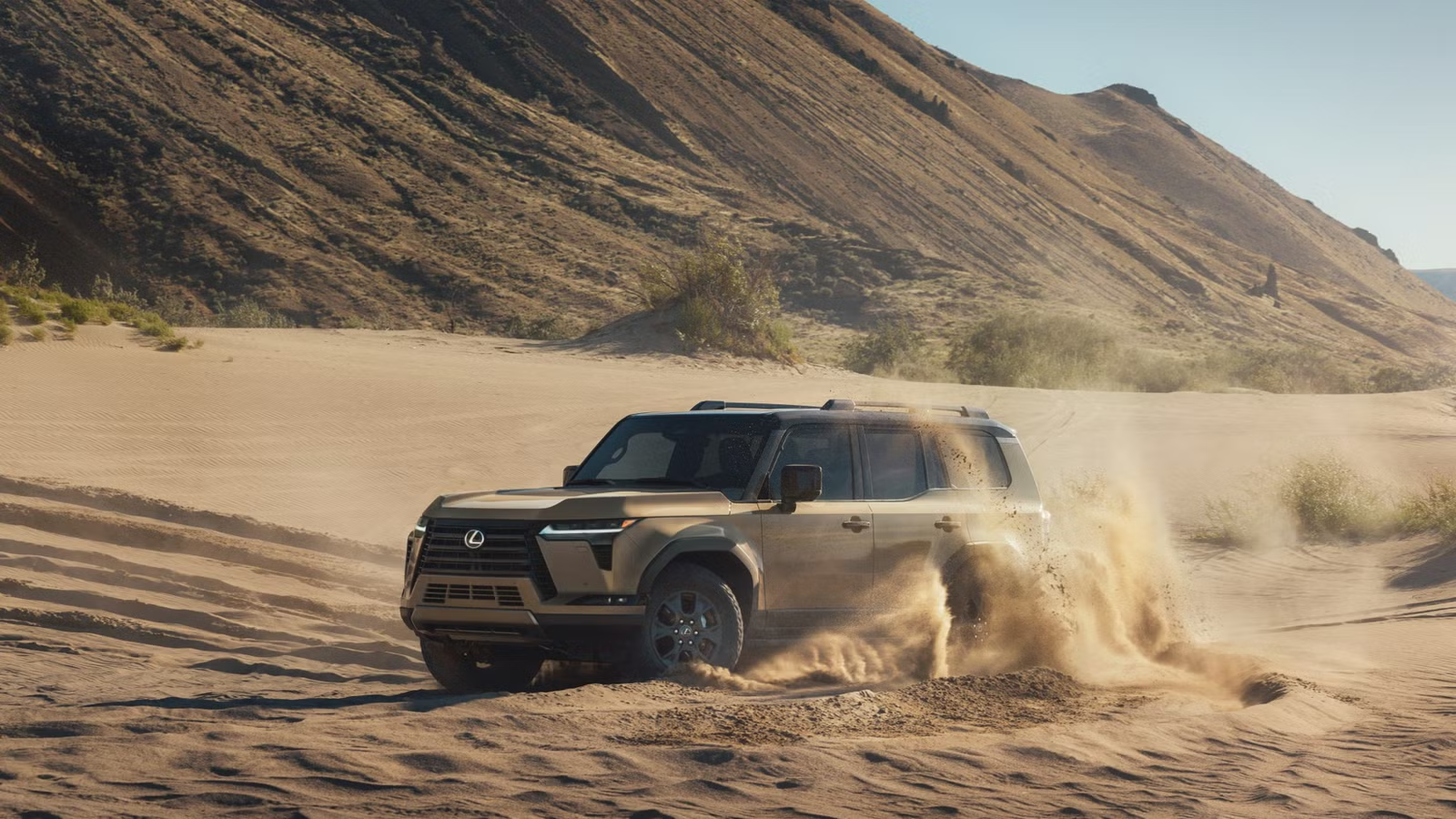
The most popular luxury SUVs in the United States tend to be the crossover variety. In fact, the entire top 10 is composed of luxury crossover SUVs, based on Car and Driver’s Bestselling Luxury Vehicles of 2026 (so far). The primary reason for choosing luxury crossover SUVs is their car-like driving dynamics and comfort, combined with the ground clearance and practicality of a traditional body-on-frame SUV.

One of the most popular options in the luxury SUV segment with a body-on-frame platform and true off-road capabilities is the 2026 Lexus GX. The GX is a more recent addition to the Lexus SUV lineup, following the debut of the LX in 1995 and the RX crossover in 1997. Though the GX has always been known for its off-road prowess, Lexus has doubled down on that trait for this generation. This has made the current GX one of the most off-road-capable luxury SUVs you can buy today.
The Evolution Of The GX
To understand how we got here with the current third-generation GX, we have to go back to the past and see why the GX was created in the first place. Spanning across three generations, the GX has been one of the brand’s foundational models.
A Midsize Luxury SUV For An Underserved Segment


Most midsize luxury SUVs on sale in the United States have a unibody crossover SUV platform. Take a look at the pioneering luxury SUV models of the European brands, and you’ll see that they’re mostly unibody crossovers with car-like driving dynamics and comfort. Sure, there’s an Escalade and a Navigator, but they’re at a segment higher. The GX, meanwhile, is one of the only few midsize body-on-frame luxury SUVs you can buy today. The first-generation Lexus GX debuted in 2002, sharing the Toyota F2 platform with the 4Runner, but in the GX’s case, the platform was enhanced for improved refinement.
2009 saw the introduction of the second-generation Lexus GX for the 2010 model year. Rather than pioneering a plethora of features, the new GX refined the formula of the first-generation model. The GX was now more modern and more luxurious. It was also the first GX that could now be equipped with advanced safety features such as automatic emergency braking and lane departure warning, just to name a few. The second-generation GX would live on until the 2023 model year, and the GX would receive two facelifts and a ton of changes during its 13-year life cycle. This makes it one of the longest-lasting life cycles that Lexus has ever done to any vehicle.
Perfection Understandably Takes Time

Finally, for the 2024 model year, an all-new GX with a ground-up redesign was born. It now rides on the more modern, more refined, and more capable GA-F platform, which supports electrification. 13 years is a long time, and I think we can all agree that it was worth the wait. Development of the current generation GX began around 2015, and Lexus International Chief Engineer Koji Tsukasaki highlighted that one of the many joys of owning the new GX is that it performs like a diver’s watch. Even if its full functionality isn’t always needed, it’s reassuring to know what it’s capable of when the opportunity arises.
“One of the many joys of owning this car is that it performs like a diver’s watch. Even if its full functionality isn’t always needed, it’s great to know it’s always capable. We believe that having the peace of mind that comes with the ability to go anywhere will inspire new experiences.”
As before, only one engine choice is available in the GX. It is called the GX 550, and it uses a 3.4-liter twin-turbo V-6 that’s lighter and smaller than the previous 4.6-liter V-8, but produces more punch at 349 horsepower and 479 pound-feet of torque. Why a twin-turbo V-6 over a V-8? Simple. It’s for the GX to meet global fuel economy and emissions regulations, while also slightly improving fuel economy. Yet despite the smaller engine, its mountain of torque means its towing capacity has increased from the previous model’s 6,500 pounds to 7,844 or 9,096 pounds, depending on the configuration. Furthermore, the third-generation GX debuted the model’s first-ever Overtrail variant, which we think is the ultimate luxury off-road midsize SUV.
Tougher As Time Passes By

24 years and three generations later, the 2026 Lexus GX 550 has evolved into a tastefully designed SUV that blends luxury with supreme off-road prowess. This is especially evident when you opt for the highly capable Overtrail version, which gets improvements for 2026.
Overtrail Further Evolves For 2026

As of this article’s writing, the 2026 Lexus GX 550 starts at $68,335 for the Premium, all the way to $84,800 for the Luxury+. For the most rugged GX experience, you’ll have to select the Overtrail or Overtrail+ version. This version gets 33-inch all-terrain tires, Electronic Kinetic Dynamic Suspension System (E-KDSS) disconnecting swaybars, plus a host of improvements for 2026. These include a one-inch lift over the previous model year, which raises its minimum ground clearance to 9.84 inches. That’s impressive next to the Defender 110’s 8.5 (with air suspension) or 8.6 inches (with coil springs) of minimum ground clearance, while the 4Runner’s minimum ground clearance varies from 8.1 to 10.1 inches, depending on the variant.
If you want a GX with a bit more elegance and on-road bias, the two other variants still offer a great balance of off-road capability with the genuine four-wheel drive (4WD) capability. These versions come with a Torsen limited-slip locking center differential, though only the Overtrail comes with an electronic locking rear differential. The Overtrail and Overtrail+ also get Multi-Terrain Select (MTS), which allows drivers to adapt the GX between Dirt, Sand, Mud, Deep Snow, or just leave it all in Auto. Lastly, Crawl Control is another Overtrail and Overtrail+ exclusive feature, which is basically low-speed cruise control so that you only need to focus on steering the vehicle when crawling over trails.
The GX’s Robust Mechanical Prowess

As mentioned, the 2026 Lexus GX 550 uses the GA-F body-on-frame platform, which makes it stand out among other midsize luxury SUVs that try to be everything all at once but become the master of none. The 2026 Land Rover Defender 110 is its chief luxury rival, but it uses a monocoque chassis that makes it a better SUV for on-road driving. To make the Defender 110 as off-road capable as it could be, Land Rover went the complicated route through its optional height-adjustable adaptive air suspension. In its highest setting, the Defender 110 has the advantage in terms of wading depth, as well as approach, departure, and breakover angles—metrics that determine how well a vehicle can clear obstacles or steep trails.
|
Vehicle |
Suspension Setting / Trim |
Ground Clearance |
Wading Depth |
Approach Angle |
Departure Angle |
Breakover Angle |
|
2026 Lexus GX 550 |
Premium / Premium+ / Luxury / Luxury+ |
8.7 in |
27.5 in |
26.0° |
21.0° |
23.0° |
|
Overtrail / Overtrail+ |
9.84 in |
27.5 in |
26.0° |
22.0° |
24.0° |
|
|
2026 Land Rover Defender 110 |
Standard Coil Springs (Standard Height) |
8.9 in |
~33.5 in |
30.1° |
37.7° |
22.0° |
|
Electronic Air Suspension (Standard Height) |
8.5 in |
~33.5 in |
30.1° |
37.7° |
22.0° |
|
|
Electronic Air Suspension (Off-Road Height) |
11.5 in |
35.4 in |
38.0° |
40.0° |
28.0° |
|
|
2026 Toyota 4Runner |
SR5, Sport, Limited, Platinum |
8.1 in |
27.5 in |
18.0° |
22.0° |
23.0° |
|
TRD Off-Road, Off-Road Premium |
9.1 in |
27.5 in |
19.0° |
22.0° |
24.0° |
|
|
TRD Pro, Trailhunter |
10.1 in |
27.5 in |
33.0° |
24.0° |
24.0° |
Meanwhile, the GX’s traditional solid rear axle and E-KDSS allow it to have the wheel articulation advantage over the Defender 110’s all-around independent axles and suspension. The Defender 110 also has the equivalent of the GX’s Crawl Control (called All Terrain Progress Control), but it can be updated to Adaptive Off-Road Cruise Control that automatically adjusts its pace depending on roughness, articulation, and other metrics. The GX and Defender 110 also have their own take on the terrain mode selection system, which Land Rover calls Terrain Response 2. Both models also have center locking differentials, but the GX has a mechanical Torsen unit, while the Defender 110 is electronic.
Here’s Who The 2026 Lexus GX 550 Is For

At this point, we’re probably starting to find out that the 2026 Lexus GX 550 is an off-roader first, while the 2026 Land Rover Defender 110 is trying to be everything in one package. Which off-road luxury SUV is perfect for you? That depends on your priorities.
The GX’s Trusted Body-On-Frame Reputation

Toyota as a company has already been synonymous with reliability and durability—even more so if we’re talking about its body-on-frame vehicles. Though the 2026 Lexus GX 550 is still too new to be evaluated for its long-term durability, the reputation is already there. With its reliance on a tried-and-tested body-on-frame construction and simpler mechanical features, the 2026 Lexus GX 550 is theoretically (and reputably) the more trustworthy vehicle. Not to mention that its dealer support network is one of the industry’s best in customer service. Savagegeese even points out that some Toyota dealers can service Lexus models, which are often cheaper, too. So if you run into trouble (though we highly doubt it, based on customer feedback on reliability) during an off-road trek with the GX, you’ll be happy to know you’re backed not just by a Lexus dealer, but by some Toyota dealers as well.
If you want something more affordable than the GX, consider the Toyota 4Runner or the Land Cruiser. Both ride on similar TNGA-F platforms, and both models come with the iForce Max 2.4-liter turbo hybrid system (which is an option in the 4Runner). Neither model comes with the E-KDSS of the GX Overtrail models, but the Land Cruiser gets the front Stabilizer Disconnect Mechanism (SDM). Unfortunately, the 4Runner is your only more mainstream option if you need a third row, as the Land Cruiser is only a five-seater.
The Defender 110’s Tech-Focused Off-Roading Approach

Meanwhile, the 2026 Land Rover Defender 110’s heavier focus on tech and electronic features to make it great to drive both on and off road can bring complications to the vehicle in a few years. We once tackled how the GX is desirable as a used purchase due to its mechanical simplicity, leading to slower depreciation. With the Defender, its quicker depreciation is a reflection of what you’ll probably deal with in the future when these electronic features need to be repaired. It also doesn’t help that Land Rover isn’t a brand known for great reliability.
But if you want an off-roader luxury SUV that’s excellent on both paved roads and trails, then the Defender 110 is going to be perfect for you. It also has the more modern infotainment and the broader engine choices (including a V-8). Meanwhile, the GX’s on-road dynamics, based on our team’s testing, are good and refined, but you will feel through its ride quality that it is an off-roader first and an on-road luxury SUV second. The GX is a vehicle you keep long-term, while the Defender 110 is a vehicle that’s financially best as a used purchase or a lease when brand new.
|
Engine |
Horsepower |
Torque |
Transmission |
Drivetrain |
Max Towing |
EPA MPG (City / Hwy) |
|
|
Defender P300 |
2.0-liter turbo four-cylinder |
296 hp @ 5,500 rpm |
295 lb-ft @ 1,500 rpm |
8-speed A/T |
AWD |
7,715 – 8,200 lbs |
18 / 22 mpg |
|
Defender P400 |
3.0-liter turbo mild-hybrid inline-six |
395 hp @ 5,500 rpm |
406 lb-ft @ 2,000 rpm |
8-speed A/T |
8,200 lbs |
17 / 20–23 mpg |
|
|
Defender P500 |
5.0-liter supercharged V-8 |
493 hp @ 6,000 rpm |
450 lb-ft @ 2,500 rpm |
8-speed A/T |
8,200 lbs |
14 / 19 mpg |
|
|
Defender P525 |
518 hp @ 6,500 rpm |
461 lb-ft @ 2,500 rpm |
8-speed A/T |
8,200 lbs |
15 / 19 mpg |
||
|
Defender OCTA (P635) |
4.4-liter twin-turbo mild-hybrid V-8 |
626 hp @ 5,850 rpm |
553 lb-ft @ 1,800 rpm |
8-speed A/T |
8,200 lbs |
15 / 19 mpg |
|
|
Lexus GX 550 |
3.4-liter twin-turbo V-6 |
349 hp @ 4,800 rpm |
479 lb-ft @ 2,000 rpm |
10-speed AT |
Full-Time 4WD |
7,601 – 9,096 lbs |
15 / 21 mpg |
|
Toyota 4Runner iForce |
2.4-liter turbo four-cylinder |
278 hp @ 6,000 rpm |
317 lb-ft @ 1,700 rpm |
8-speed A/T |
RWD, Part-Time 4WD, or Full-Time 4WD |
6,000 lbs |
20 / 26 mpg (SR5, TRD Sport, TRD Sport Premium) 19 / 25 mpg (TRD Off-Road, TRD Off-Road Premium 20 / 24 mpg (Limited) 23 / 24 mpg (Platinum, Trailhunter) |
|
Toyota 4Runner iForce Max |
2.4-liter turbo four-cylinder hybrid |
326 hp @ 6,000 rpm |
465 lb-ft @ 1,700 rpm |
8-speed A/T |
Full-Time 4WD |
6,000 lbs |
23 / 24 |

Related posts






Latest Post


No Comments