
The Harley-Davidson Engine That Was Years Ahead Of Its Time
Harley-Davidson has spent more than a century refining the traditional American V-twin, but tradition can eventually become a technical restriction. By the late 1990s, rival manufacturers were building faster, smoother, and more sophisticated performance cruisers, while tightening emissions requirements made air-cooled engines increasingly difficult to develop without compromising power, reliability, or character. Milwaukee needed more than another displacement increase. It needed an engine capable of dragging the company into a very different century.
Harley-Davidson Couldn’t Rely On Air Cooling Forever

For decades, Harley engines were designed around priorities that made perfect sense for American cruisers. They produced generous torque low in the rev range, looked suitably mechanical, and delivered the uneven soundtrack buyers expected. Pushrods kept the cylinder heads compact, cooling fins contributed to the appearance, and modest engine speeds supported a relaxed riding experience. Outright horsepower mattered, but it generally sat below heritage, simplicity, and unmistakable character on the corporate shopping list.
That formula became increasingly difficult to defend as the motorcycle industry accelerated around it. Japanese manufacturers were extracting serious performance from liquid-cooled multi-cylinder engines, while European brands continued refining high-compression twins with increasingly advanced cylinder heads. Performance cruisers were also emerging as their own category, proving that riders could have a low seat and muscular styling without accepting modest acceleration or an engine that ran out of breath early.
The VR1000 Superbike Provided The Starting Point

Harley had already taken an expensive and occasionally painful step into this world with the VR1000 superbike. Developed for American road racing, it used a liquid-cooled, fuel-injected 60-degree V-twin rather than the air-cooled pushrod arrangement found in the company’s street motorcycles. The program never became the dominant racing force Harley hoped for, but it gave its engineers valuable experience with compact combustion chambers, modern valve trains, high engine speeds, and serious heat management.

Turning those lessons into a street engine required much more than detuning a race motor and attaching a quieter exhaust. A road-going powerplant had to start reliably in different climates, tolerate traffic, meet emissions requirements, deliver manageable power, and survive thousands of miles between services. It also had to be manufactured consistently in far greater numbers. Harley had found a direction, but it needed help turning an ambitious engineering project into a polished production engine.
Porsche Had Already Helped Harley Explore A Different Future

The idea of Harley-Davidson working with Porsche sounds strange until you look further back. During the 1970s and early 1980s, the two companies collaborated on Project Nova, a proposed modular family of liquid-cooled motorcycles. Harley explored V-twin, V4, and V6 configurations that could have supported an unusually broad lineup, while Porsche Engineering helped develop the engines and related systems. The project progressed to running prototypes before financial pressure pushed Harley toward evolving its existing air-cooled platform instead.
Project Nova never reached showrooms, but it demonstrated that Harley had considered a technical reinvention long before circumstances forced its hand. It also established a working relationship with Porsche Engineering, a company experienced in liquid cooling, high-performance engine development, durability validation, and turning complicated designs into repeatable production hardware. Calling Porsche again wasn’t a random publicity stunt involving two famous badges. There was already history between them.

Harley still played the central role in determining what the new engine needed to be. Its engineers brought the basic architecture, the lessons of the VR1000, and an understanding of the sound, torque delivery, and appearance expected from an American V-twin. Porsche Engineering assisted with development and production readiness, helping refine a powerplant that had to perform like nothing Harley had sold before while remaining durable enough to carry a factory warranty. Harley itself describes the resulting engine as developed with Porsche’s assistance, rather than as a Porsche motor transplanted into a Harley chassis.
The Harley-Davidson Revolution Engine Was Years Ahead Of Its Time

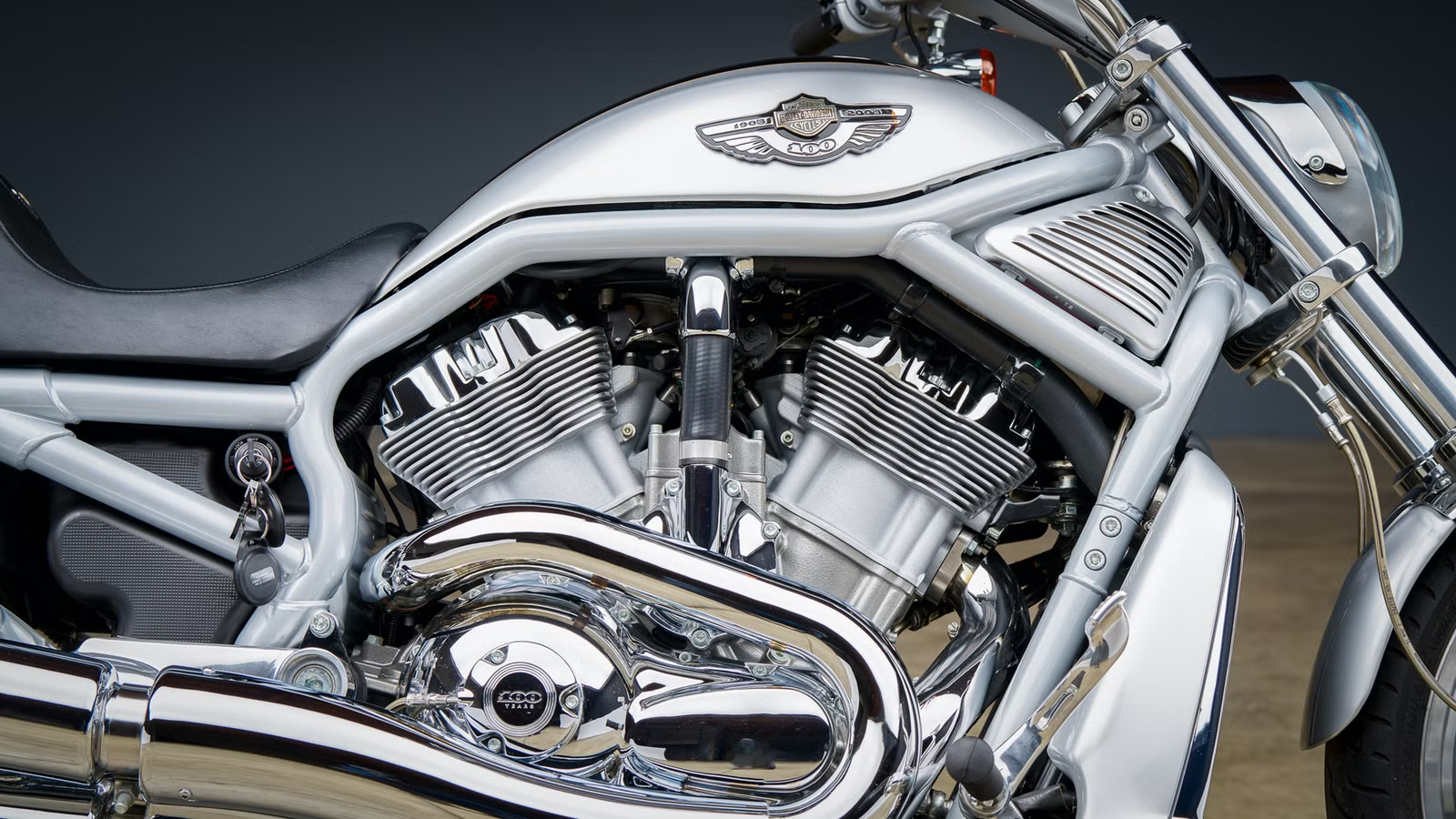
That engine was the Revolution V-twin, introduced in the 2002 Harley-Davidson VRSCA V-Rod. It was liquid-cooled, fuel-injected, and arranged at 60 degrees, with dual overhead camshafts operating four valves per cylinder. It used internal counterbalancing and an 11.3:1 compression ratio, delivering a claimed 115 horsepower at 8,200 rpm. Harley had built an engine that could spin to roughly 9,000 rpm without turning its connecting rods into expensive confetti.
The surrounding motorcycle made the departure impossible to miss. The V-Rod used a hydroformed perimeter frame, prominent radiator, long wheelbase, low stance, and an airbox hidden beneath what appeared to be the fuel tank. The actual fuel cell sat underneath the seat, allowing the engine’s intake system to occupy the valuable space above the cylinder heads. Even parked, it looked less like an updated Harley cruiser and more like a concept bike that had somehow escaped before management could reconsider.
It Used Technology Harley Riders Wouldn’t See Elsewhere For Years

Inside, the Revolution used a one-piece forged crankshaft, side-by-side connecting rods, plain main bearings, and modern four-valve cylinder heads. Its valve clearances were adjusted using shim-under-bucket hardware, while electronically controlled sequential-port fuel injection managed fuel delivery. These solutions were familiar elsewhere in the motorcycle industry, but seeing them combined in a production Harley was practically an out-of-body experience for anyone accustomed to pushrods, separate crankpin arrangements, and air-cooled cylinders.
The design also showed that modern engineering didn’t automatically erase character. The 60-degree configuration kept the engine visually recognizable as a V-twin, while balancing and liquid cooling allowed it to operate smoothly without becoming sterile. Its exposed castings, muscular proportions, and visible mechanical details still suited a Harley. The difference was that function had finally been given enough authority to challenge tradition, rather than being required to hide behind cooling fins and chrome covers.
Why Harley Abandoned The Engine Before Its Ideas Became Essential

The Revolution evolved during the V-Rod’s long production run. Displacement increased to 1,247cc, with the final 2017 V-Rod Muscle producing a claimed 122 horsepower and 86 pound-feet of torque. It paired the engine with a five-speed transmission and belt final drive, while carrying 5.0 gallons of fuel and weighing 673 pounds in running order. Its 67-inch wheelbase, 26.7-inch laden seat height, 240mm rear tire, and forward controls made it a dramatic power cruiser rather than a conventional sporting motorcycle.
The Night Rod Special used the same 1,247cc Revolution architecture but wrapped it in darker bodywork and a more aggressive layout. It measured 96.1 inches long, rode on the same enormous 240mm rear tire, carried 5.0 gallons, and weighed 666 pounds ready to ride. Both final models used dual front brake discs with four-piston calipers, anti-lock braking, cast-aluminum wheels, and a 49mm fork, giving the last V-Rods substantially more chassis hardware than Harley’s traditional cruiser image suggested.
The Revolution Inspired One Of Harley’s Most Advanced Engines

Harley ended V-Rod production after the 2017 model year, but the engineering philosophy didn’t disappear. The later Revolution Max family brought liquid cooling, dual overhead camshafts, four-valve heads, high compression, variable valve timing on some versions, and significantly higher rev limits to motorcycles such as the Pan America, Sportster S, and Nightster. Today, those ideas are presented as essential ingredients in Harley’s modern lineup, even though the original Revolution had demonstrated their value years earlier.
That’s the strange legacy of the Revolution engine. It didn’t overthrow the air-cooled Harley V-twin, and it never turned the V-Rod into the company’s new foundation. What it did was prove that Harley-Davidson could work beyond the boundaries of nostalgia and build a sophisticated, reliable, genuinely powerful engine without losing every trace of its identity. The Revolution wasn’t a failed preview of Harley’s future. It was an accurate preview that arrived before the company, its customers, and the market were ready to admit it.
Source: Harley-Davidson

Related posts

Latest Post


No Comments