
KTM’s Audi-Powered Side-By-Side Outguns Polaris And Can-Am By Up To 90 HP
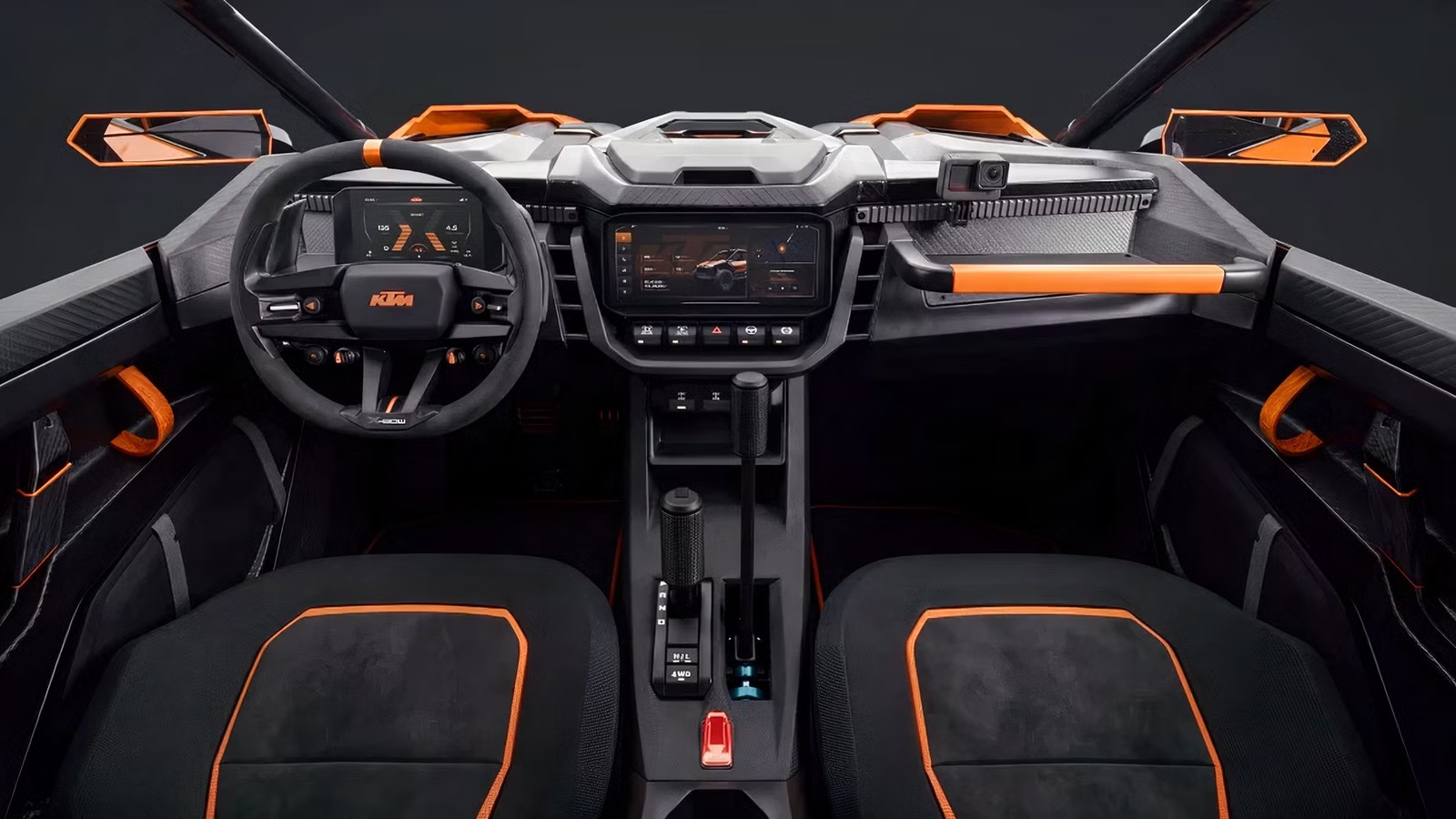
Most side-by-sides rely on belt-driven continuously variable transmissions (CVTs) to deliver power. KTM, however, has decided to go hard for its version of a side-by-side. Its new machine features a turbocharged Audi engine paired with a seven-speed dual-clutch transmission. It is an unusual combination for a vehicle designed to tackle dirt trails, dunes, and rough rally stages, but it can get established American rivals hot under the collar. KTM’s latest off-road creation also brings serious performance credentials. Its most powerful version produces 330 HP, putting it ahead of the Polaris RZR Pro R and Can-Am Maverick R.
An Audi Turbo Engine And Dual-Clutch Transmission Make This Side-By-Side Different

The typical high-performance side-by-side uses a naturally aspirated or turbocharged engine connected to a belt-driven CVT. This arrangement is popular because it provides seamless power delivery, keeping the engine within its useful rev range, and makes crawling through difficult terrain relatively straightforward. However, it is not particularly exciting for enthusiasts accustomed to conventional automotive transmissions.
KTM takes a different approach by borrowing hardware from the Volkswagen Group parts bin. Its off-road machine uses the EA888 2.0-liter turbocharged four-cylinder engine, a powerplant found in several performance-oriented Volkswagen and Audi models. It is paired with a seven-speed DSG dual-clutch transmission rather than a conventional CVT. The gearbox even has a low-range mode to tackle technical terrain.
This is a significant departure from established side-by-side engineering. A dual-clutch transmission offers rapid gear changes without the characteristic rubber-band sensation associated with CVTs. It also offers a direct connection between the driver and the powertrain. This combination is not entirely new in KTM’s history, since its X-Bow sports cars have used Volkswagen Group engines before. However, KTM’s new side-by-side brings that philosophy into a dedicated off-road vehicle.

The KTM X-Bow Arrow Delivers Up To 330 HP From Its Audi Engine

The machine is called the KTM X-Bow Arrow, and it will be offered in two configurations. The standard version produces 280 HP, while the more expensive Black Limited Edition receives a hotter version of the same EA888 engine, delivering 330 HP. Both use Audi’s seven-speed DSG transmission, making the powertrain the X-Bow Arrow’s definitive highlight. The standard Arrow already has enough output to challenge established performance UTVs. Its 280 HP puts it slightly ahead of the 275-HP Polaris RZR Pro R Boost, while comfortably exceeding the 240 HP offered by the Can-Am Maverick R. The Black Limited Edition stretches the advantage further, delivering 55 HP more than the Polaris and 90 HP more than the Can-Am.
To complement the powerful engine, the X-Bow Arrow uses a chromoly steel tubular frame, double-wishbone suspension at both ends, and KW Reiger-developed dampers. Its listed suspension travel reaches 23.6 inches, giving it considerable room to absorb large bumps and land jumps without immediately unsettling the chassis. Both versions also feature Sabelt seats and harnesses. The Black Edition gets upgraded suspension hardware in the form of electronically adjustable dampers and active anti-roll bars.
The KTM Arrow Outguns The Polaris RZR And Can-Am Maverick R

The American side-by-side market already has some seriously powerful machines, but the X-Bow Arrow takes the game considerably forward. And we are not just talking about outright horsepower. Side-by-sides need suspension capable of handling repeated impacts, sufficient ground clearance, predictable traction, and gearing that works at low speeds. The Arrow’s long suspension travel and DSG transmission with low-range capability suggest that the KTM is capable of delivering a lot more than straight-line performance.
Its development also has a genuine rally-raid connection. Belgian Dakar competitor Guillaume de Mevius, whose G Rally Team (now KTM X-Bow Lab) led the X-Bow operation, while rally-raid drivers, including Puck Klassen, contributed to development and testing. That background gives the X-Bow Arrow a more credible off-road foundation than a powerful engine would suggest.
Besides this, both versions of the Arrow feature electronic power steering and aluminum underbody protection at the front and rear. The cockpit features a dedicated digital instrument display, a 10-inch infotainment touchscreen, USB-C ports, and a rearview camera. There is also more practical equipment than its competition-inspired appearance suggests, including over 100 liters of storage and a 220-pound cargo rack capacity.
The KTM X-Bow Arrow Costs More Than A Polaris RZR And Can-Am Maverick R

The X-Bow Arrow is not trying to compete on affordability. The standard version starts at $59,800, while the 330-HP Black Limited Edition costs $98,600. For perspective, the 2027 Polaris RZR Pro R Boost starts at $49,999, making even the entry-level KTM nearly 10,000 more expensive. The Can-Am Maverick R is another important benchmark. Its 240-horsepower engine puts it behind both KTM versions, although it occupies a lower price bracket than the nearly six-figure Black Edition. KTM is clearly positioning the Arrow as a more exclusive performance machine rather than a direct alternative to established American UTVs.
At 59,800 for the standard X-Bow Arrow, buyers get 280 HP, the Audi-sourced EA888 engine, a seven-speed DSG with low-range, and the same fundamental architecture as the flagship Black Edition. Spending another $38,000 gets you 50 additional horsepower, an enclosed air-conditioned cabin, a hydraulic fly-off handbrake, active anti-roll bars, and electronically adjustable dampers. It is exclusive too, with production limited to just 500 units. The Black Edition’s premium is substantial, but so is its equipment upgrade. Booking for the KTM X-Bow Arrow is open, with deliveries expected in late 2027.

Related posts





Latest Post


No Comments