
If You Bought A Chevrolet With This Secret Option Code In 1969, You’d Be A Millionaire Today
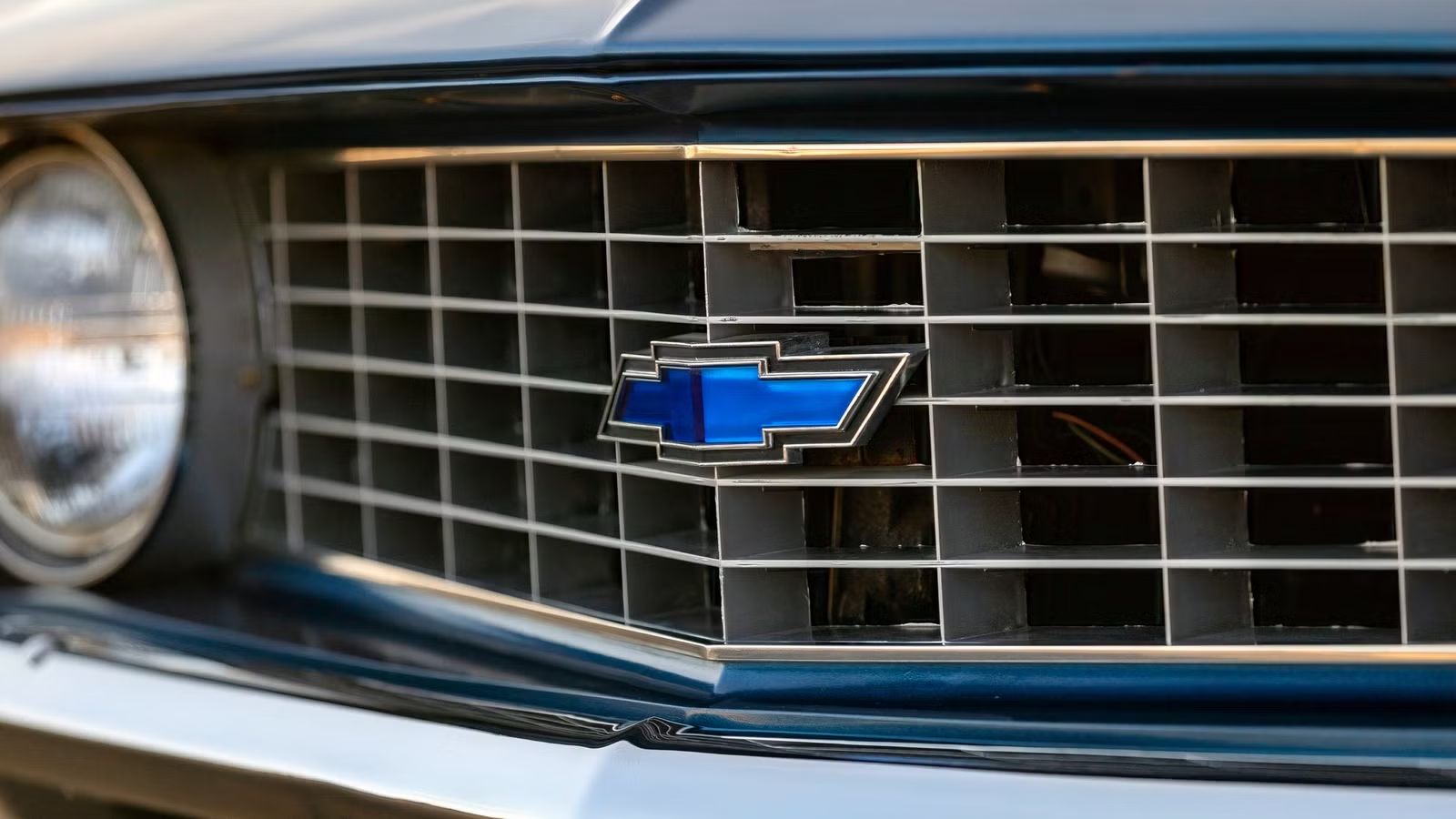
Chevrolet sold no less than 243,000 Camaros in that fateful year of 1969. Despite its reputation as the ultimate GM performance car that wasn’t a Corvette, most of them were fairly ordinary. Many sported fuel-sipping commuter engines, and even if you wanted a V8, they weren’t anything spectacular or noteworthy more often than not. With this in mind, not every ’69 Camaro you come across is worth its weight in gold, but one specific variant certainly is. If your grandpa rolled up to a Chevy dealer in 1969 and optioned his Camaro in a certain way, he almost certainly created generational wealth for his family down the line.
The Camaro: An Eternal Looker, But Not Always a Speed Demon

The first-generation Camaro is almost certainly a victim of tunnel vision by the modern zeitgeist, because the vast majority of rolling stock was, well, downright ordinary. Sure, the SS 396 big block and the high-revving corner-carving Z/28 302 were there for the performance enthusiasts, but they accounted for a small fraction of total production. They were fast, and they are certainly valuable today, but they weren’t exactly standard fare.
1969 was the first year the Camaro was offered with four-wheel disc brakes via the incredibly rare JL8 package, which essentially bolted Corvette stopping power onto the F-Body platform. Despite this, you couldn’t exactly order a top-tier Chevy performance engine in a mid-size car in 1969, thanks to strict corporate mandates prohibiting engines larger than 400 cubic inches in the mid-size form factor. In most scenarios, that would have been the end of it, but there was at least one surefire way to get around this restriction, one that only a handful of dealerships ever took advantage of.
The Central Office Production Order: Pure GM Voodoo Magic For Camaros and More


To bypass the corporate restriction, you had to know about the workaround between GM dealers and parts suppliers ordinarily used to spec taxis with heavy-duty suspensions, or utility trucks with larger engines. Dubbed the Central Office Production Order, or COPO, it was an administrative fleet-ordering mechanism meant for municipal managers and police fleet quartermasters, not performance-minded buyers trying to bypass corporate mandates that mitigated insurance premiums. But savvy, performance-oriented dealership owners eventually realized that because COPO orders went through a completely different corporate approval process, they could theoretically use it to slip banned hardware right past GM’s leadership.
Among the GM dealers who used the COPO system to perfection was Pennsylvania’s legendary Don Yenko, who utilized the system to order hundreds of iron-block 427 Camaros and build his iconic Yenko Super Cars. More notably, there was Illinois-based Fred Gibb, who used COPO code 9560 to order aluminum 427 big blocks for his self-financed NHRA drag racing team. Not every aluminum 427 big block, however, was used for racing. A scant few managed to escape and wind up in the hands of a general public that was never intended to get anywhere near them.
The ZL1: The Ultimate Camaro with the Ultimate Engine

The ZL1 427-cubic-inch aluminum big block V8 was never meant to interact with the engine bay of a 1969 Camaro. Yet COPO order 9560 ensured that a remarkably small number, no more than 69 total units, rolled off the assembly line. Its engine was born from Can-Am racing, a no-holds-barred, loosely sanctioned series where Formula 1 drivers and NASCAR Cup stars competed to escape the constraints of their respective sanctioning bodies, united by a pure love of racing. It had no business ever reaching the street, and yet it did, almost as an act of defiance by a handful of Chevy dealerships.
With somewhere in the neighborhood of 500 hp on hand, the ZL1 Camaro was a formidable presence on the street and the drag strip. It was good for a zero-to-60 sprint in the low fives, and onto a quarter-mile run in the low 13s. Add a set of racing slicks, and that number dropped to a low-11 quarter-mile pass. That’s impressive even today, and it came at a very steep price. Selecting the COPO 9560 package added a staggering $4,160 to the price of the car, nearly doubling the cost of a base Camaro equipped with something like a 307 V8.
Keep in mind that this covers only the engine package; the car itself would have cost over $7,000 by the time it was delivered. For context, a top-tier L88 C3 Corvette from the same year was $4,700, making the Camaro ZL1’s low production numbers understandable. Of course, this scarcity dramatically increased each car’s value as the years passed.
The Million-Dollar Legacy

Because of that unreal price tag, Fred Gibb struggled mightily to move the initial batch of 50 cars he ordered for NHRA homologation. He ended up sending many back to Chevrolet or trading them to other high-performance dealers just to avoid financial collapse. Still, his efforts in 1969 are exactly what created the ultimate GM collector car today. Because so few ZL1 Camaros ever saw the light of day, surviving, numbers-matching examples are the undisputed kings of the muscle car collector market.
They are the definitive manifestation of generational wealth. When a genuine ’69 ZL1 actually surfaces at a modern collector auction, it routinely commands seven figures, like a famous Hugger Orange example that pulled a staggering $1,094,500 at a Barrett-Jackson sale. More recently, one of only two Camaro ZL1s delivered to Fred Gibb Chevrolet in LaHarpe, Illinois, on New Year’s Eve in 1968 sold for $1,430,000 at Mecum’s Indianapolis auction in 2026. So, a house in the suburbs or one of these? The choice seems obvious. It proves that sometimes, working around corporate restrictions and bending the rules pays off in the most spectacular way possible. So, the next time one surfaces at auction, it is worth watching, if only to appreciate the extraordinary privilege of ownership.
Source: Mecum

Related posts



Latest Post


No Comments