
America Built This Badass V-Twin Before Harley-Davidson Ruled The Road
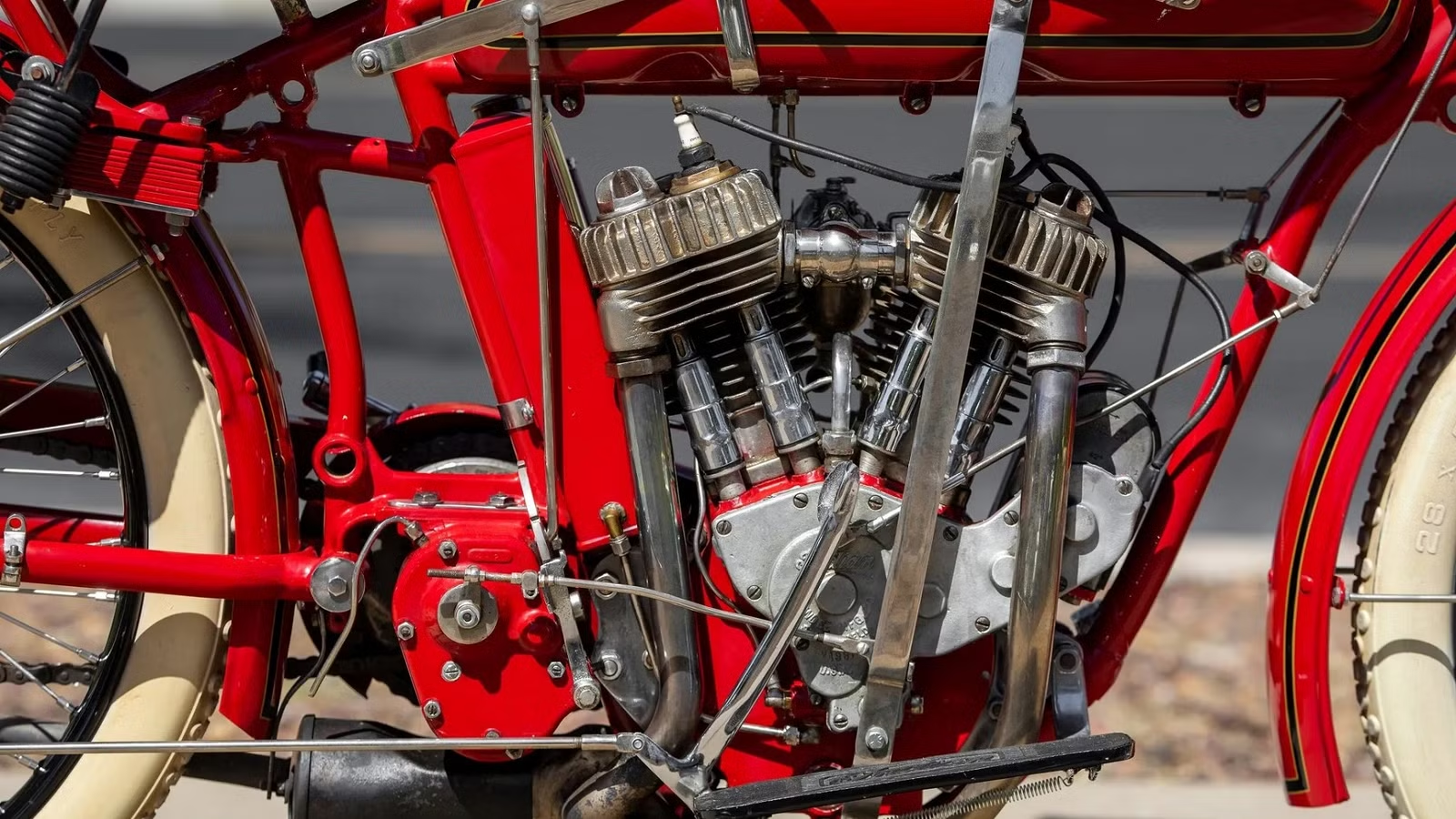
In case you didn’t know, America’s V-twin story did not always run through Milwaukee. In the 1910s, motorcycle design moved at a wild pace, and one company in Springfield, Massachusetts had the scale, race wins, and engineering nerve to set the tempo. Its next big twin arrived with nearly a liter of displacement, a simpler valve layout, real gears, chain drive, and enough speed to make rough early roads feel even rougher. And it wasn’t a Harley-Davidson.
Before Harley Dominated, America’s Motorcycle Pecking Order Looked Very Different
Harley-Davidson was already building motorcycles and growing quickly when the 1910s began. However, Milwaukee had not yet become the automatic center of the American motorcycle story. Indian, based in Springfield, Massachusetts, had grown into an industrial heavyweight – it raced hard, sold bikes internationally, and pushed new technology into production at a pace that would look aggressive even today. Other names such as Excelsior, Flying Merkel, and Pope also made the market far more crowded than modern brand recognition suggests. Early American motorcycling had no settled king, and the throne still had several companies fighting over it.
Indian reached an extraordinary high point in 1913. Historical production records put output at roughly 32,000 motorcycles, and Indian was believed to be the world’s largest motorcycle manufacturer by this period. Two years earlier, Indian had also swept the first three positions in the 1911 Isle of Man Tourist Trophy, giving the American company serious credibility on the other side of the Atlantic.
The motorcycles themselves were changing almost as fast as the businesses building them. Single-cylinder engines were sharing showroom space with much stronger twins. Chains gradually pushed aside the leather and rubber belts that could stretch, slip, or break. Gearboxes gave riders multiple ratios instead of forcing an engine to handle everything with one gear and a prayer. Frames grew stronger, suspension became more serious, ignition systems improved, while electric lighting and even experimental electric starting appeared.

A New 61-Cubic-Inch V-Twin Gave Early Riders Some Serious Muscle

By 1916, even a large motorcycle could look almost delicate to modern eyes. Skinny tires, exposed mechanical parts, narrow frames, and bicycle-style proportions remained common. Against that backdrop, a 61-cubic-inch engine sounded enormous – the new powerplant displaced roughly 998cc and used two air-cooled cylinders in a V configuration. Instead of chasing complexity, its designers used side valves, also known as a flathead layout.
The valve arrangement marked a major engineering change. Indian Motorcycle‘s older large V-twins used an F-head, or inlet-over-exhaust, arrangement. One valve sat above the cylinder while the other lived beside it. The new design put both valves alongside the cylinder, and that made the cylinder head and valve gear simpler and helped reduce manufacturing cost and maintenance. A flathead could not breathe as efficiently as later overhead-valve engines, but maximum airflow was hardly the only concern in 1916. Fuel quality varied, lubricants remained primitive, and metallurgy placed hard limits on engine speed and heat. A sturdy engine that produced useful power without eating itself for breakfast held real value. Charles Gustafson, an engineer with previous side-valve experience, understood that tradeoff particularly well.

Not everybody immediately loved the change. Some riders and dealers trusted Indian’s older F-head design and saw little reason to abandon something familiar. Historical accounts say a ride on the new engine often settled the argument because it pulled harder. Indian also subjected the design to the sort of test that meant more than a polished brochure. In 1915, Erwin “Cannonball” Baker rode a preproduction version roughly 1,655 miles from Vancouver, Canada, to Tijuana, Mexico, in 3 days, 9 hours, and 15 minutes. The run broke the existing Three Flags record, and that was a brutal demonstration of speed and endurance on roads that could make today’s potholes look professionally groomed.
The 1916 Indian Powerplus Beat Everything That Came Before It

That motorcycle was the Indian Powerplus, launched for 1916 by the company then formally known as the Hendee Manufacturing Company. The historic Powerplus family remained part of Indian’s lineup through 1924, although later versions eventually carried the Standard name. Indian has not forgotten it even today – the company says the PowerPlus name used on its current engines pays tribute to the original machine built from 1916 through 1924.
Charles Gustafson Sr. drove much of the original engine development. Gustafson had worked with side-valve designs before becoming Indian’s chief engineer, so the flathead layout came from experience rather than a random attempt to simplify production. His new V-twin kept the familiar 42-degree cylinder angle while changing how the engine breathed. It also made greater use of roller bearings – Indian paired the engine with a three-speed gearbox operated by a hand shifter, a clutch, chain final drive, and a kick starter. Those features sound basic now, but together they made the Powerplus a much more useful road machine than the pedal-assisted, single-speed motorcycles still fresh in riders’ memories. Starting it still required a leg, though.

The numbers explain why the bike earned attention. The manufacturer listed 61 cubic inches, or 998cc, 16 horsepower, a three-speed hand-shift transmission, chain drive, kick starting, and a weight of about 355 pounds. It also gave a top speed of roughly 65 mph. At that era, 65 mph could supply all the excitement a rider’s mustache could legally contain.
Even the name made unusually good sense. “Powerplus” advertised the central point of the new motorcycle: Indian had found more power. It represented another step in a V-twin program that had already run for a decade. Indian built a factory V-twin racing motorcycle in 1906 and brought a version of that idea to customers for the 1907 model year. The motorcycle manufacturer’s 39-cubic-inch, 42-degree 1907 engine was the first American production motorcycle V-twin. By the time the Powerplus arrived nine years later, the layout was no experiment – Indian had raced it, sold it, refined it, and turned the V-twin into a core part of the company’s identity well before the shape became permanently linked with American cruiser culture.
World War I Turned The Powerplus Into More Than A Fast Road Bike
The Powerplus soon faced a job far harsher than winning sales from weekend riders. When the United States entered World War I in 1917, Indian redirected a large share of its manufacturing effort toward military work. Indian says it built close to 50,000 motorcycles for the war effort between 1917 and 1919. Historical accounts identify most of those machines as Powerplus-based models. Dispatch riders and military units needed machines that could operate for long hours, carry gear, survive hard use, and keep moving when the “road” ahead sometimes deserved quotation marks.
The Powerplus made a strong case for that work. Its nearly one-liter engine provided useful low-speed muscle. Its three-speed transmission let a rider deal with hills, mud, loads, and changing surfaces more easily than a primitive single-speed machine. Chain drive offered durability, and the uncomplicated side-valve engine favored serviceability and toughness over exotic engineering. Those traits mattered when a motorcycle carried a dispatch rider, tools, ammunition, documents, or other equipment across rough terrain. Military use also gave Indian a giant real-world endurance test.
There was a business cost, however, and it helped reshape the Indian-Harley rivalry. Indian pushed hard into military contracts while Harley-Davidson put more effort into protecting and expanding its dealer network. Indian’s wartime strategy produced huge government sales, but civilian dealers had fewer new motorcycles to sell. After the war, that mattered – it would oversimplify history to blame one production decision for Harley-Davidson’s later dominance, yet the war changed the companies’ positions. Indian had proved the Powerplus on a massive scale, while Harley had strengthened parts of the retail machine that would matter once soldiers came home and civilian buyers returned. A battlefield win does not always guarantee victory in the showroom.
The Indian Powerplus Deserves A Bigger Place In America’s V-Twin Story

Harley-Davidson eventually became the American name most people connect with large traditional V-twins, and its survival gave it decades to strengthen that association. Looking backward through that success can make the early industry seem less competitive than it really was. In the 1910s, Indian stood near the center of American motorcycle engineering. Excelsior, Pope, Flying Merkel, Henderson, and others also built serious machines, but companies disappeared, merged, or changed direction with startling speed. The eventual winners wrote the longest histories simply because they remained around long enough to keep printing new chapters. The Powerplus comes from the messier period, when nobody could safely predict which badge would define American motorcycling a century later.
By 1916, Indian had already spent years developing V-twins. Its racing program had swept the top three positions at the 1911 Isle of Man TT. Production reached about 32,000 motorcycles at its 1913 peak. The company had experimented with rear suspension, electric starting, electric lighting, multi-speed transmissions, and other features while much of the motorcycle industry still worked out how far it should move from the bicycle. Then the Powerplus combined those years of experience with Gustafson’s durable side-valve engine. The result proved useful enough to become a major military platform and strong enough to build its name around one simple promise: more power.

The Powerplus stayed in the family through 1924 and helped bridge two very different stages of Indian history. It came from the pioneering period of exposed valve gear, bicycle proportions, and experimental chassis design. Before its run ended, Indian had already introduced the Scout in 1920 and the Chief in 1922, two names that would overshadow it in later decades. That makes the Powerplus easy to skip, but skipping it leaves a hole in America’s V-twin story. Its 16 horsepower sounds modest now and its 65-mph top speed looks almost quaint. In 1916, those numbers backed a rugged liter-class twin from one of the biggest motorcycle companies on Earth. The cylinder heads may have been flat, but Indian’s ambition certainly wasn’t.
Source: Indian Motorcycles, Harley-Davidson

Related posts

Latest Post


No Comments