
Hyundai Workers Are Striking Over Humanoid Robots — And It Could Affect The Cars You’re Waiting For
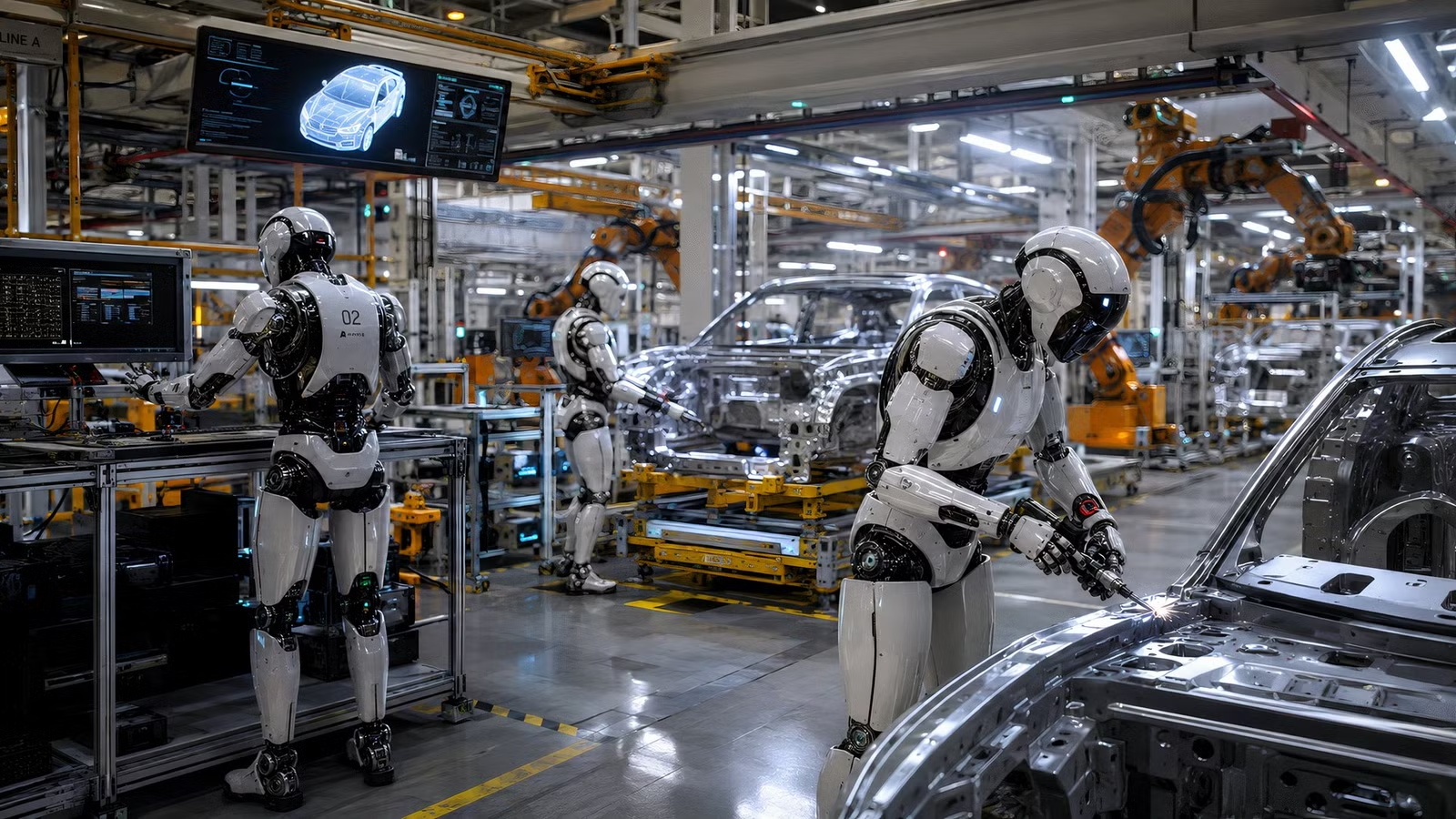
If you’re waiting on a new Hyundai, a labor dispute unfolding right now in South Korea deserves your attention. Thousands of unionized workers at Hyundai’s massive Ulsan production complex — the world’s largest automotive plant — have already walked off the job early for multiple shifts, and a new round of four-hour strikes is scheduled to begin July 20. The trigger isn’t wages alone. It’s robots: specifically, Hyundai’s plan to deploy more than 25,000 Atlas humanoid robots across its Hyundai and Kia factories.

The Ulsan complex is where Hyundai builds a significant share of its global lineup, including models that flow directly to U.S. dealerships. A prolonged stoppage won’t empty lots overnight, but it adds pressure to supply chains already stretched by tariff headwinds, and it puts a spotlight on a fundamental tension between Hyundai’s robotics ambitions and the 39,000 workers whose union is now pushing back hard.
What’s Happening at Ulsan — and Which Models Are at Risk
The Hyundai Motor union launched its initial action on July 13, with workers ending day and night shifts two hours early through July 15. Starting July 20, those actions escalate to four-hour strikes after 15 rounds of negotiations failed to produce an agreement. The Wall Street Journal called it “the car industry’s first factory stoppage addressing humanoid robots.”

Ulsan is Hyundai’s primary South Korean manufacturing hub, producing a wide range of models exported globally — including Tucson, Santa Fe, Sonata, and Ioniq variants that reach North American buyers. While Hyundai has not issued a model-specific production impact statement, any sustained reduction in shift hours at Ulsan translates directly to fewer vehicles completed per week. For buyers already tracking extended wait times on popular crossovers, that math isn’t encouraging.
The Robot at the Center of the Dispute: Boston Dynamics’ Atlas
The Atlas humanoid robot stands over six feet tall, can lift more than 100 pounds, and is built by Boston Dynamics — a company Hyundai is in the process of taking full ownership of. Hyundai’s plan is to begin deploying Atlas units at its U.S. factory, Metaplant America outside Savannah, Georgia, starting in 2028, before rolling the program out more broadly.
The economics are what spooked the union. Each Atlas unit costs an estimated $130,000 but could pay for itself within roughly two years of operation, according to a Samsung Securities analyst. If the per-unit cost drops to $100,000, analysts at Macquarie Securities suggest the robot’s operational cost could fall below the U.S. federal minimum wage — well under what a typical assembly worker earns. That’s the number the union is reacting to, not the robot’s current capabilities.
What the Union Is Demanding — and What Hyundai Has Committed

The union’s demands go beyond a pay raise. Workers want hourly pay converted to a fixed salary, protecting against automation-driven reductions in work hours. They’re also pushing to raise the retirement age from 60 to 65 and seeking larger worker bonuses — all framed as safeguards against a future where robots absorb a growing share of assembly tasks.
Hyundai, for its part, has made concrete workforce commitments at its U.S. facility: the company is contractually obligated to employ 8,100 full-time workers at Metaplant America by 2031 as part of its economic development agreement with Georgia, which came with an incentive package valued at roughly $2.1 billion. The plant already employed more than 3,800 workers by the end of 2025. Hyundai’s assembly executive at Metaplant has also argued that human hands remain essential for soft components — hoses, wires, trim panels — that robots can’t yet handle reliably. Whether those assurances satisfy the South Korean union is another question entirely.
What This Means If You’re Buying or Waiting on a Hyundai

Hyundai has navigated strikes before — the Ulsan union has a history of periodic work stoppages, and the company typically manages inventory buffers that absorb short-duration actions. A two- or three-day partial strike rarely produces visible gaps on dealer lots. But this dispute has a structural dimension that makes a quick resolution less certain: the union isn’t just asking for more money, it’s asking Hyundai to formally limit how automation can reshape the workforce. That’s a harder negotiation.
For buyers, the near-term picture depends on how quickly the two sides reach an agreement. If strikes remain limited to a few hours per shift over a week or two, expect minimal impact on U.S. inventory. If talks stall and actions intensify heading into August, models sourced primarily from Ulsan could see tighter availability by fall. Checking with your dealer on where your specific vehicle is built — and whether it’s already in transit — is the most actionable step right now.
This dispute is also a preview of a broader industry reckoning. Tesla is developing its own Optimus robot for EV factories, BMW is piloting humanoid robots from Figure AI in South Carolina, and GM is already grading suppliers on automation levels. Hyundai just happens to be the first automaker where the tension between that ambition and an organized workforce has shut down production lines. It won’t be the last.

Related posts



Latest Post


No Comments