
Hyundai Is Building A Body-On-Frame Lineup, And Here’s What That Means For Toyota’s Truck Dominance
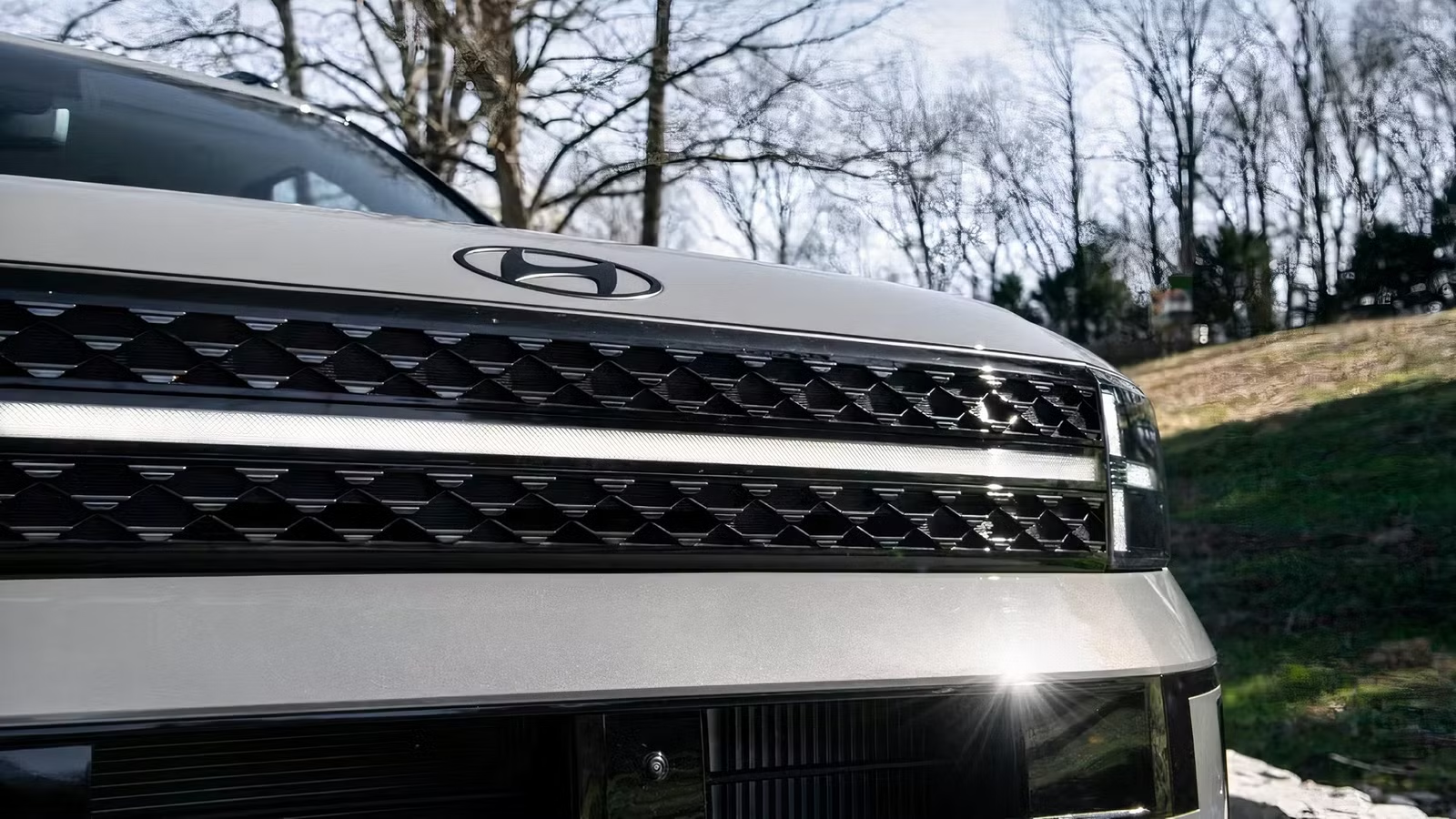
Hyundai CEO Jose Munoz confirmed this week at the company’s 2026 Investor Day that the brand’s body-on-frame ambitions run far deeper than a single pickup truck. The plan is a full family of ladder-frame vehicles — pickups, SUVs, and potentially derivatives for Kia and Genesis — designed to account for roughly half of Hyundai’s targeted 35 percent global sales growth through 2030. It’s the most credible mainstream challenge to Toyota’s decades-long grip on the body-on-frame segment that the industry has seen in years.

The first model off the new ladder-frame architecture is expected to be a mid-size pickup, arriving around 2029 as either a traditional hybrid or a range-extended configuration. Beyond that, Hyundai has already previewed where the family is headed with two concepts: the Boulder, which takes direct aim at the Ford Bronco, and the Crater. Production is likely to land at the Metaplant in Bryan County, Georgia — and Munoz made clear that American-built doesn’t mean American-only.
A Platform Family, Not a One-Off Entry
The language Munoz used at Investor Day was deliberate. “We want to develop a family of products capitalizing on platforms,” he said. “You would typically see several models derived from the same platform and will try to maximize the volume.” That framing matters: Hyundai isn’t treating this as a toe-dip into the truck market. It’s building an architecture meant to underpin multiple production vehicles across multiple brands.

How many models are officially confirmed beyond the pickup and a Boulder-style SUV? None, specifically. But the platform-family approach is exactly how Hyundai has operated with its unibody lineup for years — Kia and Genesis have shared architectures with Hyundai across multiple segments, and extending that to a ladder-frame platform would be a logical next step. Munoz indicated both sub-brands could receive their own variants, though no timelines have been attached to either.
Where Toyota Is Most Exposed

Toyota has built its truck and SUV reputation over seven decades. The 4Runner, Tacoma, Tundra, and Land Cruiser represent a lineage that competitors have chipped away at individually but never seriously threatened at the brand level. Hyundai’s approach is different: rather than proving itself with one model before expanding, it’s entering multiple body-on-frame segments simultaneously.
The mid-size pickup puts it squarely against the Tacoma, which has long been the default choice for buyers who want a proven off-road-capable truck with strong resale value. The Boulder concept, meanwhile, targets the Bronco — but a production version would inevitably draw comparisons to the 4Runner, which still sells on reputation and trail capability more than on modern refinement. That’s actually where Hyundai has an opening: the 4Runner’s platform is aging, and buyers who want something current are increasingly weighing alternatives. A well-executed Boulder-derived production vehicle could arrive at exactly the right moment.
The Timing Question and the Georgia Connection

The 2029 target for Hyundai’s first ladder-frame model creates an interesting timing dynamic. Toyota’s current-generation Tacoma is relatively new, but the 4Runner and Tundra are both candidates for next-generation updates within a similar window. Whether Hyundai beats Toyota’s next-gen products to market — or arrives just as they do — will shape how much runway the new lineup gets to establish itself before facing freshened competition.
On manufacturing, Munoz was direct about the Georgia Metaplant’s role. The facility already builds the Ioniq 5, Ioniq 9, and Kia Sportage Hybrid, with Genesis models also slated for the line. Adding ladder-frame trucks there would consolidate Hyundai Motor Group’s North American production under one roof. Crucially, Munoz also signaled export ambitions: “Definitely the United States could be not only the place to produce for domestic but also for export, as we see definitely other regions benefiting from these new segments.” Specific markets haven’t been named, but the intent is clearly global from day one.

For anyone currently cross-shopping a Tacoma, 4Runner, Bronco, or Ranger, Hyundai’s announcement doesn’t change what’s available today — but it does change the calculus for anyone willing to wait. A 2029 launch window is three years out, which is a long time in a segment where loyalty runs deep, and resale value matters as much as specs.
Powertrain is worth watching closely. The mid-size pickup is expected to launch as a hybrid or range-extender rather than a pure battery-electric — the same extended-range EV approach Hyundai is applying to the Santa Fe EREV, which targets combined range exceeding 600 miles when it arrives in early 2027. That positions the truck as a practical choice for buyers who want efficiency without the charging-infrastructure anxiety of a full EV. Whether the Boulder-style SUV follows the same powertrain path hasn’t been confirmed. What is clear is that Hyundai is treating body-on-frame not as a niche experiment, but as a structural pillar of its growth plan through the end of the decade.

Related posts

Latest Post



No Comments