The Japanese V6 Sedan That Makes Downsizing Hard To Defend
8 minutes reading
Friday, 21 Aug 2026 17:00 0 47 autotech
Engine downsizing in sedans began as automotive manufacturers faced strict corporate average fuel economy targets and global emissions regulations. Car manufacturers turn to turbochargers and hybrid battery systems to extract high output from smaller displacement blocks with fewer cylinders.
This engineering shift serves a clear purpose. It allows internal combustion architectures to deliver acceptable real-world performance while reducing tailpipe emissions during standardized laboratory test cycles. Japanese brands are rapidly embracing downsizing via electrification. This has led to the discontinuation of some well-regarded large displacement engines.
Toyota approaches internal combustion engineering with a strict focus on mechanical simplicity, under-stressed engine internals, and long-term thermal efficiency. The brand prioritizes structural integrity over maximum-effort power outputs, often utilizing cast-aluminum blocks with cast-iron cylinder liners to withstand extended service lifespans.
Machining tolerances remain exceptionally high across manufacturing plants, ensuring minimal friction and consistent oil pressure throughout millions of operation cycles. This structural design strategy produced the legendary 3.5-liter GR V-6 engine family. The durability of the naturally aspirated 2GR engine block became so widely respected that British manufacturer Lotus used tuned variants of it to power high-performance sports cars like the Evora, Exige, and Emira.
The Avalon Remains An Underrated V-6 Sedan
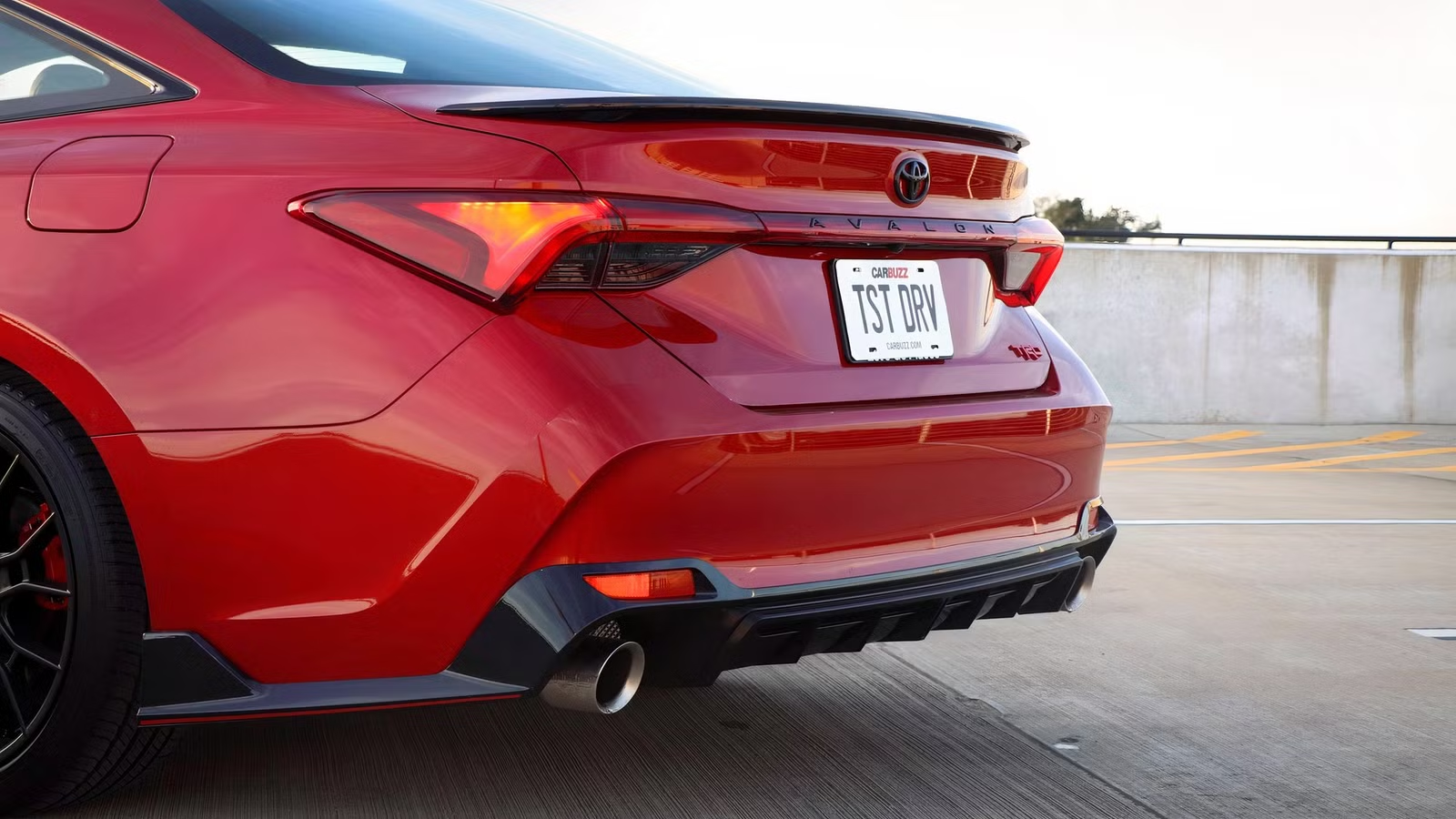
2022 Toyota Avalon TRD rear 3/4 shotToyota
The 2022 Toyota Avalon represents the final production year of Toyota’s flagship full-size front-wheel-drive sedan. It sat at the absolute top of Toyota’s non-luxury car lineup, serving as a comfortable, near-Lexus cruiser for buyers who prioritize highway cabin insulation, long-distance road comfort, and traditional mechanical layouts over aggressive sportiness.
Its core clientele consisted of older buyers, long-distance commuters, and executive fleet buyers seeking luxury levels of legroom without paying luxury brand service costs. Toyota ultimately discontinued the Avalon in 2022 due to shifting consumer demand toward crossovers, falling sedan sales, and a company-wide strategy to replace large-displacement cars with hybrid platforms.
What Makes The Avalon V-6 So Balanced
3/4 action shot of the 2022 Toyota Avalon TouringToyota
Under the hood, the 2022 Avalon V-6 features the 3.5-liter 2GR-FKS engine mated to a direct-shift eight-speed automatic transmission. The naturally aspirated engine produces 301 horsepower at 6,600 RPM and 267 pound-feet of torque at 4,700 RPM. Power is sent exclusively to the front wheels, allowing the premium sedan to complete the 0-60 MPH sprint in 6.0 seconds, reaching an electronically limited top speed of 130 MPH.
Engine longevity stems from Toyota’s D-4S fuel injection system, which combines both direct and port fuel injectors. The port injectors spray fuel behind the intake valves under light loads, preventing the excessive carbon buildup that plagues turbocharged, direct-injection four-cylinder competitors. Aluminum cylinder heads, forged steel connecting rods, and hydraulic variable valve timing with intelligence complete this balanced powertrain configuration.
Opting for the V-6 obviously means that you have to deal with worse fuel consumption estimates. The XLE returns 22/32/26 MPG, while covering 377 miles from its 14.5-gallon tank. You can expect to spend $1,000 in five years, spend $2,350 on fuel every year, and $3.94 to drive 25 miles. A full tank of gas will cost around $59.
Upgrading to the Limited or Touring results in a 22/31/25 MPG consumption return, but a larger 15.8-gallon tank means the range increases to 395 miles. This will cost you $1,250 more on fuel every five years, while spending $2,450 on fuel every year, $4.10 to drive 25 miles, and $65 to fill the tank up.
The 2GR Is Built To Stand The Test Of Time
2022 Toyota Avalon TRD engineToyota
The 2GR-FKS V-6 engine holds an elite reputation for legendary mechanical reliability, frequently surpassing 200,000 miles without major internal component overhauls or costly repairs. Long-term servicing requirements remain remarkably cheap, simple, and straightforward for mechanics to perform. Routine factory maintenance mandates synthetic oil and filter changes every 10,000 miles or 12 months, along with engine air filter replacements every 20,000 miles. Mechanics replace the spark plugs at 120,000-mile service intervals, while the durable, maintenance-free timing chain completely eliminates the expensive scheduled timing belt replacement costs that plague other luxury sedans.
Throughout its final five production years, the naturally aspirated V-6 Avalon successfully avoided major mechanical engine teardown recalls, entirely bypassing the porous engine block casting issues that affected Toyota’s 2.5-liter four-cylinder platforms during that same era. The broader vehicle platform was affected by Denso’s widespread industry recall involving defective low-pressure fuel pumps inside the fuel tank. Dealership technicians resolved this issue free of charge by installing an upgraded, redesigned fuel pump assembly.
The Avalon’s Unsuccessful Sales Run
2022 Toyota Avalon TRD front driving shot with a Camry TRD followingToyota
During its final model year in 2022, Avalon sales totaled roughly 12,000 units in the U.S., reflecting a steep decline from historic figures as consumers overwhelmingly moved to SUVs like the RAV4 and Highlander. Midsize options like the Camry continuously overshadowed the Avalon, offering similar interior tech at a significantly lower purchase price.
Within the Camry lineup, buyers increasingly selected the standard 2.5-liter four-cylinder or four-cylinder hybrid options over the available V-6 engine. Seeing low take-rates for six-cylinder powertrains across sedan lines, Toyota discontinued the V-6 option in the Camry shortly after dropping the Avalon, clearing manufacturing capacity for hybridized four-cylinder engines.
How Much The 2022 Avalon Sells For In 2026
2022 Toyota Avalon DashboardToyota
According to J.D. Power, the 2022 Toyota Avalon currently sells for anywhere between $23,814 and $38,236, depending on the specification, mileage, and condition. KBB’s fair purchase value guide suggests that pricing for the same model currently ranges between $25,946 and $31,646. According to Edmunds, a base XLE model in outstanding condition is likely to fetch $25,006 on the private market, while a rough condition will only bring $21,097 via a trade-in.
The final 2022 model year of the Toyota Avalon is available in XLE, Touring, and Limited trims for both the hybrid and V-6 models. The Japanese brand started pricing for the base model at $36,825 MSRP, making it just about $1,105 more than the equivalent Camry. As standard, this derivative features 17-inch alloy wheels, dual-zone climate control, a leather multifunction steering wheel, SofTex seat upholstery, a 9.0-inch touchscreen infotainment system, and electrically adjustable and heated front seats.
Opting for the Touring would have cost you $43,525, adding 19-inch black alloy wheels, combination SofTex and suede upholstery, front seat ventilation, rear seat heating, paddle shifters, a head-up display, aluminum pedals and interior trimming, a wireless smartphone charger, and a 14-speaker premium JBL audio system. The Limited was marginally less expensive at $43,125 and matched the Touring’s specifications, excluding the 18-inch Super Chrome alloy wheels and some of the interior trimmings.
The Avalon’s Trusted Reputation
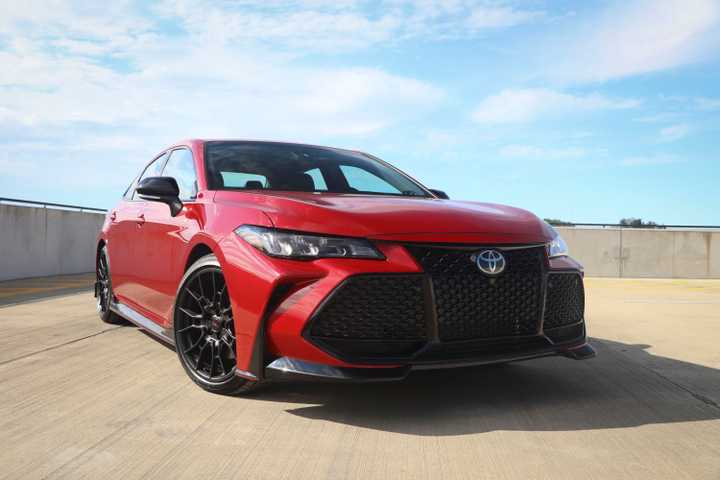
2020 Toyota Avalon TRD front 3/4 shotToyota
While it may not have the same presence as its European counterparts, the Avalon enjoyed high review scores from many esteemed publications and users. iSeeCars gives the model an 8.3/10 overall score, which includes 8.7/10 for reliability, 8.3/10 for retained value, and 8.0/10 for safety.
On the reliability front, the publication indicates that it will cover 14.4 years or 166,591 miles of usage before you encounter any major mechanical issues, with a 30.4-percent probability of reaching 200,000 miles.
J.D. Power gives the 2022 model year range with an 83/100 consumer-verified overall score, consisting of 91/100 for quality and reliability, 73/100 for driving experience, 83/100 for resale, and 76/100 for the dealership experience. The 2022 Avalon range currently sits with a 4.4/5 Edmunds owner review score, with its comfort, value, interior space, and fuel efficiency being its most noteworthy drawing cards, but some owners have criticized it for featuring uncomfortable seats, poor interior visibility, and an inconsistent touchscreen.
According to the Edmunds True Cost To Own tool, you can expect to spend $39,130 while owning the base XLE model for five years, while covering 60,000 miles. Some of these costs include $5,070 on maintenance, $1,658 on repairs, $12,243 on depreciation, and $8,976 on fuel.
The Crown’s Punchy Hybrid Replacement To The V-6 Avalon
White 2026 Toyota Crown ParkedToyota
The Toyota Crown directly replaced the Avalon as the brand’s flagship sedan, offering a high-output, performance-minded alternative in its top Platinum trim via the Hybrid MAX powertrain. This modern powertrain marries a turbocharged 2.4-liter four-cylinder engine with front and rear electric motors to generate a combined 340 horsepower and 400 lb-ft of torque. While the immediate electric torque provides punchy off-the-line thrust, standard all-wheel drive, and a rapid 5.7-second 0-60 mph acceleration time, the complex system fundamentally alters the traditional ownership experience.
The Hybrid MAX setup trades away the simple, unboosted mechanical elegance, linear power delivery, and low-complexity maintenance profile that made the original naturally aspirated 3.5-liter V-6 so legendary. Operating with a turbocharger, high-voltage battery pack, dual electric motors, and intricate power electronics creates multiple potential points of failure over an extended ownership period.
Owners face specialized dealership servicing requirements, battery degradation over time, and higher long-term replacement costs. While the Crown delivers impressive modern efficiency and quick low-end acceleration, it simply lacks the effortless highway cruising nature, refined engine note, and bulletproof mechanical durability that define the discontinued Avalon V-6.
Base Trim Engine
3.5L V6 Gas
Base Trim Transmission
8-Speed Automatic
Base Trim Drivetrain
Front-Wheel Drive
Base Trim Horsepower
301 hp
Base Trim Torque
267 lb-ft @ 4700 rpm
Fuel Economy
22/32 MPG
Make
Toyota
Model
Avalon
Segment
Full-Size Sedan
Sources: Toyota, iSeeCars, J.D. Power, Edmunds, and the EPA.









No Comments