
The Front-Drive K-Car That Ran With Ford’s Mustang SVO
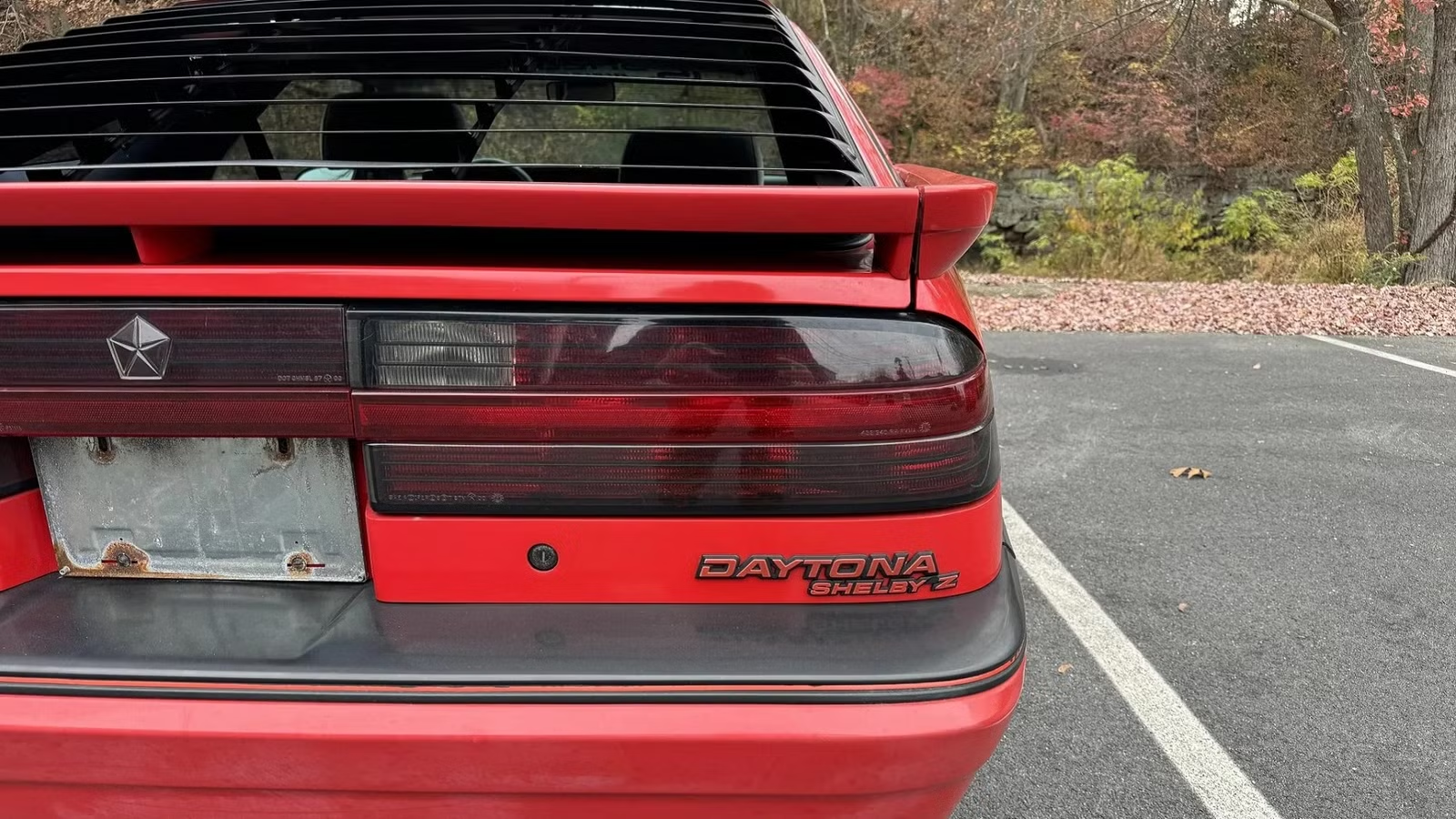
By 1987, American performance had reached a wonderfully strange point—turbo fours, fuel injection, intercoolers, and computer-controlled boost were challenging the old rule that speed needed cubic inches. Ford had already built an expensive rear-drive coupe to prove a four-cylinder could be serious, but Chrysler took a very different route. It pushed familiar front-drive hardware until the front tires had almost too many jobs. The result could run in surprisingly elite company, even if getting all of its power to the pavement sometimes felt like an arm-wrestling match.
Ford Built The Mustang SVO To Be More Than A Cheap Muscle Car

Ford’s Mustang SVO arrived for 1984 with a goal bigger than winning stoplight races. Special Vehicle Operations wanted a Mustang that could stand beside sophisticated European and Japanese performance cars without leaning on the usual V8 formula. Its 2.3-liter turbocharged and intercooled four-cylinder sent power to the rear wheels through a five-speed manual. Ford also gave it four-wheel disc brakes, adjustable Koni dampers, 16-inch wheels, quicker steering, and serious chassis tuning.
Taking roughly 150 pounds off the nose compared with a V8 Mustang helped, too. The result put balance, braking, steering, and technology much higher on the menu than a normal Fox-body GT did. The automaker even fitted a fuel-quality switch that reduced boost when the driver fed the car regular gasoline. Very 1980s, very clever.

Power climbed quickly during the SVO’s short life. The 1984 version made 175 hp, roughly matching the contemporary 5.0-liter V8 Mustang in peak output. Ford pushed the turbo four to 205 hp for the mid-1985 update, then rated the 1986 model at 200 hp and 240 lb-ft of torque. A 200-hp car was capable of hitting 60 mph in about 6.8 seconds, showing that the small engine was hardly an economy-car consolation prize.

But then came the awkward part: the bill. A 1986 SVO carried a base MSRP of $15,272, close enough to $16,000 to make the point, while a 1986 Mustang GT hatchback started at $10,691. In other words, Ford wanted buyers to spend several thousand dollars more for a Mustang with four cylinders instead of eight. That sounded backward if the shopping list began and ended with engine size and exhaust noise. Ford’s pitch made more sense when the SVO’s brakes, suspension, steering, intercooling, and equipment entered the equation, though.
Chrysler’s Unlikely Performance Formula Put Too Much Power Through The Front Tires

Chrysler attacked the same decade from another direction. Its front-drive architecture had become the corporate multitool. The company stretched and adapted related hardware into sedans, coupes, luxury cars, and other models rather than creating a clean-sheet rear-drive performance platform for every sporty idea. The Daytona used Chrysler’s G-body architecture, itself derived from the broader K-car family, but it sat lower and wore a fastback body built for a very different job than an Aries commuter sedan.
Chrysler also embraced turbocharging early. Instead of abandoning compact four-cylinder engines when buyers wanted more speed, engineers simply taught those engines to inhale much harder.
By 1987, that approach produced the 2.2-liter Turbo II. A Garrett T3 turbocharger and an intercooler helped it make 174 horsepower and 200 lb-ft of torque. The production Turbo II received a forged crankshaft, Mahle pistons with full-floating pins, stronger connecting rods and bearing caps, and other durability upgrades. An electronically controlled wastegate managed up to 12 psi of boost. The numbers sound modest to modern ears, but context changes everything. The car carrying this engine weighed about 2,800 pounds. Two hundred lb-ft in that package worked out to roughly one lb-ft for every 14 pounds of car. In 1987, that counted as real shove.
There was one small engineering inconvenience, though: the driven wheels also had to steer. Launch hard, wait for the Garrett to come alive, and both front tires suddenly had to divide their attention between acceleration and keeping the car pointed where its driver intended.
The 1987 Dodge Daytona Shelby Z Was The K-Car Cousin Running With The SVO

The car that peaked from that program was the 1987 Dodge Daytona Shelby Z, and calling it a K-car derivative needs some care. It was not simply an Aries sedan wearing a Halloween costume – the Daytona rode on Chrysler’s front-drive G platform, which grew from the same basic engineering family as the K platform but used different proportions and a sporty hatchback body. For 1987, Dodge freshened the shape with smoother fascias and pop-up headlights.
Underneath, the Shelby Z gained serious hardware, including four-wheel disc brakes, suspension upgrades, and the heavy-duty A555 five-speed transaxle with Getrag gearsets. The family resemblance existed deep in the engineering, not in the sense that someone at Chrysler simply lowered an Aries, glued on a spoiler, and called lunch early.
While Chrysler built the Daytona Shelby Z, and the model carried Carroll Shelby’s famous name, Shelby did not engineer it in the same hands-on way Shelby Automobiles developed cars such as the Omni GLH-S. The 1986 Daytona Turbo Z C/S package had already introduced larger anti-roll bars, upgraded struts, four-wheel discs, and wide Goodyear tires, and much of that thinking flowed into the 1987 car. Shelby had no further direct role in those Daytonas beyond the name connection.

The mechanical package still gave enthusiasts plenty to discuss, though. The manual-transmission Shelby Z received the intercooled 2.2-liter Turbo II, Garrett T3 turbo, 12 psi of maximum boost, 174 horsepower, and 200 lb-ft of torque. Published curb-weight references put it at about 2,813 pounds. Dodge paired the Turbo II with the five-speed; choosing the automatic meant stepping down to the less powerful Turbo I. That detail makes the hottest 1987 Shelby Z unusually focused by Chrysler standards, and also explains why the engine upgrades mattered so much. A forged crank, stronger rods, full-floating piston pins, intercooling, and electronic boost control gave the Turbo II the hardware to live with its extra cylinder pressure.
Now, about those acceleration figures. Hot Rod recorded 0–60 mph in 7.1 seconds from an early prototype, while later calculated performance data landed around 7.2 seconds. Other magazines recorded sprints in the same mid-7s zone, overlapping the broader performance neighborhood occupied by the Mustang SVO, although the quickest 200-hp SVO tests could dip into the high sixes. So the Dodge definitively did not “beat” Ford per se, but the surprise is that Chrysler’s roughly 2,800-pound front-driver could even enter the conversation with Ford’s expensive, purpose-developed rear-drive flagship.
Similar Speed Hid Two Completely Different Ideas About Performance

However, numbers on paper hide how different the two cars felt. The Shelby Z put all 200 lb-ft through its front tires, and the chassis made sure the driver knew about the arrangement. Period reviews complained about strong torque steer, a rough engine, an awkward five-speed shift action, and what Consumer Guide later summarized as a “bone-crushing” ride. Dodge had improved the suspension, brakes, tires, and transmission, yet polish never became the car’s strongest subject. It delivered performance like a bar fight conducted with a boost gauge. But that rough edge also gives the car much of its appeal today—modern performance cars work hard to remove unwanted steering corruption and driveline drama, while the Shelby Z served both with the meal and did not ask whether anyone had dietary restrictions.
The SVO came from almost the opposite idea. Rear-wheel drive separated the steering tires from the main task of putting power down. Its chassis used adjustable Koni dampers, four-wheel discs, special steering, larger wheels, and extensive tuning developed under Ford’s Special Vehicle Operations program. The lighter turbo four also reduced mass over the nose compared with a V8 Mustang. Ford wanted the SVO to feel more like a European-flavored sports coupe than a traditional cheap pony car with a large engine, and that ambition became part of the product itself. Sadly, so did the price.

Turbo technology made comparisons especially messy in the 1980s. These engines often had a clear split between off-boost and on-boost behavior. A launch that bogged below the useful boost range could waste huge chunks of time, but a hard launch might instead overwhelm the available grip. Gear ratios, shift speed, road surface, weather, fuel quality, and even how aggressively a tester treated the clutch could move a 0–60 result by surprising amounts. The Dodge added front-wheel traction and torque steer to that equation, while the Ford carried more power and rear-drive traction, but its turbo four also needed revs and boost.
Cheap V8 Power Made Both Turbo-Four Experiments Easy To Forget

The market soon reminded both companies that clever engineering still had to compete with cheap cubic inches. Ford’s 5.0-liter Mustang gained electronic fuel injection for 1986 and then moved to 225 horsepower for 1987. That engine brought the sound, simple low-rpm response, displacement, and huge tuning potential that Mustang buyers already understood. It also sat in cars that cost less than the outgoing SVO.
Once enthusiasts learned how easily the fuel-injected 5.0 responded to modifications, the Fox-body V8 became a performance culture of its own. The SVO’s carefully developed turbo four suddenly looked like the expensive route to a problem the V8 solved with two extra banks of cylinders and a much better soundtrack. History can be rude like that.
That left the SVO in an odd place. Ford had created a technically ambitious Mustang with strong brakes, fine handling, modern electronics, and genuinely competitive performance, yet its price asked customers to value those things more than the familiar 5.0 badge. Only 9,844 SVOs emerged across the 1984–1986 run.

The Shelby Z disappeared for different reasons. Front-wheel drive kept it outside the traditional muscle- and pony-car story, while Shelby’s limited direct involvement denied it some of the collector halo attached to the Omni GLH-S, Shelby Charger GLH-S, and Shelby-built CSX. Its own lack of refinement did not help either. Shoppers could get smoother V8 performance elsewhere, and a well-equipped Shelby Z could climb beyond $17,000 despite its lower starting price.
Yet that awkward place in history makes the 1987 Daytona Shelby Z worth another look. It shows how far Chrysler could push a flexible front-drive architecture with boost, intercooling, stronger internals, better brakes, and enough torque to start an argument with the steering rack. Depending on the test, its 0–60 result could land anywhere from the low sevens to well into the eights, so declaring a clean victory over the Mustang SVO would ignore the evidence. The more interesting fact survives every stopwatch dispute – Chrysler quietly built a roughly 2,800-pound, 174-hp front-driver from its K-derived engineering family, gave it 200 lb-ft and 12 psi of boost, and sent it into the same straight-line neighborhood as Ford’s sophisticated SVO.
Source: Dodge, Chrysler, Ford, HotRod, Consumer Guide

Related posts

Latest Post


No Comments