
Honda’s Little Cruiser Motorcycle Makes The Harley-Davidson Iron 883 Look Overpriced And Overweight
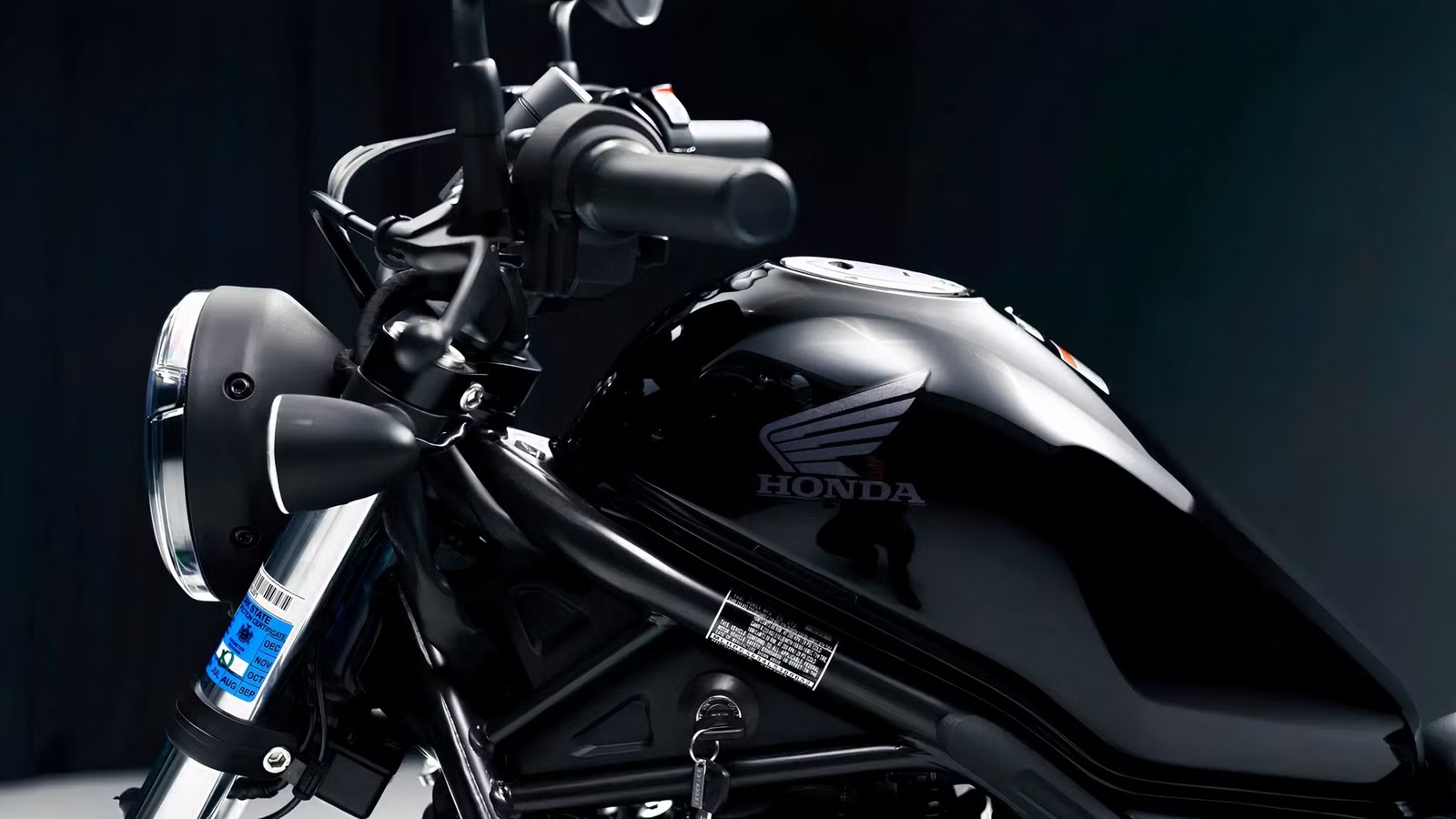
We believe entry-level cruisers should make motorcycling feel easier, not make a new rider wrestle with a machine at every stop. That makes one comparison hard to ignore – one bike asks for thousands less, carries 156 fewer pounds, uses a newer-feeling drivetrain, and still delivers the low-seat confidence cruiser buyers expect. Its rival counters with more displacement, a famous V-twin pulse, and a badge with real cultural weight.
Entry-Level Cruisers Should Build Confidence, Not Test It

Motorcycle specs tend to pull attention toward horsepower, displacement, and torque – and that’s easy to understand. Those figures are important, but a first-time cruiser buyer often has a more basic problem to solve: the motorcycle has to feel manageable. A rider needs to roll it out of a garage, back it into a parking space, balance it through a slow U-turn, and stop on uneven pavement without wondering whether leg day suddenly arrived early. A low seat helps, but mass matters just as much.
That difference becomes especially important for new riders, shorter riders, and people returning to motorcycles after years away. Weight that feels planted and reassuring at 55 mph can become a nuisance at 2 mph. Backing uphill out of a parking spot makes it noticeable, pushing the bike across a garage makes it noticeable, and catching a slightly crooked stop makes it very noticeable. Picking up a tipped motorcycle makes it impossible to ignore.
In this comparison, the heavier machine carries an extra 156 pounds. That’s roughly an adult passenger’s worth of motorcycle attached permanently to the bike.

The gap looks even larger in percentage terms. One machine weighs 408 pounds ready to ride, while the other comes in at 564 pounds in running order. That makes the heavier cruiser roughly 38 percent heavier. A skilled rider can handle either one, of course, because thousands have learned on much heavier motorcycles. But a good entry-level machine should remove unnecessary friction from the learning process.
Paying Thousands More Doesn’t Necessarily Buy A More Modern Motorcycle

The mechanical contrast makes the price gap even harder to overlook. One cruiser uses a 471cc liquid-cooled parallel-twin with a 10.7:1 compression ratio and six-speed transmission. The other uses an 883cc air-cooled Evolution V-twin with 9:1 compression and a five-speed gearbox. The smaller engine gets double overhead cams and four valves per cylinder, while the bigger motor sticks to the traditional air-cooled, pushrod formula that helped define its family. There is another advantage hiding under the rider’s left hand. This generation of the smaller cruiser gained an assist/slipper clutch as part of its 2020 update.
Honda designed the system to reduce clutch effort while also controlling back-torque during harder downshifts. A lighter lever matters when a rider spends half an hour crawling through town. The slipper function can also make a clumsy downshift less dramatic. Experienced riders may barely think about either benefit, but a beginner who is still learning clutch feel, throttle control, and gear choice has more reason to care.
None of this makes the older mechanical layout automatically bad. The big air-cooled V-twin follows an old recipe because buyers actively wanted that recipe. Harley introduced the Sportster Evolution engine in 1986, added a five-speed transmission and belt drive in 1991, and moved Sportsters to rubber engine mounts in 2004. Its pulse, sound, exposed mechanical shapes, and low-rpm character form part of the product. Liquid cooling and another transmission ratio may look better on a technical checklist, but engineering sophistication cannot measure personality. Some riders want to hear and feel an engine doing its work. The question is how much extra they should pay for that experience.
The Honda Rebel 500 Is The Cruiser That Makes The Harley Iron 883 Look Expensive

The cheaper and lighter motorcycle is the 2022 Honda Rebel 500, and putting its numbers beside the 2022 Harley-Davidson Iron 883 explains the whole argument. Honda listed the Rebel at 408 pounds curb weight, with a 471cc liquid-cooled parallel-twin, six-speed transmission, 27.2-inch seat height, and a factory fuel-economy estimate of 67 mpg. Harley listed the Iron at 564 pounds in running order, powered by its 883cc air-cooled Evolution V-twin, and gave it a 51-mpg estimate. Its drivetrain uses five ratios and a belt final drive. The name says Iron, and the scale appears to have taken that personally.
Price turns that weight difference into a much tougher sell. Honda’s base Rebel 500 carried a $6,399 MSRP for 2022. Harley’s 2022 lineup placed the Iron 883 at $10,749, and that creates a $4,350 gap. Honda also offered a $6,699 ABS version, while that function was another $819 at Harley, even widening the gap.
On practical entry-cruiser metrics, the Harley premium is difficult to defend. The buyer pays thousands more yet gets 156 extra pounds, one fewer transmission ratio, lower estimated fuel economy, and a much older basic engine architecture. There is one dimensional victory worth noting, though: Harley quoted a very low 25.7-inch laden seat height, compared with Honda’s 27.2-inch figure. Those measurements are not perfectly apples-to-apples because Harley specifically measures its number laden, but the Iron undeniably sits low. It also produces the sort of lazy, low-rpm shove that riders expect from a traditional American V-twin. Harley rated it at 54 pound-feet of torque at 3,750 rpm.

That gets to what the Harley-Davidson buyer actually receives. The Iron brings substantially more displacement, authentic Sportster proportions, an air-cooled 45-degree V-twin, belt drive, and decades of visual and mechanical continuity. Its huge customization culture lets owners turn essentially the same starting point into bobbers, café-inspired builds, stripped-down commuters, or machines that contain enough aftermarket black metal to frighten a magnet.
The Rebel cannot duplicate that history by simply winning the specs war, but that is also what exposes the price difference. The Rebel shows how much of the Iron’s premium functions as an emotional tax—money attached to experience and heritage rather than lower weight or newer drivetrain technology.
The Rebel’s Real Advantage Shows Up After The Spec Sheet

The Rebel’s strengths also compound once the motorcycle leaves the showroom. A 408-pound curb weight helps in traffic, parking lots, garages, and tight urban streets. A six-speed gearbox gives the rider another ratio to use as speed changes. Liquid cooling keeps engine temperature under tighter control than a traditional air-cooled design, especially when airflow drops.
Then there is fuel use. Honda estimated 67 mpg for the 2022 Rebel 500, while Harley quoted 51 mpg for the Iron 883. Those are manufacturer estimates rather than guaranteed real-world results, but the 16-mpg spread points toward another everyday advantage for a rider who plans to commute rather than merely polish the tank on Sunday.

There is an interesting story inside that Honda engine, too. Honda says the Rebel’s powerplant came from the sporty CBR500R family, then received different fuel-injection mapping along with valve and ignition timing intended to shift its character toward stronger low-end delivery. That helps explain why the Rebel can feel approachable without feeling like a toy. Its engine architecture has lived in several types of motorcycle, so the cruiser benefits from hardware designed to work well beyond slow-speed posing. It is a practical little twin wearing cruiser clothes.
The Iron 883 Sells A Feeling; The Rebel 500 Sells A Better Entry Point

The Iron 883 was never merely a transportation appliance with a big engine number stamped on the side. Its low stance, narrow peanut-style tank, blacked-out finish, Evolution V-twin, vibration, exhaust note, and Sportster silhouette were the reasons many buyers entered a Harley dealership in the first place. The model sat at the end of a remarkably long mechanical family line, and that history has value because motorcycles are emotional purchases. If people bought them only by calculating operating cost per mile, dealerships would look like accounting offices and chrome polish would have gone out of business decades ago.
That is exactly why this comparison says so much. The Honda asks thousands less while weighing 156 pounds less, yet it combines that accessibility with a liquid-cooled twin, six-speed transmission, assist/slipper clutch, and a strong 67-mpg factory estimate. The Iron answers with 883cc of displacement, that unmistakable V-twin rhythm, its exceptionally low loaded saddle figure, belt drive, Sportster styling, and Harley-Davidson heritage.
Those are genuine advantages for the rider who wants them. They simply solve a different problem, because a beginner needs predictable controls, manageable mass, friendly power, and a motorcycle that encourages more practice. A Harley fan, in turn, may gladly accept extra weight and cost because the machine feels like the motorcycle imagined long before the license arrived.

That leaves the Rebel 500 with a simple victory in purpose rather than prestige. It does not imitate the Iron 883’s personality, and it does not need to. It gives a new or returning rider a lighter machine, a modern and forgiving drivetrain, excellent economy, and several thousand dollars left in the budget for gear, training, fuel, or the inevitable first accessory purchase. The Iron’s appeal survives the comparison because emotion cannot be reduced to dollars per pound. Its value depends on how badly the buyer wants the Harley part of the experience.
If the badge and V-twin heartbeat are worth four grand or more to you, the Iron 883 makes perfect sense. If they aren’t, the Rebel 500 makes that premium – and those extra 156 pounds – very difficult to explain.
Source: Honda, Harley-Davidson

Related posts


Latest Post


No Comments