
Harley Just Built A Postwar-Style Bobber With Cornering ABS And A Hidden Monoshock
In the years immediately following World War II, a lot of American motorcycle customization happened mostly with whatever was already sitting in the garage. Military motorcycles returned to civilian life, motorcycle racing picked up again, and riders continued stripping unnecessary equipment from Harley-Davidsons and Indians to reduce weight and change the way the bikes looked. Harley-Davidson itself notes that inexpensive refurbished military motorcycles entered civilian use after the war, while the stripped-down style eventually became closely associated with the postwar bobber.

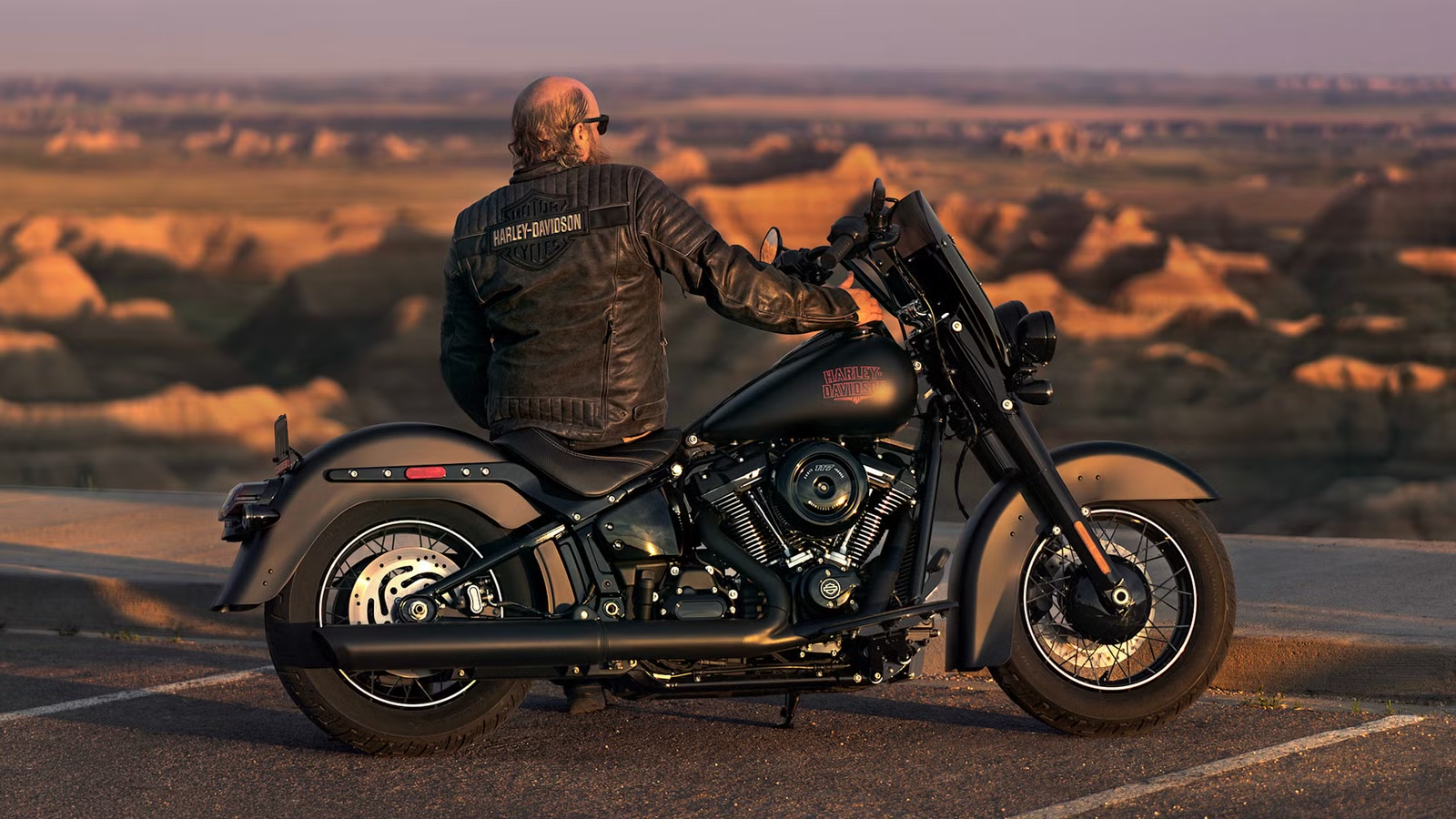
That history has been packaged and sold plenty of times since then, including by Harley-Davidson. What makes its latest interpretation more interesting is what the company has hidden underneath the old-school silhouette. The basic idea is still a big V-twin, solo seat, minimal bodywork, and very little visual clutter. Mechanically, however, this motorcycle has far more in common with a current Softail than anything somebody was cutting apart in a garage in 1946.
Postwar Bobbers Started With Riders Taking Parts Off
The bobber did not begin as a factory model or even a clearly defined category of motorcycle. Riders had already been shortening fenders and removing equipment from racing motorcycles before World War II, and the practice continued as motorcycle activity expanded again after 1945. Weight mattered, but so did simplicity. A motorcycle with less bodywork also happened to look very different from the heavily valanced machines manufacturers were selling at the time.

Postwar military surplus helped put inexpensive motorcycles back into circulation as well. Harley’s WLA had served extensively during World War II, and the company notes that some former military machines were later refurbished and sold cheaply to civilian riders. The familiar postwar custom developed around that broader culture of modifying what was available rather than ordering a finished custom from a manufacturer. That distinction matters because Harley is now trying to sell motorcycles that deliberately leave room for owners to make the next move.
Harley Is Trying To Recapture The Blank-Canvas Idea

That approach fits unusually well with Harley-Davidson’s current corporate strategy. CEO Artie Starrs introduced the company’s “Back to the Bricks” plan in May 2026, identifying new and used motorcycles, Parts & Accessories, and Apparel & Licensing as areas where Harley believes it already has the credibility to regain market share. The plan also calls for a more rider-focused product portfolio with greater emphasis on accessibility and customization. Harley is targeting mid-single-digit growth for its Parts & Accessories and Apparel & Licensing businesses over the medium term.
A relatively simple cruiser therefore has value beyond its original configuration. Harley has spent decades selling seats, exhaust systems, bars, luggage, engine upgrades, and cosmetic parts to riders who rarely leave their motorcycles completely stock. The company doesn’t explicitly say its newest bobber was engineered to increase accessory sales, so that connection should not be overstated. But a stripped motorcycle that invites modification fits comfortably inside a strategy that specifically identifies customization and Parts & Accessories as areas for future growth.
The 2026 Harley-Davidson Deadwood Brings The Bobber Back To The Factory

The motorcycle Harley chose for that role is the new 2026 Deadwood, a factory bobber offered in the United States and Canada. It arrives almost completely blacked out, with Denim Black paint, a solo tuck-and-roll seat, clean fenders, black tubeless laced wheels, and only limited brightwork around the engine. A chopped smoked windshield sits above the headlight, while the rear suspension has been shortened to pull the bike lower over its rear wheel. Harley lists the Deadwood at $17,999 MSRP in the United States.
It isn’t quite as bare as its styling initially suggests. The teardrop tank holds 5 gallons, considerably more useful for distance riding than the small tanks fitted to many custom bobbers, and the bike weighs 686 pounds. Seat height is 25.5 inches laden and 26.5 inches unladen, which explains the apparently conflicting measurements published for the motorcycle. The stance may borrow from old customs, but the dimensions belong to a modern big-twin cruiser.
A Hidden Monoshock Preserves The Hardtail Silhouette

The rear suspension is where Harley pulls off much of the visual trick. Instead of external twin shocks like the Dyna used to have, the Softail chassis uses a hidden free-piston coil-over monoshock. Harley lists 43mm of shock stroke and cam-style preload adjustment. From the side, the arrangement leaves the rear of the frame clean enough to suggest a rigid-frame custom without requiring the rider to actually live with one.
The front end is equally modern underneath its old-school covers. Harley uses a 49mm Dual Bending Valve telescopic fork with aluminum triple clamps and dual-rate springs, while the fork legs disappear behind traditional “beer can” covers. The black tubeless laced wheels are another useful compromise, providing the appearance of conventional wire wheels without requiring inner tubes. Harley’s own U.S. specification sheet lists a 130/90B16 front and 150/80B16 rear tire, clearing up some of the conflicting tire information that appeared around the bike’s launch.
The Milwaukee-Eight 117 Classic Makes 120 LB-FT
Harley did not use the Deadwood’s retro positioning as an excuse to install a smaller engine. Its Milwaukee-Eight 117 Classic displaces 1,923cc, with a 4.075-inch bore, 4.5-inch stroke, and 10.3:1 compression ratio. Factory output is 98 horsepower at 4,600 rpm and 120 lb-ft of torque at just 2,500 rpm. Exhaust runs through a 2-into-1 system with the catalyst positioned in the header.
Those specifications also place the Deadwood close to Harley’s other current 117 Classic models rather than making it a low-output styling exercise. The 2026 Street Bob, for example, carries the same 98-hp and 120-lb-ft factory ratings, despite starting at $14,999. The Deadwood’s extra $3,000 is therefore not buying a stronger engine. Much of the distinction comes from its 5-gallon tank, lowered stance, laced wheels, windshield, styling, and the specific combination of equipment Harley chose for the model.
Cornering ABS And Traction Control Give Away Its Modern Chassis

The clearest break from the postwar theme comes when the ignition is switched on. The Deadwood has Road, Rain, and Sport riding modes along with Harley’s current Rider Safety Enhancements. Cornering ABS adjusts brake intervention based partly on lean angle, while cornering traction control does the same when rear-wheel slip develops under acceleration. Drag-torque slip control can intervene when excessive engine braking begins to disturb the rear wheel.
None of those systems announce themselves visually in the way a large TFT display would. Harley instead uses a 5-inch analog speedometer with a digital section for the tachometer, gear position, ride mode, traction control, ABS, tire pressure, range, and other information. Cruise control and tire-pressure monitoring are also included. The Deadwood looks intentionally simple from a few feet away, but it’s mechanics are far from primitive.
The $17,999 Deadwood Fits Harley’s New Strategy

The Deadwood arrives at an important point for Harley-Davidson. The company’s Back to the Bricks plan calls for renewed growth in core areas where Harley believes its brand and dealer network still give it an advantage, with customization specifically included in its rider-focused product strategy. At $17,999, the Deadwood also sits below the $19,999 Heritage Classic while remaining above the $14,999 Street Bob and $15,999 Super Glide. That makes it a mid-range Softail rather than an attempt to compete with inexpensive Japanese cruisers on price alone.
Harley’s second-quarter results provide some early context, although they don’t prove the Deadwood itself will work. North American retail motorcycle sales increased 3% year over year, while global new-motorcycle dealer inventory fell 17%, and the company said it had made progress on Back to the Bricks. The Deadwood fits that plan in a particularly literal way: Harley supplies the 117ci engine, modern Softail chassis, suspension, and cornering electronics, then deliberately keeps the rest of the motorcycle visually restrained. The Deadwood takes that old garage-built formula and reverses it. Harley supplies the stripped-down starting point, then leaves the owner to decide what comes next.
Source: Harley-Davidson

Related posts

Latest Post


No Comments