
Harley-Davidson Filed a Trademark for ‘RMCR’ — And It Points to a Production Café Racer
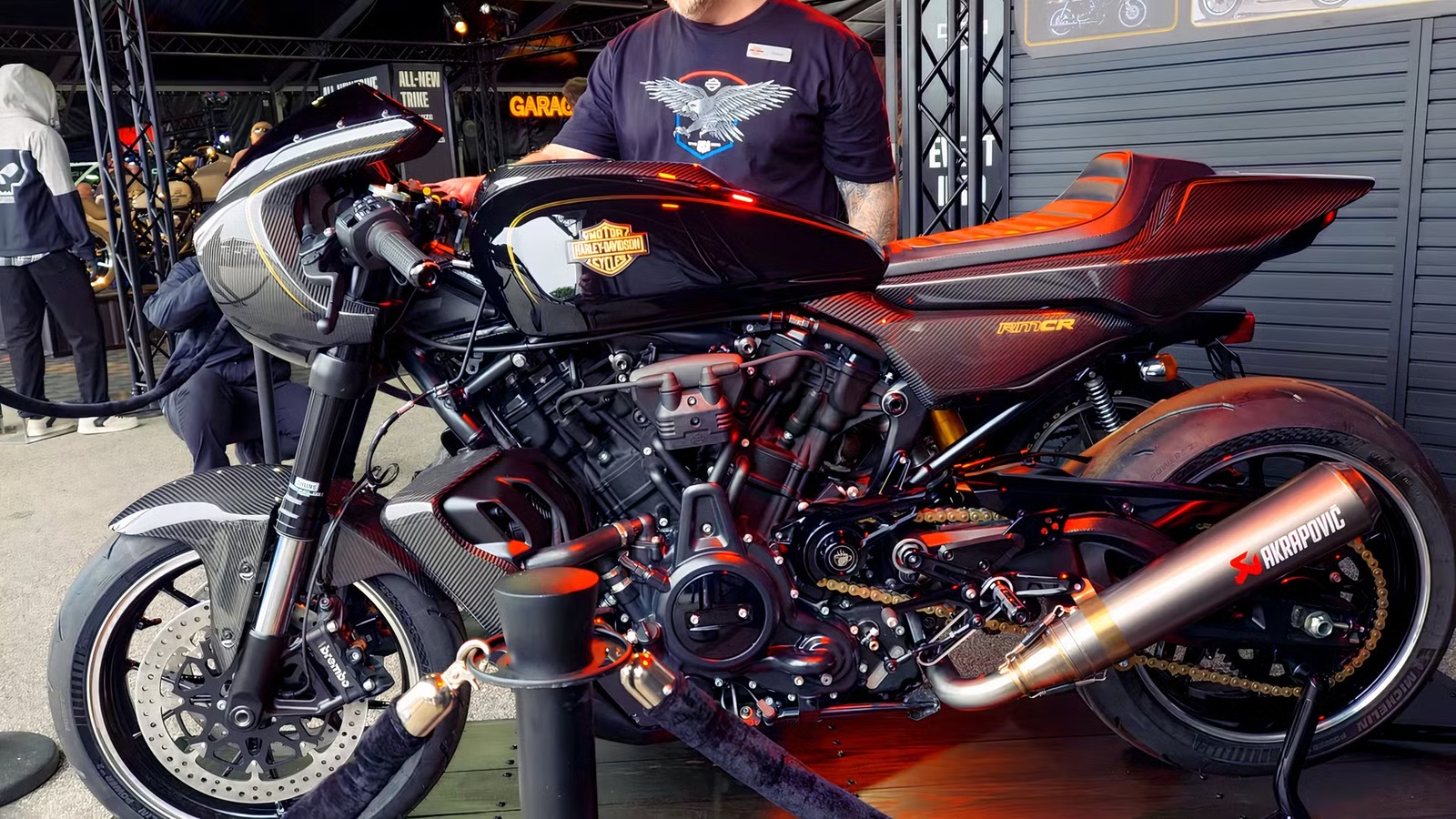
Harley-Davidson filed trademark applications for both ‘RMCR’ and ‘RMXR’ with the U.S. Patent and Trademark Office on July 29, 2026 — and the paperwork is the clearest signal yet that the viral Revolution Max Café Racer concept is heading toward a showroom. Both applications, serial numbers 50020187 and 50020053 respectively, cover International Class 012 (motorcycles and structural parts) and were submitted on an intent-to-use basis by the same in-house attorney out of Harley’s Juneau Avenue headquarters in Milwaukee.

The RMCR concept had already generated outsized buzz after appearing at Milwaukee’s Mama Tried Motorcycle Show earlier this year, then at Daytona and the MotoGP round at Circuit of the Americas. CEO Artie Starrs acknowledged the response during the company’s first-quarter presentation, calling the feedback ‘extraordinary’ and hinting the Motor Company might bring it to market. The trademark filing, discovered this week, moves that possibility considerably closer to fact.
What the Trademark Filing Actually Tells Us
Both applications were filed as Section 1(b) intent-to-use claims, meaning Harley has not yet sold a motorcycle under either name — the company is asserting a good-faith intention to use the marks in commerce. That’s a meaningful legal step, but not a production guarantee. Once the USPTO completes examination and publishes the marks without opposition, Harley receives a Notice of Allowance and has six months to file a Statement of Use proving the bikes are actually in commerce, with extensions available up to three years total.

The filing structure itself is worth noting. Both applications landed on the same day, from the same attorney, with sequential internal docket numbers. That reads like a coordinated family of names rather than a single speculative filing — suggesting Harley is planning a platform expansion, not just protecting one concept.
The RMCR Concept: What’s Already Known

The RMCR is built around the 1250cc Revolution Max V-twin — the same liquid-cooled engine that powers the Pan America 1250, where it produces 150 horsepower and 94 lb-ft of torque. That’s a substantial step up from the XLCR, Harley’s last production café racer from the late 1970s, which made 57 hp and 67.9 lb-ft.
The concept itself is visually striking: pinstriped carbon fiber bodywork, Brembo brakes, a custom 2-into-2 Akrapovič exhaust, and small details like a coffee cup icon on the rear hub cover that signal genuine craft rather than a styling exercise. The RMCR would be Harley’s first production café racer in nearly 50 years, and the reception at Mama Tried — and the social media momentum that followed — made clear the market has been waiting for exactly this.
The RMXR: A Flat-Tracker With Historical Roots
The RMXR is the less-documented of the two filings, but the naming logic is hard to miss. Harley has used the XR designation for flat-track-inspired models going back to the XR750 — the most successful motorcycle in AMA flat-track history — and forward through the XR1200 and XR1200X, which ran from 2006 to 2013 on the air-cooled Sportster platform. The ‘RM’ prefix points squarely at the Revolution Max engine as the new model’s foundation.
An early flat-track prototype was shown alongside the Pan America when Harley first announced the Revolution Max platform, featuring a high-routed exhaust reminiscent of the Sportster S. Whether the production RMXR uses the 1250cc or the smaller 975cc Revolution Max — the engine found in the Nightster — will determine where it sits in Harley’s product roadmap and price range.
Market Timing and the FTR Void

The financial logic behind a two-model RM platform expansion is straightforward. Developing the Revolution Max engine was expensive; spreading that R&D cost across the Pan America, a café racer, and a flat tracker makes each model easier to justify. It’s the same calculus Indian attempted with the FTR 1200 — and the gap Indian left when it discontinued that model is real, even if the FTR never fully captured the segment it was chasing.
Harley’s Back to the Bricks strategy, laid out by Starrs earlier this year, centers on sharpening the core motorcycle lineup, strengthening dealer relationships, and improving the ownership experience. Two performance-oriented Revolution Max models fit that framework directly. Based on Harley’s published product roadmap slide from the Back to the Bricks presentation, the RMCR could arrive as a 2027 model, with the RMXR potentially following as a 2028 model — though neither timeline is confirmed. EICMA later this year would be a natural stage for a formal reveal.
Intent-to-use filings can lapse, and Harley has canceled Revolution Max models before — the Bronx streetfighter never made it past the prototype stage. But the combination of the RMCR’s viral reception, Starrs’ public comments, the Revolution Max engine’s return to U.S. production, and now a simultaneous dual trademark filing makes this feel different. Keep watching the fall show calendar.

Related posts


Latest Post


No Comments