
Harley-Davidson Built A Dyna-Killing Motorcycle That Still Has A Cult Following
Harley-Davidson has built plenty of motorcycles around its traditional V-twin formula, but few have attempted to combine American cruiser styling with genuine sportbike-inspired handling. The bikemaker’s Dyna family earned a loyal following for its performance-oriented character, muscular engines, and engaging chassis. However, Harley’s decision to retire the Dyna nameplate in 2017 didn’t mean the end of that philosophy. A particularly unusual Softail arrived shortly afterward, bringing a bigger engine, a lightweight chassis, and a surprising ability to tackle corners. It had a short production run, but its distinctive combination of performance and styling has helped it develop a following among Harley enthusiasts.
Harley-Davidson Discontinued The Dyna But Retained Its Performance Cruiser Philosophy

The Harley-Davidson Dyna family occupied an important place in the bikemaker’s history. Models such as the Super Glide Sport, Low Rider, and Street Bob offered a different interpretation of the traditional American cruiser. Their exposed twin rear shock absorbers, relatively straightforward chassis, and powerful V-twin engines appealed to riders who wanted something more engaging than a conventional heavyweight touring motorcycle.
However, Harley-Davidson officially discontinued the Dyna family in 2017, consolidating its cruiser platforms around a redesigned Softail architecture for the 2018 model year. The biggest engineering difference was the rear suspension. Dynas used conventional twin shock absorbers, while the new Softail platform employed a hidden monoshock beneath the seat.
The redesigned platform was lighter and more rigid, with Harley claiming improvements in handling and ride quality. Several familiar Dyna names survived the transition, including the Low Rider and Street Bob.

The change also created an opportunity for Harley-Davidson to explore more performance-oriented cruisers. Rather than simply reproducing the old Dyna formula, Harley developed motorcycles that combined the Softail’s modern engineering with the aggressive character that had made the Dyna family popular. One of its most unusual interpretations would arrive in 2018.
The Harley-Davidson FXDR 114 Combined A Milwaukee-Eight Engine With Drag Bike Styling

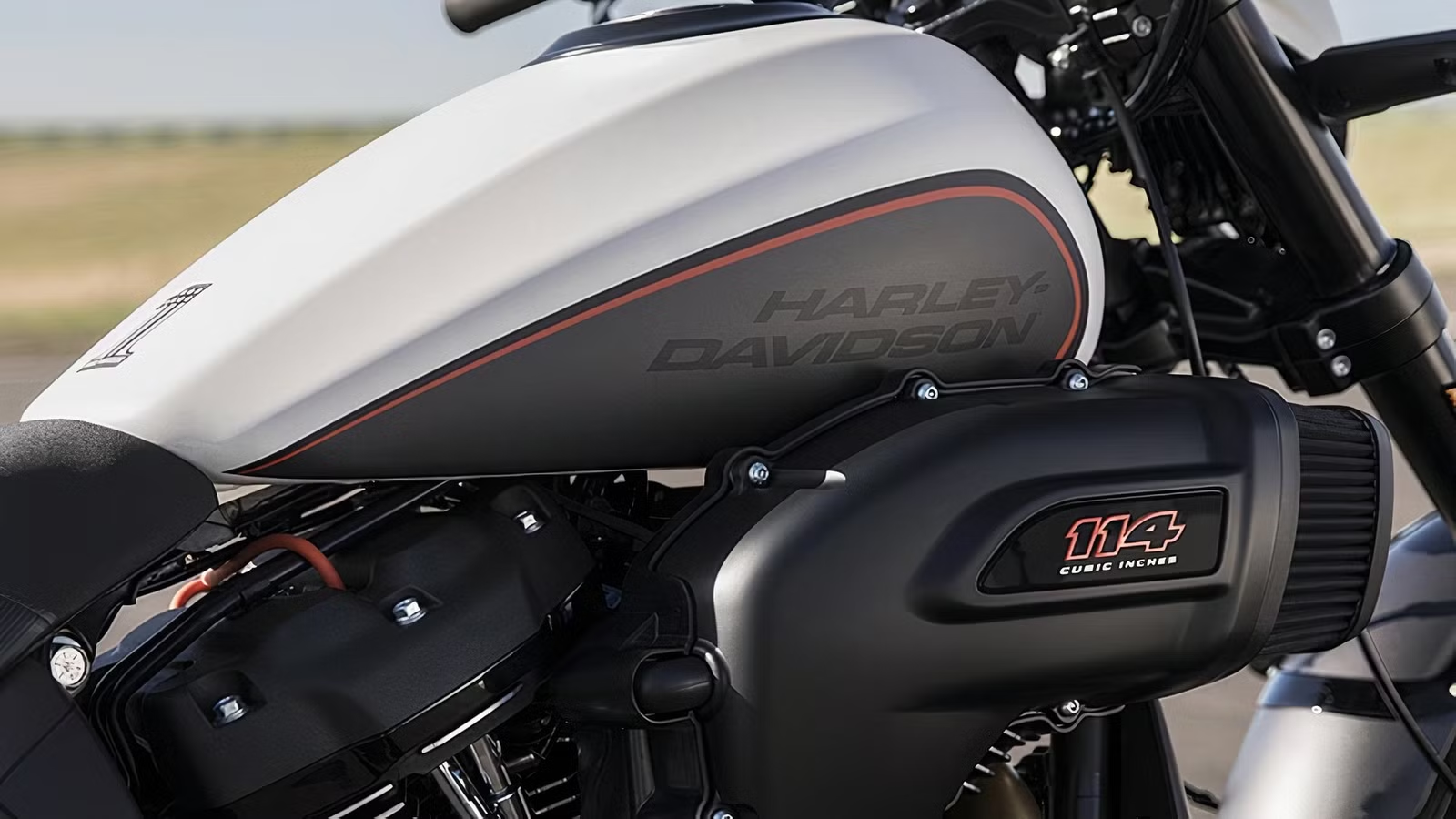
Introduced for the 2019 model year, the Harley-Davidson FXDR 114 was a radical interpretation of the American power cruiser. Its design drew inspiration from drag-racing motorcycles, with an elongated fuel tank, forward-facing air intake, stubby rear section, and an enormous 240-section rear tire. Unlike traditional Harley cruisers, the FXDR looked purpose-built for aggressive riding.
Power came from the Milwaukee-Eight 114, an air- and oil-cooled 1,868cc, 45-degree V-twin producing 119 lb-ft of torque at 3,500 rpm. The engine featured four valves per cylinder and was paired with a six-speed transmission and a belt final drive. The FXDR also received a distinctive 2-into-1 exhaust setup and an exposed forward-facing air-intake inspired by Harley’s Screamin’ Eagle drag racing motorcycle.
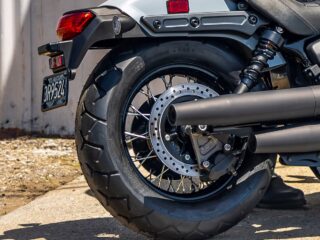
Its performance-oriented equipment extended to the chassis. Harley used an aluminum swingarm, lightweight aluminum subframe components, and composite fenders to reduce weight. The result was a motorcycle that looked considerably more aggressive than Harley’s conventional Softails while retaining the unmistakable character of a big Harley V-twin.
The Harley-Davidson FXDR 114 Had A Surprisingly Capable Chassis And Impressive Handling

The FXDR 114’s most interesting engineering achievement was arguably its handling. Despite weighing 668 pounds, the motorcycle was considerably more capable through corners than its stretched drag-bike proportions suggested. Harley equipped it with a 43mm fork offering 5.1 inches of travel, while the rear got a concealed monoshock with preload adjustability. The aluminum swingarm helped reduce unsprung weight, and the redesigned Softail frame provided a rigid foundation for the suspension.
The motorcycle also had a 68.3-inch wheelbase, a 34-degree rake and a 4.7-inch trail. Its maximum lean angles were 32.6 degrees on the right and 32.8 degrees on the left. These figures were particularly impressive for a motorcycle with such a substantial rear tire. The braking setup included dual 300mm front discs with four-piston calipers, and a 292mm rear disc with standard ABS.
Cycle World noted that the FXDR initially resisted turn-in slightly because of its massive 240-section rear tire, but once leaned over, it followed a surprisingly natural cornering arc. The publication also praised its lean angle, noting that riders could approach corners much more aggressively. It wasn’t a sportbike replacement, but the FXDR could deliver considerably more cornering ability than its styling suggested.
Why Harley Discontinued The FXDR 114 And How Much They Cost Today

Despite its distinct engineering, the FXDR 114 had a relatively short production life. Harley introduced it for 2019, updated its available colors and reduced its base price for 2020, but the motorcycle disappeared from its lineup for 2021. Harley never provided a definitive explanation, though its unconventional styling, premium positioning, and relatively specialized appeal most likely limited its potential audience, and consequently demand.
The 2019 FXDR 114 originally carried a starting MSRP of $21,349, while the latter 2020 model started at a considerably lower 18,999. Today, the motorcycle has developed an interesting position in the used motorcycle market because of its limited production run and unusual combination of performance-oriented engineering and drag-bike styling. Recent used listings show 2019 examples priced between $11,000 and $15,000, depending on mileage and condition.
The Harley-Davidson FXDR 114 never became a mainstream success, but that is part of its appeal. It represents an attempt to build a muscular American cruiser that could do more than just accelerate in a straight line. Its short production run, distinctive design, and capable chassis have made it one of the more interesting used modern Softails for enthusiasts seeking something different from the traditional Harley formula.

Related posts
Latest Post


No Comments