
10 Japanese Motorcycles With More Horsepower Than Harley’s CVO Street Glide
Harley-Davidson’s CVO Street Glide isn’t short on performance. Its Milwaukee-Eight VVT 121 motor puts out 115 horses and a massive 139 lb-ft of torque. That’s a ridiculous number for a luxury bagger. But the Japanese take things considerably further. From supercharged Kawasakis to comfortable sports tourers, these ten motorcycles all produce more peak power than Harley’s flagship Street Glide.
10
Kawasaki Ninja H2 | 240 HP

Nothing on this list beats the Ninja H2 for outright performance. Kawasaki’s supercharged flagship makes a claimed 240 horsepower from its 998cc inline-four engine, giving it an enormous 125-horsepower advantage over the CVO Street Glide.
The secret sauce here is obviously the supercharger. Rather than simply increasing displacement, Kawasaki uses forced induction to push substantially more air into the engine and produce performance that would normally belong to a race machine. The H2 also gets a bunch of riding aids and premium Brembo braking hardware.
Of course, comparing a hypersport with a bagger isn’t exactly apples to apples. The Harley is better suited to relaxed riding, where luggage, long-distance comfort, audio, and substantial low-end torque are major priorities. But if we’re talking pure horsepower, the Kawasaki isn’t even playing the same game.

9
Honda CBR1000RR-R Fireblade SP | Around 214 HP

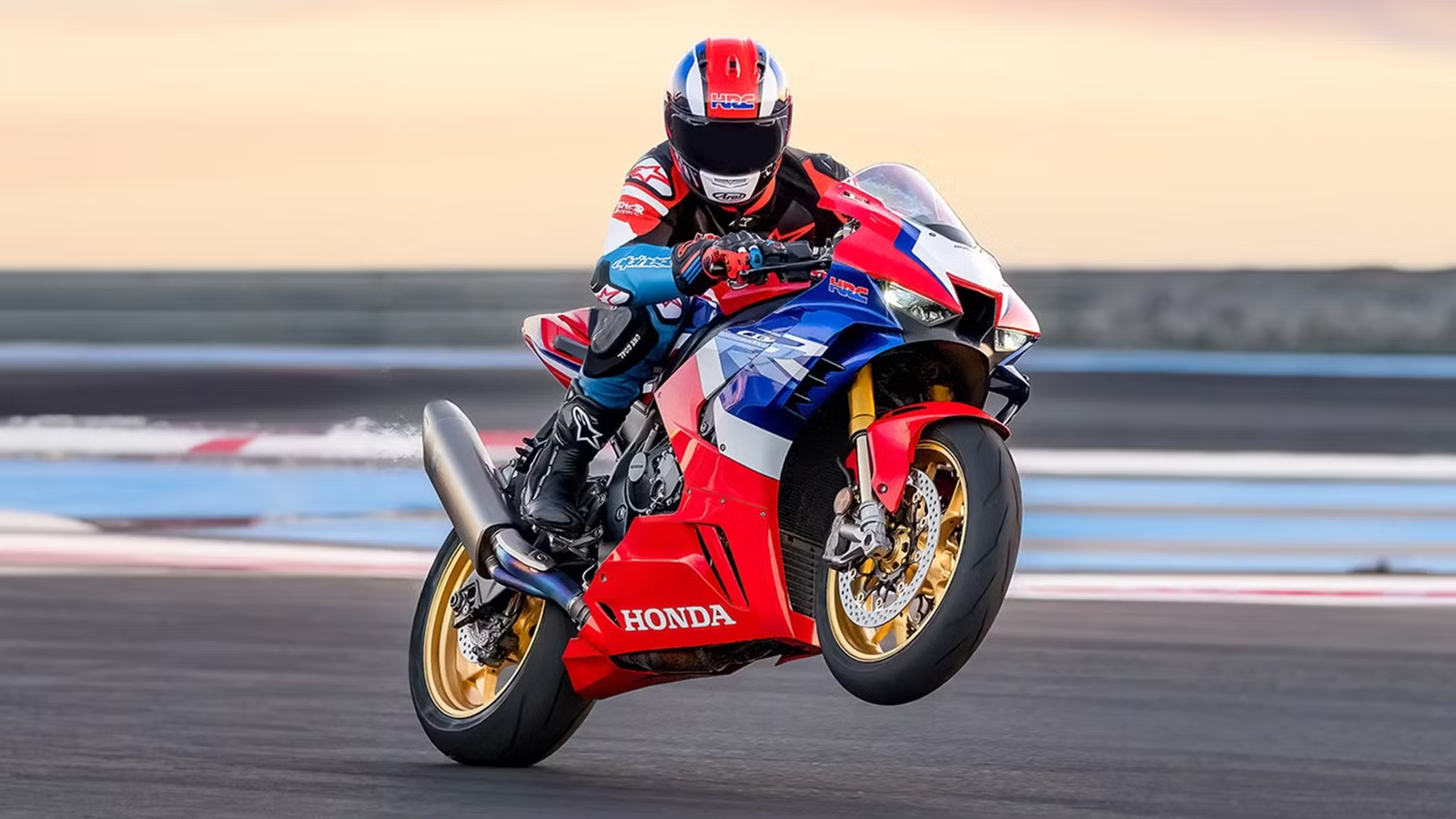
Honda’s most serious superbike makes the Harley’s horsepower number look relatively modest. The CBR1000RR-R Fireblade SP’s 1,000 cc inline-four produces approximately 214–215 horsepower, depending on how the output is converted and which market specification you’re looking at. That’s nearly 100 horsepower more than the Harley-Davidson in consideration.
The Fireblade is built with an entirely different purpose in mind. It has an extremely over square engine, high compression, aerodynamic winglets, electronic suspension, and premium brakes to create something far closer to a racing motorcycle than a conventional road bike.
Peak power also arrives at a screaming 14,000 rpm. The CVO Street Glide delivers its 115 horsepower much lower in the rev range and produces considerably more torque, so the riding experience couldn’t be more different.
8
Kawasaki Ninja H2 SX SE | 207 HP

The H2 SX SE is probably the most interesting comparison here because, unlike the regular H2, it actually has a serious touring intention. It has the same 998cc, supercharged motor as the H2, but in a slightly relaxed tune. Still, that’s 92 horsepower more than the CVO Street Glide. And the most interesting thing is it comes with factory-fitted saddlebags.
The Harley remains the more traditional tourer, particularly for riders who value relaxed V-twin character and comfort. But the H2 SX SE shows how differently the idea of covering huge distances quickly is interpreted in Japan.
7
Yamaha YZF-R1 | Around 198 HP

The Yamaha YZF-R1 has been one of the defining Japanese superbikes for decades. Its 998cc CP4 cross plane inline-four produces approximately 198 horsepower in its road-legal avatar, giving it an 83 hp advantage over the Harley.
But the R1’s character is about much more than peak output. Its cross plane crankshaft gives the engine a distinctive character and strong connection between throttle input and response. Yamaha has also equipped the bike with a sophisticated electronics package developed around a six-axis IMU.
But, there is one catch in 2026: Yamaha’s newest European R1 Race is track-only, although road-legal versions remain relevant in other markets and on the used market.
6
Kawasaki Ninja ZX-10R | 190 HP

The Ninja ZX-10R slots below the supercharged H2 range in Kawasaki’s lineup, but 190 horsepower is hardly what anyone would call restrained. Its 998cc inline-four produces 190 horsepower in current US specifications, which still gives it 75 horsepower more than Harley’s CVO Street Glide. It is built for the racetrack and gets all the modern bells and whistles.
Where the Harley uses its large-displacement V-twin for relaxed torque, the ZX-10R rewards when you rev it out. Peak power arrives at 11,500 rpm, and the chassis is designed to exploit that output through corners rather than simply provide effortless highway acceleration.
5
Suzuki Hayabusa | Around 187 HP

The Hayabusa is where the comparison becomes a little more relevant to real-world road riding. Suzuki’s 1,340cc inline-four produces roughly 187 horsepower, around 72 more than the CVO Street Glide. But unlike a committed superbike, the Hayabusa has always balanced speed with everyday usability.
The riding position is relatively comfortable, the engine has plenty of low and mid-range torque, and its aerodynamic body provides useful wind protection over long journeys. The current generation also brings cruise control, traction control, selectable power modes, launch control, cornering ABS, and a bidirectional quick shifter. For riders who want outright power without committing to full superbike ergonomics, the Hayabusa remains one of Japan’s most distinctive answers.
4
Yamaha MT-10 | Around 164 HP

The MT-10 takes the R1’s engine architecture and turns it into something considerably more useful – a naked streetfighter. It’s the same 998cc cross plane from the R1 but detuned to put out 164 horsepower, which is roughly 49 horsepower more than the CVO Street Glide.
Rather than chasing peak output like the R1, Yamaha tuned this bike for stronger low and mid-range performance. That makes the MT-10 particularly entertaining at road speeds.
Its upright riding position, wide handlebars, cruise control, modern electronics, and relatively comfortable ergonomics also make it far easier to live with than an actual superbike. It doesn’t offer the luggage capacity or relaxed long-distance character of the Harley, but it packs considerably more horsepower into a much lighter package.
3
Honda CB1000 Hornet SP | Around 155 HP

Honda’s CB1000 Hornet SP proves that you don’t need an exotic motorcycle to have fun. With its 1,000cc inline-four engine producing 155 horsepower, it easily exceeds the Harley’s power figure by 40 horsepower. The motor is borrowed from Honda’s previous-generation Fireblade, but it’s been tuned for street use. It also gets a bunch of riding aids.
What makes the Hornet interesting is its value. It offers serious litre-class performance in a straightforward naked bike rather than surrounding the engine with expensive bodywork or luxury touring equipment.
2
Suzuki GSX-S1000GX | ~150 HP

The GSX-S1000GX is another bike that has more than enough horsepower but is genuinely practical. Its 999cc inline-four produces around 150 horsepower, giving it approximately 35 more than the CVO Street Glide. The GX wraps that powerplant in a comfortable crossover chassis with electronically controlled suspension, upright ergonomics, cruise control, and optional hard luggage. That makes it far more relevant to the Harley comparison than a dedicated superbike.
Both motorcycles can cover long distances and carry luggage, but their philosophies are completely different. The CVO relies on a huge V-twin, low-end torque, and traditional American touring character. The Suzuki instead uses a high-revving four-cylinder engine, lighter chassis, and sportier dynamics. Neither approach is inherently better, but the power difference is very difficult to ignore.
1
Kawasaki Ninja 1100SX | 134 HP

The Ninja 1100SX might sit at the bottom of this list, but it still comfortably beats Harley’s flagship bagger. Its 1,099 cc inline-four motor makes 134 horsepower and 83.2 lb-ft of torque. That’s only 19 horsepower more than the CVO Street Glide, making this the closest comparison of the ten.
The Kawasaki also has genuine touring ability. It comes with cruise control, an upright riding position, substantial wind protection, optional integrated hard cases, and enough passenger accommodation for longer journeys. Where it really shines over the Harley is weight and handling. The Ninja 1100SX is designed to feel relatively agile through corners while still remaining comfortable over longer distance.
For riders who want a touring motorcycle with considerably more emphasis on handling and outright performance, the Kawasaki is a compelling alternative without entering the extreme territory of the H2 SX SE.

Related posts



Latest Post


No Comments