
The New 4Runner TRD Pro Wrangler Loyalists Are Finally Watching
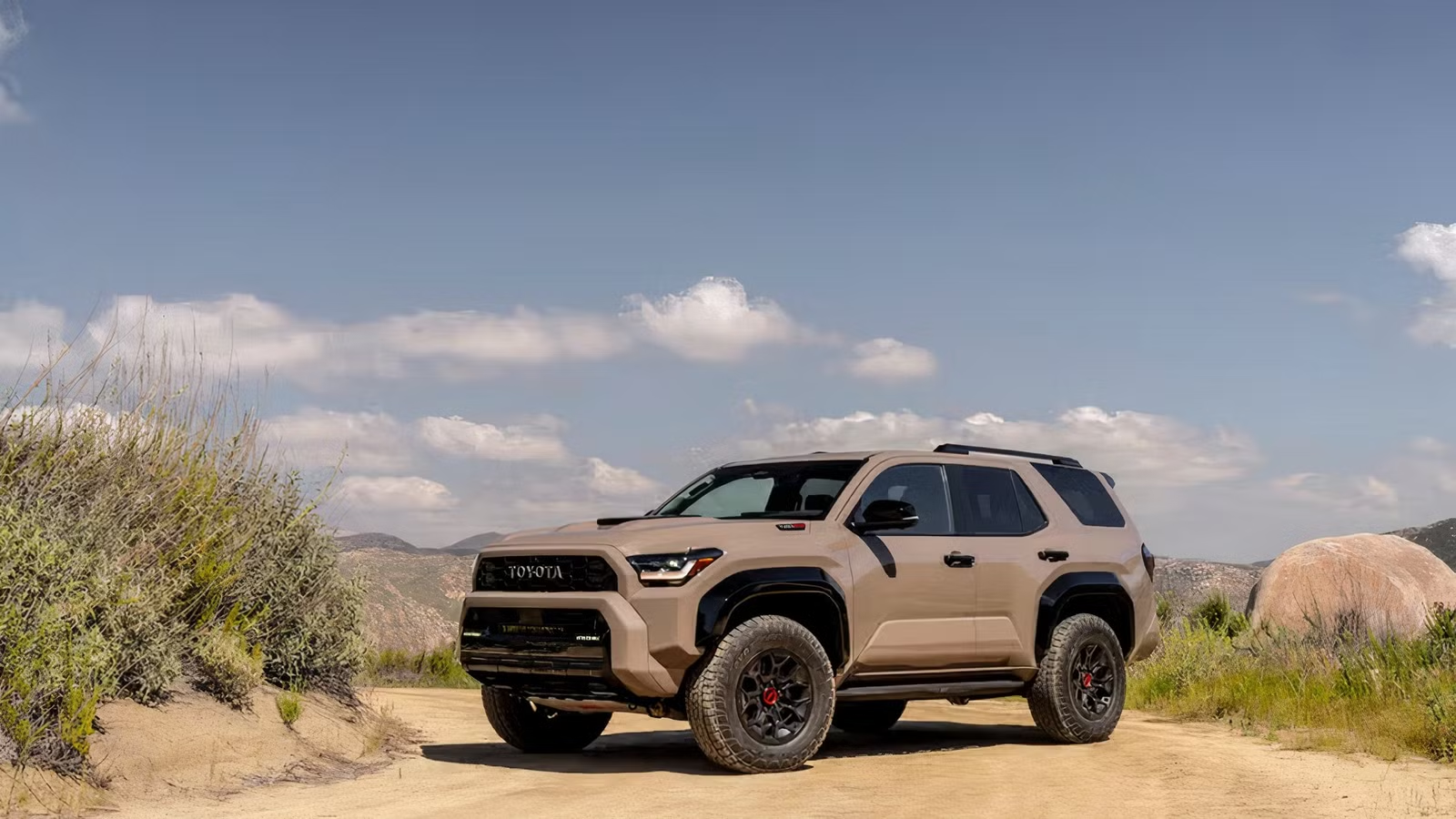
For two decades, the body-on-frame SUV conversation started and ended with the same two names. Wrangler owners mocked Toyota’s aging V6, Bronco owners pointed to their locking diffs and 35-inch tires, and the old fifth-generation 4Runner sat quietly in the corner, reliable but irrelevant to the argument. That silence just ended with the new sixth-generation 4Runner. A full redesign, a hybrid powertrain borrowed from the Tacoma and Land Cruiser, and a price tag that finally matches the ambition have put Toyota’s off-roader back in the conversation, and this time, the Jeep and Ford faithful are actually paying attention.
The Body-On-Frame SUV Segment Finally Has A Real Three-Way Fight

For years, cross-shopping in this segment meant picking a personality, not weighing a spec sheet. The Jeep Wrangler Rubicon was the trail-first purist’s pick, built around a removable top, solid axles, and a reputation forty years in the making. The Ford Bronco Sasquatch was Ford’s answer, matching the Jeep’s off-road hardware with a modern interior and a marketing campaign built entirely around beating Moab.
The old fifth-generation 4Runner, still running a 270-horsepower V6 and a five-speed automatic when it was discontinued, wasn’t part of that argument. It sold well on nostalgia and Toyota’s bulletproof reliability reputation, but nobody cross-shopped it against a Rubicon on capability.

That dynamic no longer holds. Toyota built the sixth-generation 4Runner on the same TNGA-F platform underpinning the Tacoma, Tundra, Sequoia, and Land Cruiser, and it shows in the spec sheet. The new truck brings a genuinely competitive hybrid powertrain, FOX-tuned suspension, a locking rear differential, and a redesigned interior that finally looks like it belongs in 2026 rather than 2009. For the first time since the Wrangler and Bronco started trading blows, there’s a third serious option on the lot, and it wears a Toyota badge.

That matters because this segment has always been more tribal than rational. Jeep people buy Jeeps, Ford people buy Fords, and cross-shopping happened mostly at the margins. A genuinely competitive 4Runner changes that calculus, especially for buyers who want trail capability without joining a brand cult first.

It also matters for timing. Both the Wrangler and Bronco are known quantities at this point, refined through years of running changes and owner feedback, while the redesigned 4Runner is the newest platform in the group. That novelty cuts two ways. It means Toyota’s engineers had a clean sheet to address the outgoing model’s biggest weaknesses, but it also means the updated 4Runner hasn’t accumulated the multi-year track record that made the Wrangler and Bronco trusted trail companions in the first place.
The 326-HP 4Runner TRD Pro Brings Hybrid Torque And 10.1 Inches Of Clearance

The numbers explain the sudden attention. According to Toyota’s own press materials, the TRD Pro’s i-FORCE MAX hybrid powertrain pairs a 2.4-liter turbocharged four-cylinder with an electric motor for a combined 326 horsepower and 465 pound-feet of torque, routed through an eight-speed automatic and a part-time four-wheel-drive system with a locking rear differential. That torque figure lands at just 1,700 rpm, which matters more off-road than the headline horsepower number does.
The TRD Pro trim adds FOX QS3 internal-bypass shocks with driver-adjustable damping, a front skid plate, a stabilizer-bar disconnect system for extra wheel travel, and all-terrain tires on 18-inch TRD wheels. Ground clearance sits at 10.1 inches, up from the outgoing model and ahead of the standard TRD Off-Road trim’s 9.1 inches, with a 33-degree approach angle and a 24-degree departure angle. That’s real hardware, not badge-engineering.

Inside, the TRD Pro gets SofTex-trimmed heated and ventilated front seats, a substantially larger touchscreen with wireless smartphone integration, and Toyota Safety Sense 3.0 as standard. Toyota lists a starting MSRP of $68,600 for the TRD Pro before options, a figure that would have sounded absurd on a 4Runner a decade ago and now puts it squarely in Land Cruiser territory. More on why that matters shortly.
Rubicon 4xe And Bronco Sasquatch Still Have Trail Tricks Toyota Must Answer

Specs on paper are one thing. Trail hardware is another, and here the Jeep and Ford still hold real advantages that a Wrangler or Bronco loyalist won’t give up easily. Take the Wrangler Rubicon 4xe as the direct comparison point. Its plug-in hybrid powertrain, a 2.0-liter turbo four paired with two electric motors, produces a combined 375 horsepower and 470 pound-feet of torque, along with roughly 22 miles of EV-only range.
More relevant off-road, the Rubicon 4xe offers front and rear locking differentials, a front sway-bar disconnect that works even in low range, and 10.8 inches of ground clearance with a 44-degree approach angle and 36-degree departure angle, numbers the 4Runner simply doesn’t match. Pricing starts around $61,395 for the base Rubicon 4xe, though a comparably equipped truck with the popular option packages typically lands closer to the 4Runner’s $68,600 sticker.

The Bronco Sasquatch package tells a similar story. Standard on the Badlands and available across the lineup, it adds 35-inch tires, front and rear electronic locking differentials, a 4.7 final-drive ratio, and Bilstein position-sensitive shocks, pushing ground clearance to 11.5 inches on the four-door and delivering a 43.2-degree approach angle with up to 33.5 inches of water-fording capability, a genuine best-in-class figure. A Badlands Sasquatch with the 2.7-liter EcoBoost V6, rated at 315 horsepower and 415 pound-feet, typically prices out in the mid-$60,000s once the Sasquatch package and V6 upgrade are added.
Toyota hasn’t matched either rival’s locking-differential count, and the 4Runner’s approach angle trails both by a wide margin. The honest answer is that Toyota built a genuinely capable trail truck, not a class-leading one. For buyers who measure their weekends in rock crawls and water crossings, the Wrangler and Bronco still have an edge Toyota hasn’t closed.
The Hybrid Powertrain Trades Old-School Character For Usable Torque And Better Efficiency

Where the Toyota 4Runner does pull ahead is in how the power actually gets used. The old 4.0-liter V6 was famously unstressed and famously unremarkable, good for 270 horsepower and not much urgency. The i-FORCE MAX setup replaces that with a turbocharged four-cylinder and a 48-horsepower electric motor mounted in the transmission bell housing, drawing from a 1.87-kWh nickel-metal-hydride battery. The result is 465 pound-feet available almost immediately, which shows up as noticeably stronger low-speed crawling torque and quicker responses pulling away from a stop, without the turbo lag that plagued earlier Toyota four-cylinder trucks.
Independent testing has clocked the hybrid TRD Pro at 6.8 seconds to 60 mph, quicker than the old V6 but behind the Rubicon 4xe’s electric-assisted launch. Real-world fuel economy lands around 21 mpg combined, a genuine improvement over a body-on-frame SUV segment that has historically treated fuel bills as an afterthought, though it doesn’t match the Rubicon 4xe’s plug-in range when the battery is charged and the commute is short.

What buyers lose is the old V6’s mechanical simplicity and, for some, its sound. The turbo-four under load is audibly a turbo-four, not the smooth six-cylinder hum longtime 4Runner owners knew. What they gain is a powertrain that actually feels appropriate for a nearly 5,500-pound SUV, rather than one working overtime to move it.
The Real Test Is Whether A $68,600 4Runner Makes More Sense Every Day

This is where the decision actually gets made, and it has less to do with trail specs than with the other six days a week the truck spends on pavement. The 4Runner’s redesigned cabin, larger touchscreen, and genuinely comfortable heated and ventilated seats address the one area where the outgoing model felt most dated, and the ride quality benefits from FOX shocks tuned as much for comfort as for off-roading.
At $68,600 to start, though, the TRD Pro isn’t competing only with Jeep and Ford. It’s brushing up against Toyota’s own Land Cruiser, a vehicle with full-time all-wheel drive and a more upscale interior for not dramatically more money once options are added. That positioning cuts both ways. It signals how seriously Toyota now takes this segment, but it also means the TRD Pro has to justify its price against in-house competition, not just outside rivals.

There’s also the question of what the hybrid system costs to own long term. Toyota backs the nickel-metal-hydride battery with a 10-year, 150,000-mile warranty, which should ease concerns about a component that didn’t exist on 4Runners a generation ago, and the brand’s resale strength has historically been one of the segment’s most persuasive arguments regardless of powertrain. A Wrangler or Bronco buyer weighing the switch isn’t just comparing torque curves; they’re weighing a known depreciation curve and dealer network against an unproven one.
For a Wrangler Rubicon 4xe owner who spends more weekends on fire roads than rock ledges, the 4Runner’s blend of usable torque, daily-driver refinement, and Toyota’s reliability reputation is a legitimate reason to cross-shop for the first time in years. For a Bronco Sasquatch owner who actually fords rivers and needs every degree of approach angle available, the Jeep and Ford still have the harder-edged capability to back up their reputations. The new 4Runner doesn’t end that argument. It just means, for the first time in a long while, there’s a genuine third option worth test-driving before anyone signs the paperwork.
Sources: Toyota U.S., MotorTrend & Edmunds, The EPA

Related posts



Latest Post


No Comments