
Ford’s Station Wagon That Had Muscle Car Power In The 1960s
The performance wagon didn’t arrive with the Audi RS2 or a Volvo with a Porsche-tuned engine — it was born decades earlier, in American driveways, beneath fake wood paneling. Long before European brands made the fast estate fashionable, a handful of Detroit automakers were already dropping big-block V8s into family haulers large enough to swallow a camping trip whole. The formula was gloriously straightforward: take the roomiest wagon in the lineup, bolt in the most potent engine available, and see who was brave enough to order one. As it turns out, a stubborn and discerning few did — and what they got was some of the most entertainingly absurd performance machinery of the muscle car era.
Muscle Wagons That Bucked The Trends

The muscle car Golden Era was in full swing by the second half of the ’60s, having been kicked off by the Pontiac GTO in 1964. Not only were manufacturers finding ways to fit a coupe with the kind of V8 previously reserved for heavy machinery, they were also hunting for new segments to conquer on the muscle car wave.
One niche that seemed underexplored was the station wagon. With the baby boomer generation enjoying a bit of disposable income — and starting families — large hatch versions of sedans were selling well, offering a way to head off for the weekend with ten suitcases and grandma packed in.

The result was cars like the Dodge Coronet wagon, which could be had with a 383 big-block V8 producing 330 horsepower and 425 lb-ft of torque, backed by a three-speed automatic. The Chevrolet Caprice-based Kingswood Estate of 1970 was available with a massive 454 V8 and a four-barrel carburetor. This wood-sided monster delivered 395 gross horsepower and 500 lb-ft of torque to that weekend camping trip with the family.

The second-gen Oldsmobile Vista Cruiser arrived for the 1968 model year with respectable engine offerings, including a 250-horsepower 330 and a 325-horsepower 400, but Olds recognized that some customers weren’t satisfied with respectable. For them, Oldsmobile offered from 1970 to 1972 a big-block 455-ci V8 as well.
The Ford Country Squire Started Out As A Sensible Idea

Ford wanted in on the muscle wagon game in the ’60s. If Pontiac had kicked off the muscle car business with the GTO, the Blue Oval could lay claim to helping get the hot rod wagon game going in the ’50s.
Pre-dating even the muscle car era, in 1957, Ford offered the F-Code Country Sedan Wagon with a supercharged 312 Y-Block V8. This jukebox on wheels was, perhaps unsurprisingly, not hugely popular, but it did offer 300 horsepower and 340 lb-ft of torque. The question for the ’60s became: what could Ford pull from the lineup to make a face-melting estate car for the new decade?
The Country Squire was the unsuspecting recipient of muscle car madness, and it seemed about as fitting as strapping a rocket pack onto a Labrador. The Ford Country Squire was, as the name suggested, a cozy living room on wheels — a body-on-frame chassis engineered for comfort, seating for nine, and an ability to chew up miles like the emperor of the slow lane.
The Engine Options Were Decidedly Un-Hot Rod

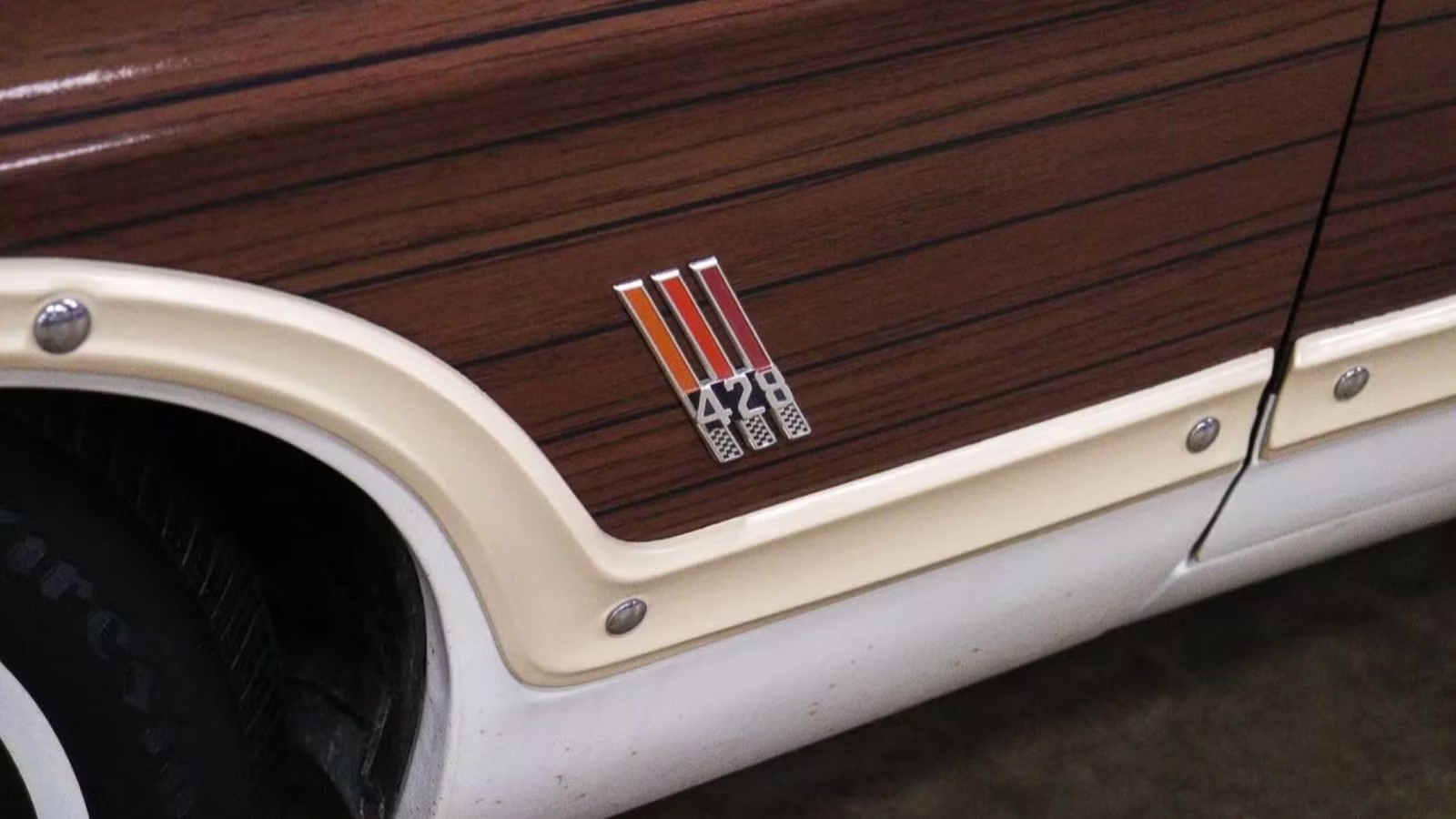
You wouldn’t find many people salivating over the Country Squire’s engine lineup. The standard mill in 1967 was a straight-six, while a 200-horsepower, 289 small-block V8 or a 315-horsepower, four-barrel 390 was available as an option. Perhaps the tequila was flowing at the business meeting one night, but it was decided that the Country Squire should receive a top-gun motor in the form of Ford’s 428 V8, which had been swiped from the Thunderbird. This 428 was good for 345 horsepower and 462 lb-ft of torque.
This motor was normally paired with a three-speed automatic, but at least one example was matched with a four-speed manual transmission instead. That car, now owned by Hagerty’s Barn Find Hunter Tom Cotter, came about because the original buyer — a muscle car enthusiast with a family — personally wrote to then-Ford executive Lee Iacocca requesting a Country Squire wagon with the four-speed manual, and Ford built it.
The 428 Country Squire Was A Drag Strip Monster For Trips To The Hardware Store

|
Engine |
Horsepower |
Torque |
|---|---|---|
|
7.0-Liter V-8 |
345 HP |
462 LB-FT |
What makes the 428 Country Squire so compelling is that it is very much a sleeper car of its era. Because this was a wagon, Ford saw no reason to dress the most potent version with the “go faster” visual cues that were standard on a proper muscle car. In fact, the options lists on many ’60s cars were a pretty wild pick-and-mix affair.
You could spec everything else in suburban grandpa trim and still tick the box for a Thunderbird Q-Code big-block motor. Buyers typically got the standard wood paneling, power drum brakes, 15-inch steel wheels with full covers, air-assisted rear suspension, and a luggage rack — paired with an engine that would propel them down the road at genuinely alarming speed.
The Country Squire Is A Muscle Car The Size Of An Office Block

|
Wagon |
Engine |
Horsepower |
Torque |
0-60 mph (est.) |
|---|---|---|---|---|
|
Ford Country Squire 428 |
7.0L V8 |
345 hp |
462 lb-ft |
~8 sec (est) |
|
Oldsmobile Vista Cruiser 400 |
6.6L V8 |
325 hp |
440 lb-ft |
~8.5 sec |
|
Dodge Coronet Wagon 383 |
6.3L V8 |
330 hp |
425 lb-ft |
~8.5 sec |
|
Chevrolet Kingswood Estate 454 |
7.4L V8 |
395 hp (gross) |
500 lb-ft |
~8 sec |
Top speed for the 428 Ford Country Squire was a faintly ridiculous 120 mph, and anyone watching this 4,400-pound behemoth on drum brakes — not counting the extended family inside — hurtling toward them had better step aside. With some estimates placing the Thunderbird’s 428 at 0–60 mph in around eight seconds, the Country Squire wouldn’t have been far behind — enough that the big Ford wagon wouldn’t completely embarrass itself at the drag strip. After all, these figures are very similar to the Chevrolet Kingswood Estate 454, despite having both a smaller engine and less horsepower. But in the end, perhaps unsurprisingly, not many buyers opted for the 428 Country Squire, and they are a rare find today.
The 428 Country Squire Is An Affordable Entry Into Rare Muscle Car Fame

|
Wagon |
Base MSRP (Late 1960s) |
Engine Upgrade Cost |
Approx. Price Today (Collector Market) |
|---|---|---|---|
|
Ford Country Squire |
~$3,300 |
Big-block options extra |
$25,000 – $50,000 |
|
Oldsmobile Vista Cruiser |
~$3,508 |
400 / 455 V8 options |
$20,000 – $60,000 |
|
Dodge Coronet Wagon |
~$3,025 |
383 V8 upgrade |
$15,000 – $40,000 |
|
Chevrolet Kingswood Estate |
~$3,400 |
454 V8 option |
$25,000 – $55,000 |
For 1968, the Country Squire received a facelift, trading its stacked headlights for a more streamlined, Charger-like nose with hidden lamps. The 428 remained available, but scanning the classifieds, examples are extremely difficult to find for sale — though loving restorations of these near-mythical machines do surface in the depths of Facebook. In recent years, two 1967 models have sold at auction.

The first is the aforementioned special-order four-speed 428, which went up for sale on Bring a Trailer in 2020 and fetched $47,750, complete with cool patina and a well-used aesthetic — well above average when compared to similar models such as the Vista Cruiser and the Coronet. Another Country Squire 428 was offered by the same site in 2023, appearing in very original condition, though that car sold for $25,250, hinting at possible depreciation. While rare big-block ’60s muscle car heroes often command six figures or more, the unicorn Country Squire remains a quirky, comparatively affordable entry into that world — and you can bring the whole family along for the ride.
Sources: Hagerty.com, Bring a Trailer

Related posts


Latest Post


No Comments