
Everything you need to know about Ford

The cars of Ford dominated the UK car sales charts for so long that many buyers thought they were buying the products of a British company rather than an American one.
In a way they were, because Ford of Britain was formed way back in 1909. But the company always had its roots in the Ford Motor Company set up in America by motor industry pioneer, Henry Ford.

The ‘blue oval’ badge of Ford quickly became one of the most recognisable brands of any type. Ford was the dominant manufacturer in the automotive market, with its products – both cars and vans – topping UK best-seller lists for half a century. Vehicles such as the Cortina, Escort, Fiesta and Transit became household names. The Ford plant at Dagenham in Essex was the biggest car manufacturing site not just in the UK, but across Europe.
In more recent times, however, the image of Ford in the UK has changed. Ford of Britain was subsumed into Ford of Europe in 1967 and car production in Dagenham stopped in 2002 (although it still makes lots of engines). And after topping the UK sales charts for 48 straight years, Ford finally lost its title in 2021 to Volkswagen. The decline has continued – despite an 8% growth in sales in 2025 Ford remains in third place behind VW and BMW, with Kia not far behind in fourth.
The reason for part of this change might be levelled at a slow evolution into electric vehicles compared to rival brands, but the EVs are finally coming in a period of transformation for Ford.
So what’s the history of Ford in the UK?

Two years after Henry Ford established his company in the USA in 1901, the first Ford cars arrived in the UK. The Ford Motor Company (England) was established in 1909 and a year later opened an assembly plant in Manchester – Ford’s first factory outside America. By 1919, 40% of cars registered in the UK were Ford products.
A second factory followed in Cork, initially making tractors and later cars. The Manchester plant was extended, but Ford decided it needed better sea access and in 1929 began building a new factory alongside the Thames estuary in Essex at Dagenham. This eventually became the biggest car plant in Europe, stretching across 500 acres. Its first product was the Model Y, a small car that was the first Ford specifically designed for sale outside America and the first £100 car (equivalent today to around £6,000).
After playing a major role in the war effort, building both vehicles and Merlin engines for aircraft, Ford returned to producing cars. In 1946, Dagenham built its millionth vehicle and by 1953, 40,000 people were working directly for Ford of Britain.
New factories followed at Halewood in Liverpool and Swansea in Wales, and throughout the second half of the 20th century Ford grew to dominate the car market with models that became very familiar to even those who didn’t drive cars – the Anglia, Cortina, Escort, Sierra and Fiesta. The Escort and Fiesta, in particular, consistently took best-selling UK car awards, year after year.
It wasn’t all good news, however. Industrial action became a growing issue and in 1968 a three-week strike by female sewing machinists proved to be a landmark dispute. The women made car seat covers and were seeking pay parity with male colleagues – they brought production to a halt across Ford and the dispute was only settled with the intervention of government employment secretary, Barbara Castle. Later the story of the women was immortalised in the film Made in Dagenham.

Ford got even bigger in 2008 when it took over Jaguar and Land Rover, owning both brands for eight years before selling them and the Halewood factory to Indian giant Tata Motors. By this time, Ford’s car production had moved away from Britain, victims of both high costs and disruption caused by repeated industrial action.
The Cork plant had already closed in 1984 and Dagenham felt the changes, too. Production of the Sierra large car was transferred to Belgium from 1990, leaving just the Fiesta being made in Essex. In 2002 it was decided to build the new Fiesta only in Spain and the last of almost 11 million vehicles came off the Dagenham line.
Since then, Dagenham has been turned into an engine production centre, making a million a year. It’s now Ford’s only UK engine plant – a second facility at Bridgend in south Wales opened in 1980, but closed in 2020 as part of a cost-cutting drive.
Ford built its last vehicle in the UK, a Transit van, at Southampton in 2013, 102 years after the first Ford came off a UK production line. Today, to choose a Ford is no more buying British than going for a Volkswagen, Toyota, Renault or many other brands.
What models does Ford in the UK have and what else is coming?
For more than half a century, Ford made the cars that everybody knew, and since the 1990s the three core models had been the Fiesta, Focus and Mondeo, all three routinely in the UK best-sellers charts. From 2009 to 2020, the Fiesta was Britain’s most popular car for 12 straight years.
Today none of them remain – for now. Being named Britain’s best-selling car of all time did not prevent the Fiesta being axed in 2022 (though the last stock is still available in early 2024) and Ford dropped the Mondeo in the same year. The Focus followed its sisters out of showrooms in 2025.
Core of the current Ford line-up, and the car that both did for the Fiesta and assumed its UK best-seller status in 2023, is the Puma, a small SUV. Launched in 2019 and reviving a name formerly used on a small coupe in the 1990s, the Puma was mildly updated in 2024 and has held onto that title of the UK’s best-selling car.
The Puma is available with a mild hybrid engine in three outputs, or as an EV, the Puma Gen-E. The petrol version a New Car Expert Rating of B on The Car Expert’s industry-leading Expert Rating index, praised for its driving and efficiency but considered average on safety and running costs. The most powerful sporty ST model drops to a New Car Expert Rating of C, partly due to its high emissions.
The Puma Gen-E also clocks up a New Car Expert Rating of B, but in this case it is considered average behind the wheel but praised for its excellent running costs.
The Puma’s bigger sister is the Kuga, an SUV that has been around since 2008. Now in its third generation, updated in 2024 with the big change a redesigned front end, it comes in hybrid and plug-in hybrid form. Low emissions, a good safety rating and running costs contrast with a mediocre driving experience, some reliability issues and a less than impressive warranty – the last being a minus across the Ford range.
Ford’s move towards electrification has been rather slower than many manufacturers. For several years the only EV available in the UK was a car that started the process of re-using some of the best-known model names. The Mustang Mach-E is not the coupe muscle-car the name suggests (though confusingly you can buy the latest version of that car from dealers) but an electric SUV.
One aspect the two Mustangs share is potency, the fastest Mach-E hitting 60mph in under five seconds. But they contrast markedly in Expert Ratings – the Mach-E earns a New Car Expert Rating of A, principally on its lack of emissions and a high safety rating, while the traditional Mustang gets a New Car Expert Rating of E, thanks to very high running costs and equally high emissions.
Ford’s next bout of name re-use was on the Explorer, an electric mid-sized SUV that went on sale at the end of 2024 – however the UK model shares little, not even its size, with the very large US-market Explorer. It’s actually the product of a tie-up between Ford and Volkswagen, the VW equivalent being the ID.5. Again the Explorer earns a New Car Expert Rating of A, despite the warranty drawback and some reviewers commenting that it doesn’t really stand out in any particular area.
The next revived name caused the most controversy – a new Ford Capri. Instead of the famed sporty hatchback of the 1980s, buyers now get an electric coupe-SUV closely related to the Explorer but also Volkswagen’s ID.4. Look beyond the name, however, and the Capri has earned consistently positive reviews, again leading to a New Car Expert Rating of A.
The Ford range in our Expert Rating index
Ford also used to offer a pair of people-carriers, the S-Max and the Galaxy, much used by luxury taxi firms. The retrenchment of the range has put paid to both, and currently the only MPVs on sale are the (Volkswagen) van-based Tourneo Custom and Tourneo Connect.
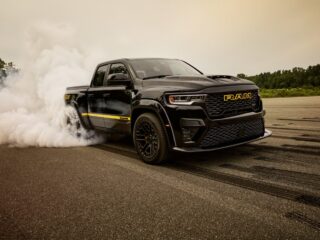
One other Ford commercial vehicle merits a mention – the Ranger pick-up has proven a major success, with many sold to retail customers who didn’t particularly need a pick-up but liked the idea of driving the Ranger. Alongside the diesel powertrain it’s available as a plug-in hybrid with an all-electric version on the way.
Ford’s next models are set to see the raiding of the historic name pot increase in a big way, none more so that with the launch of a new Fiesta. Predicted to hit showrooms in 2028, it will be an EV and the result of another tie-up with a rival manufacturer, in this case Renault – the new Fiesta will be closely related to the French brand’s highly successful reinvention of the Renault 5.
Industry sources predict a return for the Ford Focus too, this time as a mid-sized crossover in much the same way that the Puma crossover succeeded the original Fiesta. Few details of the new Focus are available but it could well be another model shared with a rival brand.
Yet another joint programme, with Chinese manufacturer Geely, is likely to lead to the launch of a new Ford Kuga in 2029, with a more coupe-like shape and available initially as an EV but later as a plug-in hybrid.
Before that another US Ford badge is set to debut in the UK. In 2028 we could see the arrival of the Ford Bronco, another mid-sized SUV but one pitched as a proper off-roader, and powered by a hybrid engine.
Where can I try a Ford car?
Over the past 70 years, if you went out to buy a new car the first dealership you came across was likely to be selling Fords – with around 400 outlets, the blue oval was the biggest name on the forecourt.
In 2020, however, as part of plans “to build a stronger and more sustainably profitable Ford sales and servicing network for the future in the UK,” Ford announced it would slash dealer numbers virtually in half, closing between 160 and 180 outlets. This was achieved by early 2025 but with close to 200 main showrooms Ford is still one of the most prolific names on the automotive high street.
What makes Ford in the UK different to the rest?
A difficult one this as for so many years a Ford was the ‘safe choice’ – the cars were affordable and so many of them on the roads. New drivers were very likely to find themselves in a used Fiesta or Escort as their first car and for anyone looking to buy the first dealership visited was typically that of either Ford or its prime rival in Britain, Vauxhall.
In recent years that has changed. Hit heavily by the rise to mainstream prominence of former budget brands such as Kia and Hyundai and more recently the new Chinese entrants to the UK market, plus changing desires among the buying public, who increasingly no longer want the same practical-but-not-exactly-exciting cars that everyone else drives, Ford has had to reassess its entire business.
Being the biggest maker with the most cars on the roads doesn’t being the success it once promised. The resultant transformation of Ford has been a drawn-out process, not helped by the slow adoption of EVs, but the brand is making steady progress to becoming a very different operation to the household name of the late 20th century.
A Ford in the UK fact to impress your friends
Turning Dagenham from a car manufacturing plant to one making engines had one slightly unusual side effect.
So much land became surplus to requirements that there was plenty of space to rehearse the opening and closing ceremonies of the 2012 London Olympics in relative secrecy. The rehearsals took place in the spring of that year, in often very poor weather. The opening ceremony, held at a brand-new stadium just ten miles from Dagenham and helmed by Oscar-winning director Danny Boyle, was globally praised as a masterpiece.
Summary
Ford in Britain today is very different to even just ten years ago. Then it was the biggest name in cars, the Fiesta anchored at the top of the charts. While the Puma has regained some of that top-seller status, today a slimmed-down Ford offers fewer models and is no longer the most obvious go-to when buying a new car.
Driving a product of the blue oval does remain very popular, but Ford’s biggest test is ahead as the brand continues its roll-out of promised new electric models. These will determine just how much future influence Ford has on a market it dominated for more than a century.
This feature was originally written in March 2024 and updated in October 2026.

Related posts

Latest Post



No Comments