
1969 Pontiac Grand Prix SJ: The Forgotten American GT
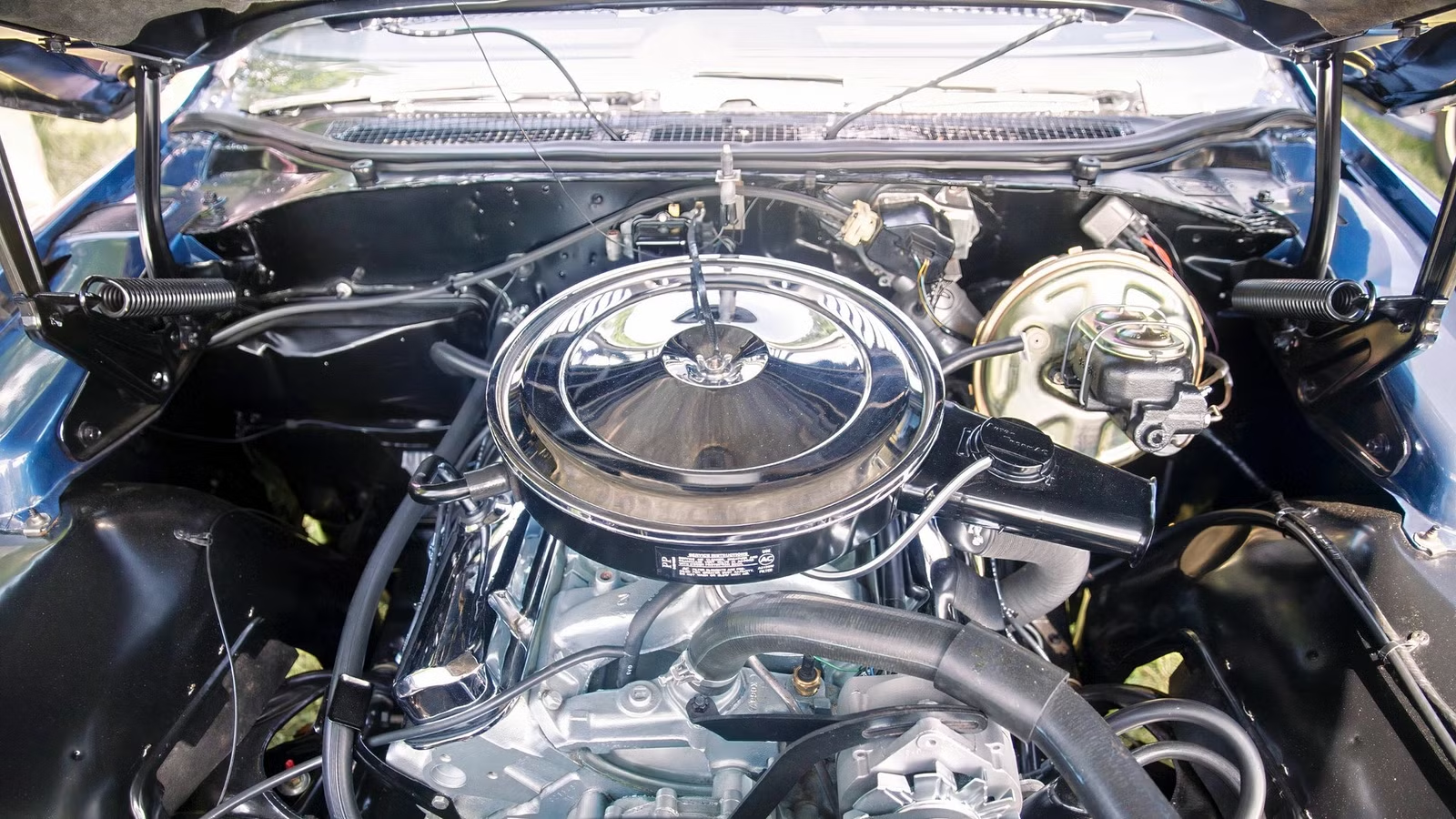
Pontiac’s late-’60s performance story—well represented across Pontiac coverage—is usually told with three familiar words: GTO, Firebird, and Ram Air. The Ram Air V8s deserve that attention, but they also leave one very strange car parked in the shadows: a personal-luxury coupe that belonged in a completely different conversation.

In 1969, this long-hooded Pontiac mixed serious V8 power with load-leveling suspension and a cockpit built around the driver. Its hottest engine even carried a higher published horsepower rating than Ferrari’s V12-powered 365 GT 2+2. First, consider what Ferrari offered in the 365 GT 2+2.
Why Ferrari’s V12 GT Looked Untouchable In 1969
The Ferrari 365 GT 2+2 wasn’t some stripped competition special wearing license plates. It was a proper four-seat grand tourer, with a front-mounted 4.4-liter 60-degree V12 and the kind of long-distance mission that made speed only part of the job. Ferrari’s own archive lists the Colombo V12 at 320 hp at 6,600 rpm and a 245-km/h top speed, or roughly 152 mph. Those were serious numbers in the late 1960s, but the car’s appeal went beyond speed. This was Maranello building something meant to cross big distances quickly while carrying more than two people.
Ferrari also made the luxury part explicit. Power steering and air conditioning were standard, while independent suspension at all four corners helped separate the 365 from less sophisticated four-seat GTs. It was expensive and exotic, but it wasn’t supposed to punish its passengers for the privilege.

Across the Atlantic, Detroit was fighting a different war. Big engines, aggressive gearing, functional induction systems, and increasingly loud muscle-car identities filled American showrooms. Pontiac was right in the middle of it, yet its performance story is still dominated by cars like the GTO and Firebird. That’s why a personal-luxury coupe feels like the wrong place to look for a Ferrari comparison. Cars in that category were supposed to be handsome, comfortable, and easy to drive, usually with an automatic doing the shifting. A V12 Ferrari belonged on the fast side of the grand-touring world. A plush American two-door was supposed to watch from the other lane. One Pontiac did not get that memo.
But Horsepower Wasn’t Its Only Ferrari-Level Surprise

The mystery coupe’s engine earns the headline, but its chassis and cabin make the Ferrari comparison more interesting. Pontiac was also trying to solve some of the same problems Ferrari faced with the 365 GT 2+2: how do you make a big, powerful coupe stay comfortable and composed when people and luggage climb aboard?
Ferrari went high-tech for the era. The 365 GT 2+2 used independent rear suspension and Koni-supplied hydro-pneumatic self-leveling hardware that compensated for changing loads. Even the surviving self-leveling hardware is cataloged separately in Ferrari parts documentation. A weekend’s luggage wasn’t supposed to leave the rear of this GT dragging toward the pavement.

Pontiac took a different route but chased a similar result. Its performance-oriented version used an automatic rear-leveling setup designed to maintain ride height under load. The hardware was not a shared Ferrari/Koni design, and the two systems should not be treated as identical, but a Detroit luxury coupe and a Maranello GT were trying to solve the same problem.
Then there was the cabin. Pontiac called its driver-focused layout the “Command Seat,” wrapping the instrument panel toward the driver and pairing it with bucket seats and a floor console. That tells you what kind of car Pontiac wanted this to be. Comfortable, yes. Anonymous, definitely not.
The Unexpected GT: 1969 Pontiac Grand Prix SJ 428 H.O.

The car was the 1969 Pontiac Grand Prix SJ, with a muscle-car heart hiding under all that personal-luxury sheetmetal. The SJ came standard with a 428-cubic-inch V8 rated at 370 hp, while the optional 428 H.O. raised the factory figure to 390 hp at 5,200 rpm and 465 lb-ft at 3,400 rpm. Ferrari rated the contemporary 365 GT 2+2 at 320 hp, so the hottest Grand Prix carried a 70-hp advantage on paper. The redesigned Pontiac also rode on an exclusive 118-inch wheelbase and put a remarkable amount of hood between the driver and the horizon. Pontiac’s 1969 brochure lays out just how unusual that engine menu was.
The H.O. wasn’t just a number typed in bold on a brochure. Pontiac gave it 10.75:1 compression, a hotter camshaft, special exhaust manifolds, a low-restriction air cleaner, and freer-flowing dual exhausts. That is muscle-car hardware wearing a personal-luxury nameplate. One caveat matters, though: these are period factory ratings published under different conventions, not results from the same dyno on the same day. The 70-hp gap is a brochure-to-brochure comparison, not a laboratory verdict on which engine made more power under identical conditions.

Full side view of a green 1969 Pontiac Grand Prix SJ showing its long hood, formal vinyl roof, redline tires, distinctive rear quarter, and Grand Prix SJ badging.
Rarity sharpens the story. Pontiac built 112,486 Grand Prix coupes for 1969, but 111,472 left with the Turbo Hydra-Matic automatic. Only 1,014 used a manual transmission of any kind, and just 676 received the four-speed. Put another way, a four-speed Grand Prix accounted for barely six-tenths of one percent of production. The car was a sales hit, but it hid a rare Grand Prix SJ configuration in plain sight. Most buyers wanted the long hood, bucket seats, and effortless torque without doing their own shifting.
The exact SJ count is where neat trivia gives way to messy history. Hagerty puts the SJ 428 four-speed figure at roughly 302 cars, while the Pontiac-Oakland Club International estimates fewer than 100. Pontiac never officially broke out four-speed production by J and SJ trim, so the disagreement itself is part of the story rather than something we can cleanly settle. What is solid is the 676-car four-speed Grand Prix total, with the SJ combinations making up only a fraction of that already small number.
Beyond Ferrari, Here’s Why Pontiac’s GT Was Forgotten

Now the chassis and cockpit details stop looking like side notes. The SJ’s automatic rear leveling, “Command Seat” layout, Strato buckets, and driver-angled controls weren’t random luxury add-ons; they were part of a car built to cover distance quickly without turning every mile into work. Ferrari attacked the same grand-touring brief with independent rear suspension, Koni self-leveling hardware, a five-speed manual, and a V12. The solutions were different. The mission wasn’t.
The Grand Prix’s real problem was category. Pontiac had already given enthusiasts louder heroes, and the Pontiac GTO became shorthand for the muscle era while the Trans Am legacy supplied decades of hood scoops, graphics, and pop-culture swagger. Next to those cars, the Grand Prix looked almost too civilized. Its huge 1969 sales total made it seem common, while its luxury image pushed it away from the muscle-car mythology that kept other Pontiacs famous.

That’s how a car this interesting became easy to miss. The Grand Prix’s sales made it look ordinary, and its comfort encouraged the boulevard-cruiser label. Its hottest engines and rarest gearboxes never entered Pontiac folklore. The division built other under-the-radar Pontiacs, but the SJ was doing something different: mixing torque, comfort, driver-focused controls, and load-leveling suspension into one long-legged package.
Calling it a “Ferrari killer” would actually sell it short. The better argument is that Pontiac built its own kind of GT, with American hardware, American scale, and a distinctly Detroit answer to the same grand-touring question. That distinction matters more than the Ferrari comparison. The GTO and Firebird can keep the posters. The 1969 Grand Prix SJ deserves to be remembered as an American GT on its own terms.

Related posts



Latest Post


No Comments