
Chevy’s Absolutely Radical 400-HP Pickup Truck Nobody Remembers
The early 2000s were a very different automotive market. Some manufacturers looked forward, leaning into the burgeoning interest in the future with cars like the screen-bearing BMW 7 Series (E65), or the F1-inspired Ferrari Enzo, or the genre-defining Porsche Carrera GT. But others looked back, playing on nostalgia for the bygone century with retro-inspired designs that blended past and present. And while it led to some interesting cars, there was one fascinatingly bonkers truck that lasted just four years and deserves to be remembered today.
The Early 2000s Were Obsessed With Retro Cars

The early 2000s were a real golden age for retro-inspired cars. Buoyed partly by the new millennium, some manufacturers looked backward for inspiration and incorporated styles from years gone by but with modern engineering to make them more practical. The market was flooded with cars like the PT Cruiser (built to look like a 1930s hot rod), the BMW Z8 (made to look like a 1950s BMW 507), and the Volkswagen New Beetle (a relaunched version that was an homage to the rounded silhouette of the original).
It was a smart move by manufacturers. Vintage cars can have far more heart than modern counterparts, but their comparatively inferior mechanicals make them a risky choice for a daily driver. Taking the exterior of the vintage versions and the internals of their more reliable counterparts made for a far easier sell, while designers got to have a bit more freedom to experiment with how they brought an old car into the 21st century. Chrome trims, round headlights, long hoods, chunky fenders — everything was on the table, as these new cars weren’t restomods and thus had a bit more wiggle room for interpretation. And one American institution particularly wanted in.
Chevrolet Wanted To Turn Nostalgia Into A Hot Rod


Chevy had plenty of history to draw from when the retro craze kicked off. The Detroit-based company was founded in 1911 and had created some of the American automotive industry’s most recognizable pickups, muscle cars, and performance machines, and it saw an opportunity to showcase that heritage in a modern vehicle. And a hot rod made sense.
Hot rods had played an important part in making the American automotive industry what it was at that point. Traditional hot rods had been about taking familiar shapes and turning them into something altogether faster, louder, and more attention-grabbing. It made for a relatively open design brief, essentially allowing Chevrolet to experiment with proportions and create something unbound by conventional design philosophies.
The result was something more than just a simple design exercise, or a quick hop onto an already popular bandwagon. What they created was something so unique and unusual that it would become one of Chevrolet’s most eccentric creations ever to leave its factory.
Meet The Chevrolet SSR: A 400-HP Pickup With A Corvette Heart

With the neo-retro trend in full swing, Chevrolet was looking to enter. But, unlike competitors, it didn’t want to simply revive a dead nameplate like the eleventh-gen Ford Thunderbird, MINI Hatch, or the aforementioned New Beetle. The idea instead was to take the familiar classic pickup proportions, exaggerated fenders, a long hood, and a quintessentially American aesthetic and combine them with the underpinnings of a modern performance car. The result was the Chevrolet SSR. And it was unlike almost anything else on the market.
For a start, the SSR (which stood for Super Sport Roadster) didn’t really fit into any one segment. It had the two-seat cabin, rear-wheel-drive, and bed of a pickup truck, along with the retractable hardtop of a roadster, and the aesthetic of a hot rod that had gone through a bubble text filter. The classic Chevrolet hallmarks of a long hood, large front fenders, a tall grille, and rounded bodywork were all there, but they were turned up to 11. It couldn’t be accused of being a subtle car, that much is certain. But simply looking at the exterior of the car is to miss what’s truly absurd about the SSR.
Sure, a retractable hardtop with a truck bed behind it is an unusual combination (those choices aren’t exactly going to return many matches on Autotrader), but they did give the car an unmistakable identity. But to see how truly odd the SSR was, you had to look under the hood.

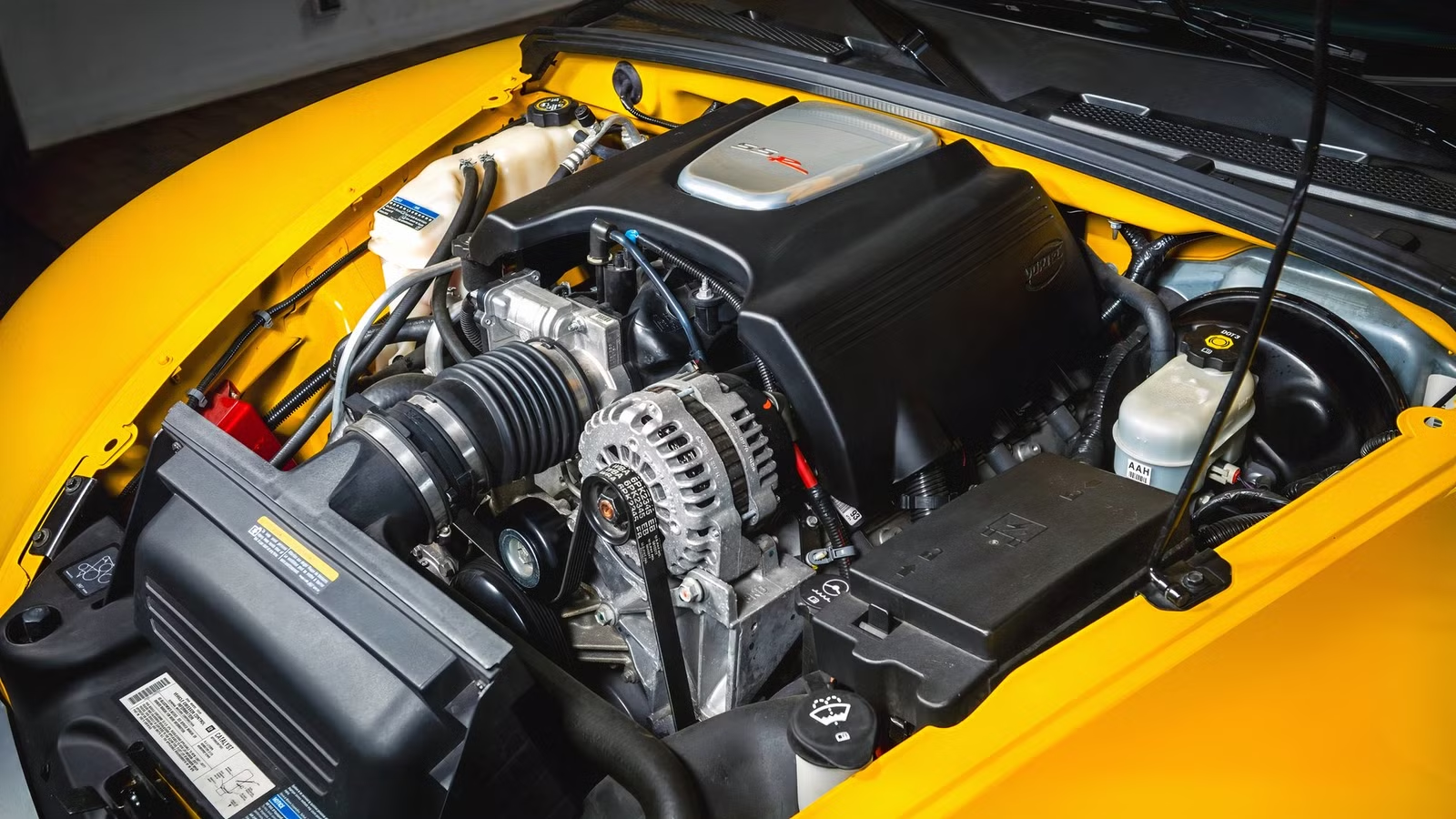
Earlier versions of the car had a 5.3-liter V8 engine but, in 2005, it received GM’s 6.0-liter LS2 V8. That is an engine from the same family as the C6 Corvette, fitted to a car that couldn’t be confused for something performance-oriented. But looks can be deceiving and, in LS2 form, the SSR still made 390 hp and 405 lb-ft of torque. Though this considerable power boost came later, Chevrolet had always had performance in mind for the SSR. It was the official pace car of the 2003 Indy 500, leading the pack and eventual race winner Gil de Ferran with 290 HP and 325 lb-ft of torque.
Why Chevy’s Wildest Pickup Failed To Catch On

The SSR was a little bit of everything. It was a convertible, it was a pickup, it was a performance car, it was a hot rod. But while this combination (albeit without the hot rod aspect) works incredibly well for Australia’s Utes, it simply didn’t work for the Chevy.
For a start, there were better options for all the bases the SSR covered. Its small bed meant that using it as a pickup was impractical, while anyone focused on performance wouldn’t be buying a car that had spread itself across multiple different segments. Its weight didn’t help either, as the retractable hardtop and LS2 contributed to the car’s considerable heft of over 4,700 pounds. The C6 Corvette, for reference, came in at around 3,200 pounds, while a 2004 Chevrolet Silverado started at 4,142 pounds.
The intended audience is also worth considering. There were no direct competitors to the SSR because it occupied a segment entirely its own. Performance trucks are arguably the closest match, but a buyer wouldn’t be choosing between an SSR and something like a Dodge Ram SRT-10 or a Ford F-150 SVT Raptor — the SSR occupied a category of its own.

And, lastly, price. The SSR started at $42,000, though the LS2-equipped model was $43,000 in 2005. That is the equivalent of $73,520 today. For the same price, a buyer could opt for a Chrysler 300C with a HEMI V8 and options, a Porsche Boxster (987), or the C6 Corvette that shared the same engine. It contributed to poor sales, with just 24,118 SSRs receiving VINs before production ceased.
The Forgotten SSR Has Earned A Place In Chevy History

The SSR may have lived fast and died young, lasting all of four model years, but it hardly faded into obscurity. Part of that is because it was already pretty obscure to begin with, but the SSR wasn’t truly appreciated in its own time. And that’s part of its charm. The rarity of the car means that it remains a consciously deliberate choice. Nobody drives an SSR by accident, least of all the LS2-packing version. This has seen it fall firmly into the enthusiast circle, where people passionate about it keep it alive.
The SSR represents a time when manufacturers weren’t afraid to take a risk. Far too many cars are commercially safe choices. They’re slight tweaks, or yet another family-friendly SUV, or, worst of all, bringing back a nameplate for a car that has no business bearing it (looking at you, Ford, with the Mustang Mach-E, the Capri, and the Puma). And that is exactly what makes the SSR memorable. It is a car that eschewed convention to create something entirely unheard of and genuinely different. It has a personality that cannot be mimicked, and while it isn’t the best hot rod, the best performance car, the best pickup, or even the best convertible, it is the best amalgamation of all of them. And that’s enough.
Sources: Chevrolet

Related posts


Latest Post


No Comments