
Cadillac CTS-V Wagon: The ZL1-Powered Family Hauler
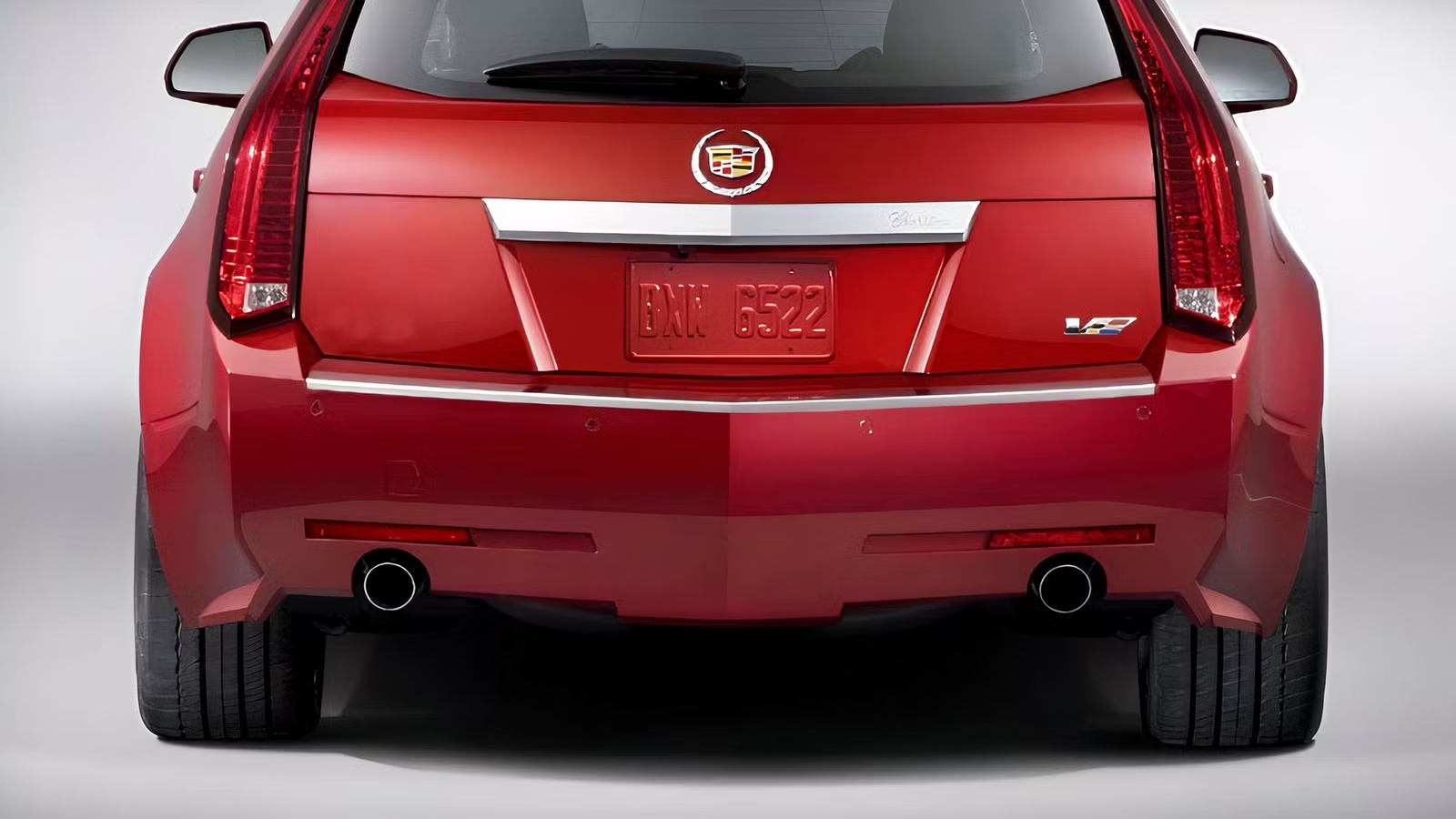
At what point does a station wagon become something “more” than a family hauler that’s not a crossover? Does it need to be luxurious beyond the pale, have as much storage capacity than a van, have a shape so peculiar, it still gets talked about years after it left production? Well, what happens when a wagon looks perfectly normal on top, but underneath, it’s got the guts, the heart, and the soul of an all-American sports car? Well, you get a machine that will, in all likelihood, never be replicated ever again. Namely, because Americans don’t buy wagons anymore.
The CTS Wagon: A Cadillac With Great Potential

For Cadillac, the CTS was the brand’s attempt to usher itself into the 21st century with what it hoped Americans actually wanted to buy. Launched in January 2002, the first-generation CTS was Cadillac’s ticket out of Grandpa’s driveway and into the apartment parking lots of late Gen-Xers and some of the first millennials to get their driver’s licenses. It was a fine platform, one which, while not sporting a Caddy Northstar engine, brought the brand far closer to European rivals like the BMW 3 Series than ever before.
As serviceable as it was, these early CTSs still lagged behind rivals from Europe. Even the first roost of LS-sporting CTS-Vs ultimately failed to secure the kind of prestige and notoriety that Cadillac desired out of the model. Yet, what the Gen-I CTS did accomplish was securing the brand’s “Art and Science” design philosophy as a guiding light for Cadillac through the rest of the decade. It was a philosophy that served Cadillac well when they attempted to redesign the CTS for a second generation starting in 2007 for the 2008 model year. Jumping off the previous generation, styling cues rife with sharp, aggressive corners and tasteful lines was met by a re-worked interior with less obvious plastic trim pieces and plush leather.

It was everything Cadillac needed to finally shed the old-person car stigma that plagued the brand for decades. Suddenly, Cadillac could claim they had a genuine flagship coupe or sedan to sell in the thousands right along the beloved Escalade. That good fortune carried the Gen-II CTS into the 2010s, where GM had yet another stroke of genius. Knowing now that consumers were happy to pay for a non-SUV Caddy with a range of peppy V6s, it served to reason that they’d get a real kick out of the same package, but with even more carrying capacity.

The CTS Sport Wagon: Serviceable Luxury, Real Practicality.

The first five-door Cadillac CTS Sport Wagon was unveiled to the world at 2008’s Pebble Beach Concours d’Elegance in California. There, it received warm introductions, where critics praised how similar it looked to the coupe and sedan, but with the added practicality of 25.0 cubic feet of cargo space with the rear seats extended, and 58 cubic feet when the 60/40 rear seats were stowed away. The first production examples rolled into dealerships in 2010, with the same choice of a three-liter V6 with 270 horsepower, or a 304-horsepower, 3.6-liter direct-injected V6 as its more conventional siblings.
Suddenly, Cadillac offered an all-American alternative to German sportbacks like the BMW 3 Series Touring, the Mercedes C-Class Estate, and the Audi A4 Avant, three machines that utterly dominated that niche segment of the market with the utmost authority. Elsewhere, the CTS Sport Wagon also competed with the Lexus IS 250 and 350 SportCross, proving that Cadillac could compete with a broad group of vehicles in its class from across the world.

On a styling front, the CTS Sport Wagon was everything its coupe and sedan counterparts were, but with an even broader canvas to add sharp angles and bodacious curves. The rear tail lights framed the back hatch, and twin exhaust tips gave an heir of sportiness which, for once, didn’t overpromise and under-deliver. So far as the 3.6-liter V6 was concerned, these Caddy wagons really could get out of their own way, and with a starting MSRP of $38,265 back in 2010, or around $58,000 adjusted for inflation today, that was still thousands off the sticker price of the equivalent German wagon. Of course, a wagon was never going to outsell a sedan in the American market. Yet, that didn’t stop Cadillac from outfitting the CTS Sport Wagon with the best darn powertrain General Motors put together in the 2010s. With performance in mind, what they came up with was nothing short of stunning.
Cadillac CTS-V Wagon: A Once in a Lifetime American Performance Wagon

Save for oddball things like the Dodge Magnum SRT8, there hasn’t been a performance oriented sports wagon built in the US quite like the Cadillac CTS-V Wagon. Unveiled in 2011, just a year after the standard CTS Sport Wagon, this grocery-hauling missile of a machine wasn’t just a middle finger to European sporty wagons, it was like throwing firecrackers and M80s at their front windows, and what a wonderful firecracker it turned out to be. Sporting a 6.2-liter supercharged LSA V8 under the hood, it’s the same engine you’d find in the fifth-generation Chevy Camaro ZL1.
You know, the same Camaro that lapped the Nürburgring in seven minutes and 41 seconds while making rival six-figure exotic sports coupes look overpriced and try-hards by comparison. With 556 horsepower and 551 lb-ft of torque fed to a rear limited-slip differential and an optional Tremec six-speed manual gearbox, this 4,400-lb behemoth was kept tidy with magnetic ride control adaptive dampers and chunky Michelin Pilot Sport tires. Put simply, if the consensus on Cadillac was that they built useless land barges that couldn’t take a corner without falling to pieces, the CTS-V family took that sentiment and nuked it from orbit.

Zero to 60 was handled in roughly four seconds, and the top speed? Well, it was limited to 175 mph in the automatic variant, but it could reach as much as 190 mph. Meaning, of course, with a decent tail wind and an ever so slight downward incline, this humble American wagon could push 200 mph. For a car you could take your kids to soccer practice, and then pick up drive thru on the way home with all their stuff in the rear hatch, that was pretty darn amazing. Its MSRP, compared to, its rivals, was also bewitchingly fair. We’re talking $62,990 before fees, or roughly $93,500 in modern money, was still leaps and bounds cheaper than anything coming from Germany. For some context, the equivalent E63 AMG easily pushed $100,000 in 2011 money when you took options and dealer markups into account.
Fighting Depreciation Like a Champ

Cadillac put an end to all CTS Wagon production with the introduction of the third-generation model in 2014. By then, the car was a larger, more upscale product than it was previously, and one that offered a next-gen LT-series supercharged V8 in its own performance models. With that said, the Gen-II CTS-V now takes on a second life as a very serviceable second-hand speed machine.
While modern sporty Cadillacs like the 2026 CT5-V can push $150,000 with all the ‘fixins added, you can pick up a used CTS-V for something like $35,000. Heck, even the more reasonable 2026 CT4-V Blackwing can stretch beyond $70,000 with options, and it’s fair to say a gen-II CTS-V is within the performance margins of that. That said, this only applies to coupes and sedans, as Cadillac only ever made 1,767 CTS-V Wagons. That works out to roughly 350 with manual gearboxes and the rest with six-speed automatics. Knowing this, you won’t be shocked to learn a well-preserved CTS-V wagon can fetch just as much as you’d pay for a new CT4-V Blackwing. Given how rare they are, it’s a figure we’re sure the faithful out there are sure to accept.
Source: Cadillac, Bring a Trailer

Related posts




Latest Post


No Comments