
Buick’s One-Year Family Hauler Out-Twisted Most Muscle Coupes With 510 LB-FT
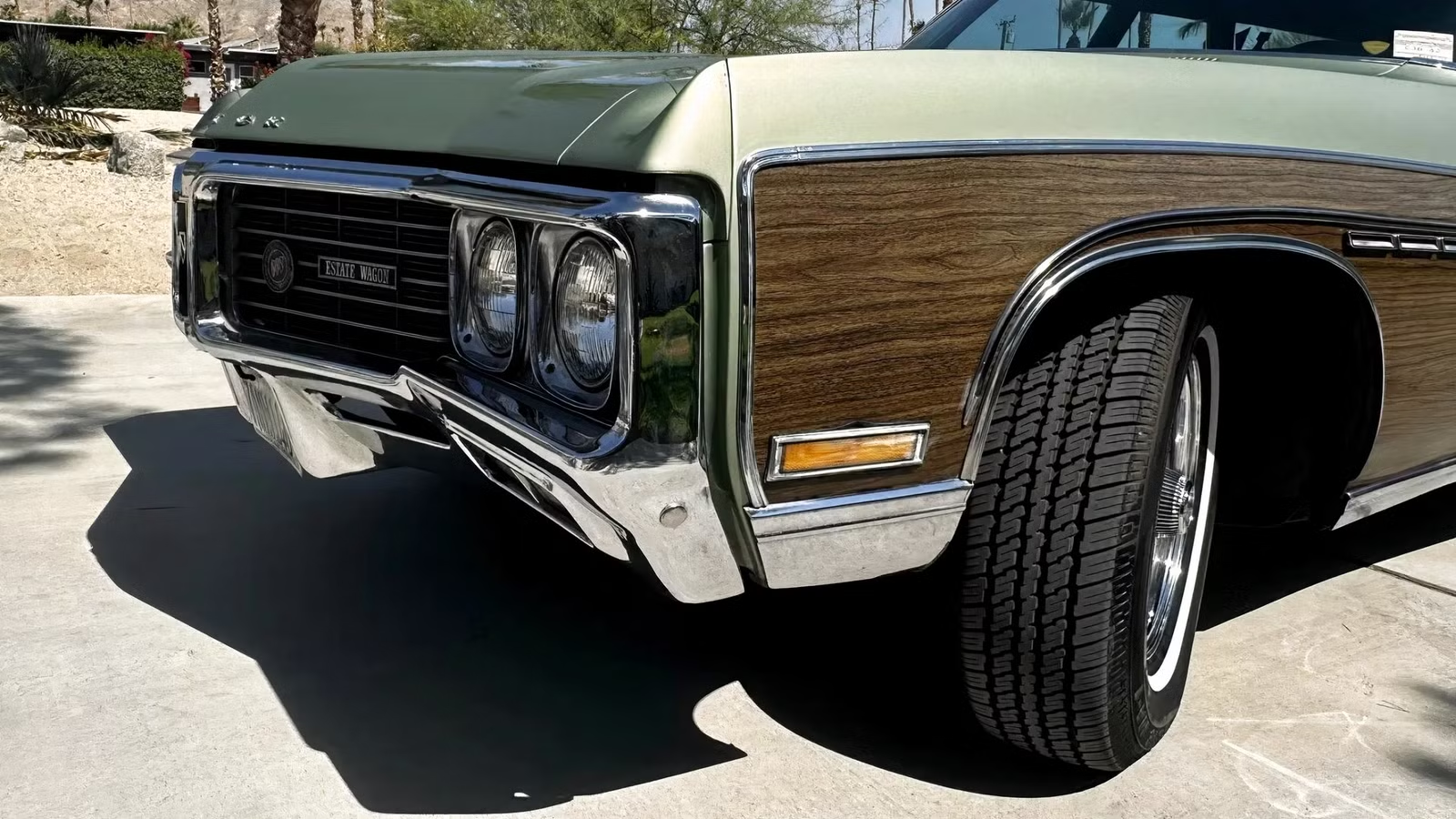
Many of us gearheads love old-school station wagons. They have a kind of character that modern SUVs just don’t have. They’re family hauling as it once was, powered by good old-fashioned American engines. Some of those old-fashioned American engines were surprisingly powerful, too. Why? Well, their manufacturers often dipped into the craziest engines they had in the parts bin.

What kind of engines were those, you might ask? They were engines that, if you’re a muscle car enthusiast, you might already be familiar with. They were just put into very un-muscle-car vehicles, and for reasons that aren’t as stupid as you might think.
Back In The 1970s, You Could Have Station Wagons With Massive, Powerful Engines
Out of all those golden age American Cars, some of the weirdest (and perhaps some of the most wonderful) are the big-block station wagons of the 1970s. From the outside, these are typical American full-sized station wagons. In many ways, they still are. But look under the hood, and you’ll see engines that look like they came out of a muscle car. That’s because, quite honestly, they did. They’re either completely or almost completely identical to the big-block units you’d find in golden age muscle cars. That means they’ve got both the power and the character that you’d get in a classic big-block muscle car. Except, this time, there’s a lot more practicality.

These Super-Powerful Wagons Were Sleepers By Accident
It might seem very confusing that typical full-sized station wagons got the option to have big, powerful engines. Nobody would typically buy a station wagon to have a muscle car-grade engine. But, there is some logic behind it. Automakers wanted these cars to have engines that had a lot of torque. Why? Because a lot of customers used these cars for towing, and/or hauling heavy loads. If you’re going to be doing some proper tow-car duties, you need all the torque you can get. As the big-block, muscle-car-style V8s were the torquiest engines they had access to, these wagons accidentally became super-powerful sleepers.
The 1970s Wagons That Got Muscle Car-Beating Outputs

If you were an American customer back in the 1970s, what cars could you have got that had muscle car power? Well, there are at least four clear examples. All of them have plenty of power, plenty of torque, and plenty of character. A couple of them have a good bit of rarity value, too. This can be because they were only produced for one model year. Alternatively, it can be because barely any were ever produced at all.
The 1970 Buick Estate Wagon 455 Is A One-Year-Only Family Hauler That Has More Torque Than Most Muscle Coupes

If there’s any station wagon that could be considered the absolute king of these big-block sleepers, it may very well be this one. The Buick Estate Wagon 455 was only available for the 1970 model year, and from the outside it looks like any other classic station wagon. It has all the practicality of a classic station wagon you’d want, too. It just also has a 455 cubic-inch V8, producing 370 hp and 510 lb-ft of torque. That gives it more torque than even the most powerful muscle cars of its day.
The 1970 Chevrolet Kingswood Estate 454 Throws A Corvette Big-Block Into A Woody Wagon
Buick wasn’t the only General Motors brand that allowed you to put a huge amount of power and torque in a full-sized station wagon. In that same 1970 model year, the Chevrolet Kingswood could be ordered with the 454 cubic inch V8. This is the same engine that you could have in big-block variants of the Corvette. It’s actually more powerful than the Buick Estate Wagon 455 (395 hp), but it has slightly less torque (500 lb-ft). That means the Buick still leads when it comes to overall output.
Chrysler’s B-Body Wagons Could Have Magnum V8 Power

Away from the GM umbrella, Mopar allowed you to get a little adventurous with its wagons too. In that same 1970 model year, the Dodge Coronet 440 wagon was available with a 383 cubic inch V8. The most powerful 4-barrel version of the engine produces 330 hp and 425 lb-ft of torque. That’s significantly lower on those metrics compared to the previous two wagons discussed. But you could still haul a serious load with it, and it still has power comparable to muscle cars of the day.
The 1973 Chevrolet Chevelle Malibu SS 454 Wagon Is A Big-Block Unicorn From The End Of The Golden Era

This wagon is perhaps one of the rarest and most special Chevrolet models ever. For a very brief period, Chevy made an SS version of the Chevelle Malibu Wagon. That’s special enough just on its own. What makes it even more special, though, is that it had the option of that 454 cubic-inch V8 from the big-block ’70s Corvettes. While it was strangled compared to earlier big-block Chevys (245 horsepower and 375 lb-ft of torque), it could still do a great job of being a real powerhouse for a station wagon.
Only around 71 of these 454-equipped Chevelle Malibu SS wagons are estimated to have ever been made. If you ever see one, know that you’ve spotted something rarer than even some of the rarest supercars.
You Could Still Get An Unassuming Wagon With A Muscle Car V8 As Late As The 1990s

While the golden age of the American automobile was long gone after the mid-1970s, that didn’t mean the death of the surprisingly powerful station wagon. The torque characteristics of good old-fashioned American V8s ensured they kept getting used in these big haulers for a long time. In fact, you could still get a frumpy-looking station wagon with proper muscle car power as late as the 1990s. That’s thanks to the existence of the ’90s D-Body cars. The Chevrolet Caprice Wagon and Buick Roadmaster Wagon from that era both could have the 5.7-liter LT1 V8 from the C4 Chevrolet Corvette.
The LT1 was significantly detuned in these wagons. It only had 260 hp, and was mated to a typical sluggish 4-speed automatic transmission. But it could still go when you put your foot down. That’s thanks to it having as much as 335 lb-ft of torque. While that may be nowhere near as much as those ’70s monsters, it’s still enough to seriously haul.
Sources: Chevrolet, Buick, Dodge

Related posts


Latest Post


No Comments