
BMW Ripped The Clothes Off Its Superbike And Created A 160-HP Street Psycho
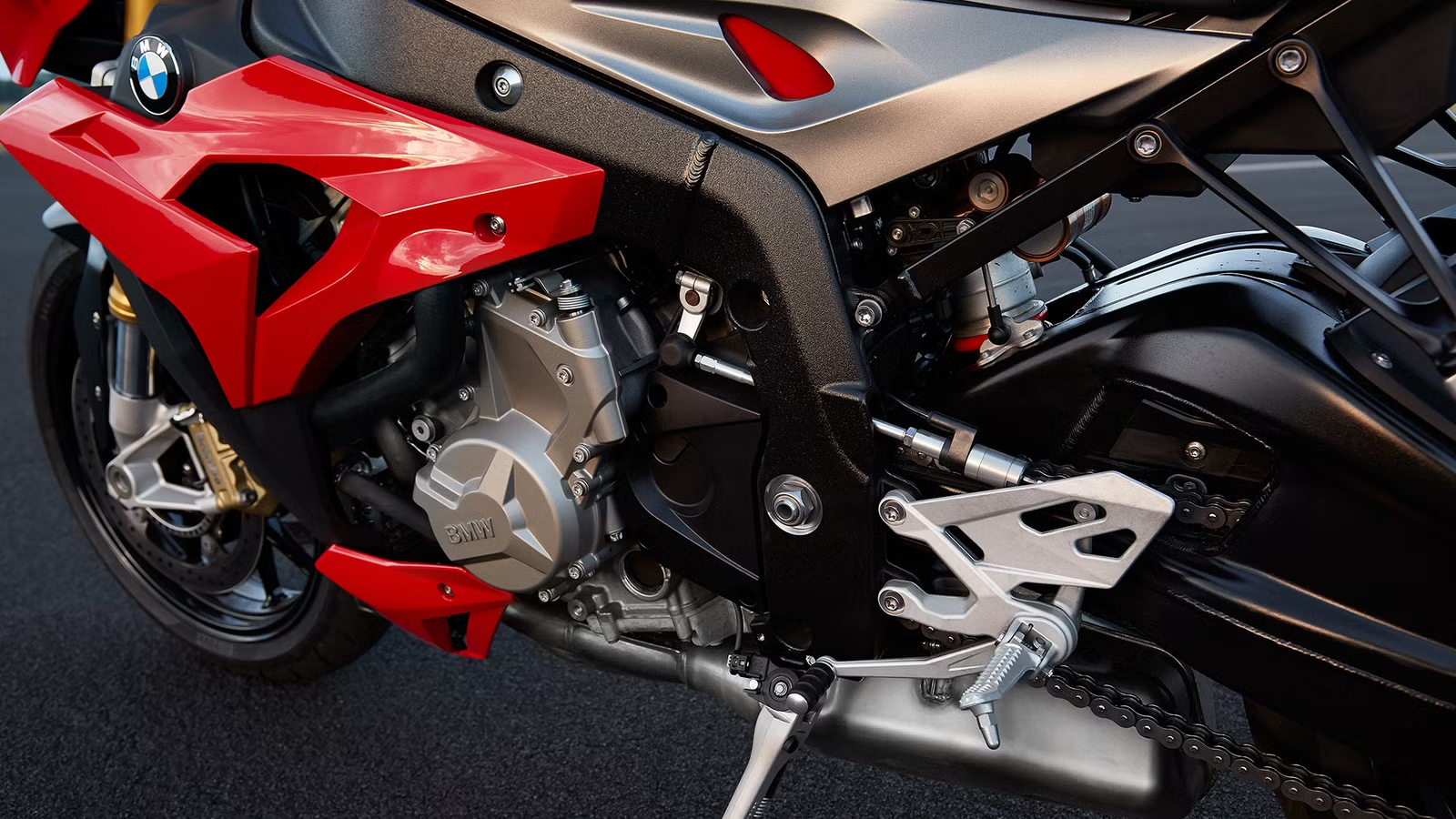
Naked bikes have always been about power, position, and fun. They’re for people who want all the excitement and performance of a superbike, but with the look and feel of something that doesn’t belong with the race bikes on the paddocks and pit lanes of the world. And while some brands have made bikes that target the naked category from the outset, BMW took a different approach by taking the fairing off a superbike and creating something truly radical in the process.
When Naked Bikes Became The New Kind Of Rebellion

The 1990s were a transitional period for motorcycles. For decades, the fastest production bikes had been wrapped in increasingly elaborate fairings, hiding their mechanicals behind aerodynamic bodywork and adopting ever more aggressive riding positions in an effort to bring the racetrack to the road. But while some bikes covered their machinery, others exposed it.
The spiritual start of the modern naked bike category began in 1993 with the launch of the Ducati Monster. A commercial answer to what riders had been doing for years already — removing damaged fairings and doing without, then bolting on some flat handlebars for a more upright riding position – it paved the way for bikes like the Triumph Speed Triple and Yamaha MT-07 and MT-09. These were bikes that still had the masses of power you’d expect from a sportbike, but went their own way with it.
The Superbike Arms Race Was About To Spill Onto The Street


By the early 2010s, the naked category had evolved. They weren’t simply custom, homemade jobs or a handful of bikes put out by manufacturers testing the water, but an entire segment with power figures that belonged more on racetracks than they did on public roads. Electronics were, thankfully, more sophisticated than in the 1990s, with systems like traction control, ABS, and different engine modes far more standard and capable of changing what a motorcycle could really do. But that technology created an opportunity: if a superbike already had more power than it realistically needed, where do bikes go from here?
The answer wasn’t to simply continue an increasingly difficult path of one-upmanship, but to focus instead on how that power felt. Tons of power is no use if you can’t actually put it down. Naked bikes were already powerful motorcycles that had been distilled down to their base parts of chassis, engine, brakes, and electronics, so making sure those parts were as capable (and as fun) as possible was the name of the game.
The Kawasaki Z1000 had adopted this approach, receiving one of Kawasaki’s famous Z-series names in 2003 as a modern streetfighter. By 2014, it had evolved into the unapologetically lairy machine that people know today. But while the Kawasaki had plenty of power, there was another naked bike that had even more.
The 2014 BMW S 1000 R Was A 160-HP Superbike In Street Clothes

The 2014 BMW S 1000 RR is no stranger to power or speed. The 999 cc superbike makes 193 HP at 13,000 RPM, en route to a top speed of around 190 MPH. So it’s just a little bit nippy. And, as the S 1000 RR superbike is a track-focused, road-legal missile on wheels, it makes for the perfect basis of a naked bike. So that’s what BMW did: they took off the fairings, removed an R from its name, and created the BMW S 1000 R.
The naked version was remarkably similar to the superbike. It had the same 999 cc inline-four engine at its heart, though was retuned for the road and made a still-exciting 160 HP at 11,000 RPM. Torque figures were comparable, around 83 lb-ft for both, but that wasn’t really the point. The S 1000 RR was a superbike you could ride to the track as well as on it, while the S 1000 R was aimed squarely at the street. Its performance didn’t need to make sense on the track.
The engine’s tuning wasn’t the only thing that changed between the two, as the aesthetics understandably differed. The full fairing was, obviously, gone, exposing its engine and muscular tank instead, though it did retain a little bodywork above the cylinder heads and at the bottom of the radiator. The raked headlights of the RR were also swapped in favor of a more compact setup.

No naked bike would be complete without a more upright riding position, and that’s what the single R version got. The wheelbase was almost an inch longer, while there was an extra 0.8 degrees of rake and slightly more trail than the RR to make the chassis more relaxed. You also sat 14mm lower than the track-focused bike, an amount which is surely noticeable to nobody but which must do something.
Riders who preferred to let a computer do some of the riding work could spec the bike with ABS, traction control, and selectable riding modes as well, should they feel the need to allow BMW to take charge while they hooned about on what was essentially a naked superbike. And that’s what really made the S 1000 R special; it wasn’t just a bike with a big engine and no clothes. This bike was a road-focused interpretation of what was, at the time, BMW’s most insane liter-class superbike, and it retained a surprising amount of it in the process.
The S 1000 R didn’t try to be exciting by throwing more horsepower at the problem, or by being ludicrously fast for the sake of it. It was everything that naked bike riders (that is, riders of naked bikes, thank you) had wanted all along: superbike performance and aggression on something stripped-back and wild.
BMW Didn’t Just Remove Fairings, It Rewrote The Formula

The key with the S 1000 R was that while it might have been a non-identical twin to the S 1000 RR, it wasn’t simply a superbike without fairings. It was its own bike, with its own attitude, its own personality, and its own prerogatives. And that was important.
It would have been easy for BMW to take the fairings off, say it’s a naked bike, and call it a day. But that wouldn’t have satisfied anyone and riders understood that a spec sheet wasn’t the real measure of how much fun a bike is. Cold, hard numbers can’t communicate the emotions and feelings that a bike can elicit, and how fast they can get the heart pumping. With its lack of fairing, the S 1000 R wore its heart for all to see, making the engine as much a part of its aesthetic as it was its propulsion.
This gave the bike a different kind of presence. It wasn’t a regular bike masquerading as a race bike, or a bike wearing the skin of something far more powerful. The S 1000 R was aggressive, conspicuous, and self-assured enough that it was confident to stand on its own and make riders question whether they had what it took to ride it. And you can’t put that on your little spec sheet.
The Street Psycho That Helped Define BMW’s Modern Naked-Bike Era

The S 1000 R proved that BMW didn’t need to keep its most serious hardware hidden away underneath race-inspired bodywork, and that the German brand could engage in something a little more hooligan. By putting its superbike DNA into a more accessible naked-bike format, it helped to establish a formula that became increasingly important to BMW Motorrad.
The S 1000 R has continued to evolve since that first generation, gaining more power (it’s currently up to 170 HP), more electronics (keyless ride, cruise control, “Pro riding modes” and wheelie control are all optional extras) and more sophisticated equipment along the way. But however many generations it goes through, they can all trace their roots back to the 2014 model.
When it was released in 2014 it wasn’t the first high-performance naked bike, nor did it invent the concept of stripping back a superbike for the street. But what it did was catapult BMW into the naked bike conversation, making it a serious contender that was difficult to ignore. More than a decade later, the S 1000 R remains a snapshot of its era – a bike that took the clothes off a superbike and dared people to ride it. And it remains that to this day.
Sources: Motorcycle Specifications

Related posts
Latest Post


No Comments