
1970 Plymouth AAR Cuda: The Driver’s Muscle Car Under $100K
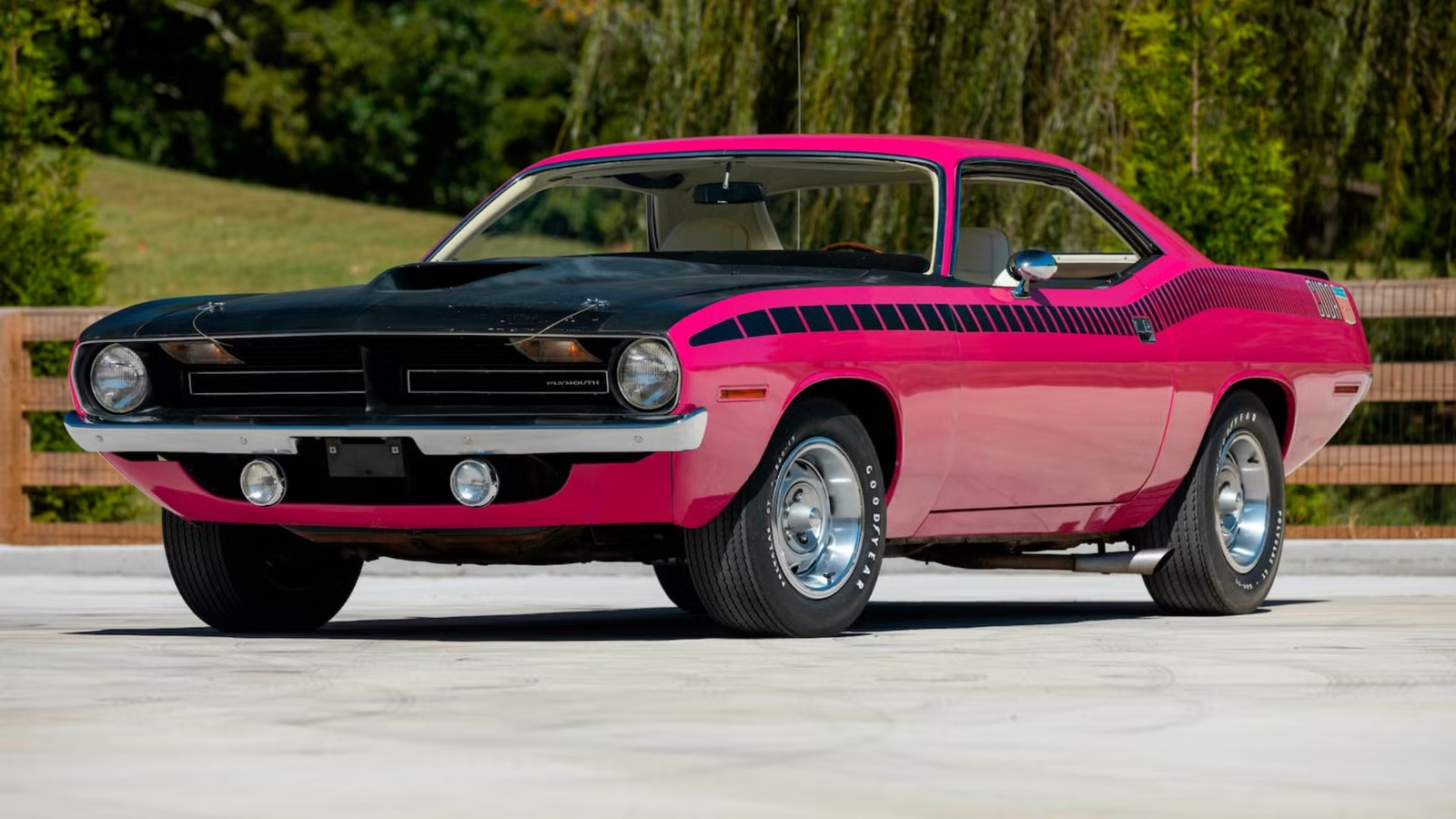
When discussing the topic of muscle cars, someone will always bring up their reputation for stiff handling. Whether trying to defend or debate against the muscle car, there’s always a repeating opinion that muscle cars are only good at going fast in a straight line. But there’s another kind of muscle car, in a different weight class, built to go fast down the straightaway and cut the apex in a corner.

In 1966, the Sports Car Club of America (SCCA) created the Trans-American Sedan Championship series. The name was changed the following year to the Trans-American Championship, otherwise known as the SCCA Trans-Am Series.
This series experienced a golden era between 1968 and 1972, coinciding with the peak years of the muscle car era. This era of Trans-Am racing spawned several iconic cars, such as the Camaro Z/28, the Mustang Boss 302, and the Javelin AMX. But fourth place doesn’t get to stand on the podium. Among the legendary Trans-Am pony car racers, the 1970 Plymouth AAR Cuda has consistently been left out of the collector car spotlight. A mighty Mopar that has never reached the same record-breaking dollar amounts as the rivals it raced against.
Born To Be Light, the Trans-Am Rule That Forced Small Block V8 Power

The SCCA Trans-Am racing series had a strict rule limiting the engine displacement to under five liters. This meant automakers had to go back to the drawing board and engineer a small-block V8 with big-block power and the endurance to survive the grueling demands of racing. This one rule would result in legendary engines like Ford and Chevrolet developing their own 302ci V8s.
Chrysler had to destroke its 340ci V8 down to 303ci to qualify and enter its new E-Body Plymouth Cuda and Dodge Challenger in the Trans-Am Series for the 1970 season. In addition to the displacement rule, automakers had to homologate the cars they planned to race. This meant they had to build at least 2,500 street-legal, production examples to sell to the public. Those buying a Plymouth Cuda in 1970 had a choice of flavors. They could either go with the brawler 426ci Hemi, or the lighter and tighter AAR Cuda with a punchy 340ci Six-Pack and a suspension setup designed to handle a road shaped like the curves on a Corvette Stingray. In 1970, Plymouth entered two AAR Cudas into the Trans-Am racing series with drivers Dan Gurney and David Earl “Swede” Savage Jr.
The 1970 Plymouth AAR Cuda, A Lean And Mean Road Racer

The 1970 Plymouth AAR Cuda gets its name from Dan Gurney’s race team, All American Racers. Fun fact: Dan Gurney founded the All American Racers team with Carroll Shelby in 1964. The AAR Team built the Cuda into a hardcore road racer with over 400 hp from its destroked 340ci small-block V8. In addition to power, the AAR Team incorporated weight-saving measures like using titanium parts and acid-dipping the body panels to make these Trans-Am-spec AAR Cudas lean and mean.
But even with seasoned racing drivers like Dan Gurney and Swede Savage behind the wheel, the AAR Cuda never scored a victory during the 1970 Trans-Am Championship Series. Both the #42 and #48 AAR Cuda race cars struggled and often ended the race with DNFs rather than podium finishes. By 1971, Plymouth pulled the plug and dropped out of Trans-Am racing. This left the Plymouth AAR Cuda as a one-year production model with 2,724 units built during the spring of 1970.
The Plymouth AAR Cuda is a Driver’s Muscle Car

The production variant of the 1970 AAR Cuda was a little more restrained, although not by much. AAR Cuda production models featured a 340ci V8 with unique cylinder heads, and an aluminum intake feeding fuel through three two-barrel carburetors, known as the “Six-Pack.” All of this mechanical muscle produced 290 hp at 5,000 rpm. Buyers had the option to select a TorqueFlite automatic over the standard A-833 four-speed manual transmission. But what really made the AAR Cuda was the suspension.
Each AAR Cuda received a race-inspired side-exit exhaust system, sway bars at the front and rear, and heavy-duty shocks. Heavy-duty rear leaf springs raised the rear end, providing the necessary clearance to fit G60X15 Goodyear tires at the back and smaller E60X15-sized tires at the front, which also gave the AAR Cuda an aggressive stance. This staggered wheel setup made the AAR Cuda the first American production vehicle to come from the factory with different-sized tires front and rear.

Of course, we can’t leave out the AAR Cuda’s paint schemes. With vibrant color options like Lime Green Metallic, Vitamin C, and Lemon Twist, the 1970 Plymouth AAR Cuda featured black matte-finish paint on the hood and front fender tops. The lightweight fiberglass hood was unique to the AAR Cuda, featuring a functional air scoop and race-inspired hood pins. Moreover, the AAR Cuda’s distinctive strobe-stripe side graphic comprises 75 individual segments of decreasing width that end with a red, white, and blue AAR crest.
Snazzy colors aside, what makes the 1970 Plymouth AAR Cuda a driver’s muscle car is the suspension and lack of weight at the front. While a Hemi Cuda may offer more horsepower and torque, that big block V8 is hanging over the nose of the car. It creates an uneven weight distribution, which can cause the front end to dip under hard braking and lead to understeer in corners. Essentially, it’s a heavyweight boxer that can only throw haymakers.
The AAR Cuda, by contrast, has a lighter yet strong 340ci small-block and a heavy-duty suspension designed for hot laps rather than quarter-mile times. The AAR Cuda may be small in cubic inches, but makes up for it with a more sophisticated suspension that puts its power to the road and hugs the turns. It can do more with less, like a disciplined MMA fighter.
A Collectible Contender, But Not a Winner

It’s amazing how much a car’s value can change simply based on the engine. The type of V8 in a 1970 Plymouth Cuda can mean the difference between paying five figures or over one million! According to Hagerty, the most expensive 1970 Plymouth Hemi Cuda sold in the last three years sold for a whopping $2,942,500. Even not-perfect examples in “good condition” carry an estimated value of $132,263.
A good-condition 1970 Plymouth AAR Cuda carried an estimated value of $70,200, or even as low as $46,800 for “fair” condition. Of course, pristine-condition examples can surpass the six-figure mark, but compared to other Chrysler muscle cars of the era, the AAR Cuda looks like a bargain. Especially when you consider it was literally born to race. But why is this variant of the Plymouth Cuda not as desirable?
Part of the reason could be its failures and shortcomings in the Trans-Am Championship series. If you apply the classic NASCAR motto of “Win on Sunday, Buy on Monday,” the AAR Cuda didn’t win, and who wants to spend big money on a loser? Yet, for Mopar enthusiasts looking to buy a classic muscle car without breaking the bank, the 1970 AAR Cuda may be the ideal candidate. A gem overlooked by many is still a gem, and the AAR Cuda can shine bright with the right set of eyes.
Source: Hagerty, Old Cars Weekly, Historic Trans Am, The70AARCuda

Related posts



Latest Post


No Comments