
The Forgotten GM Muscle Car Hiding A Corvette Engine For Under $15K
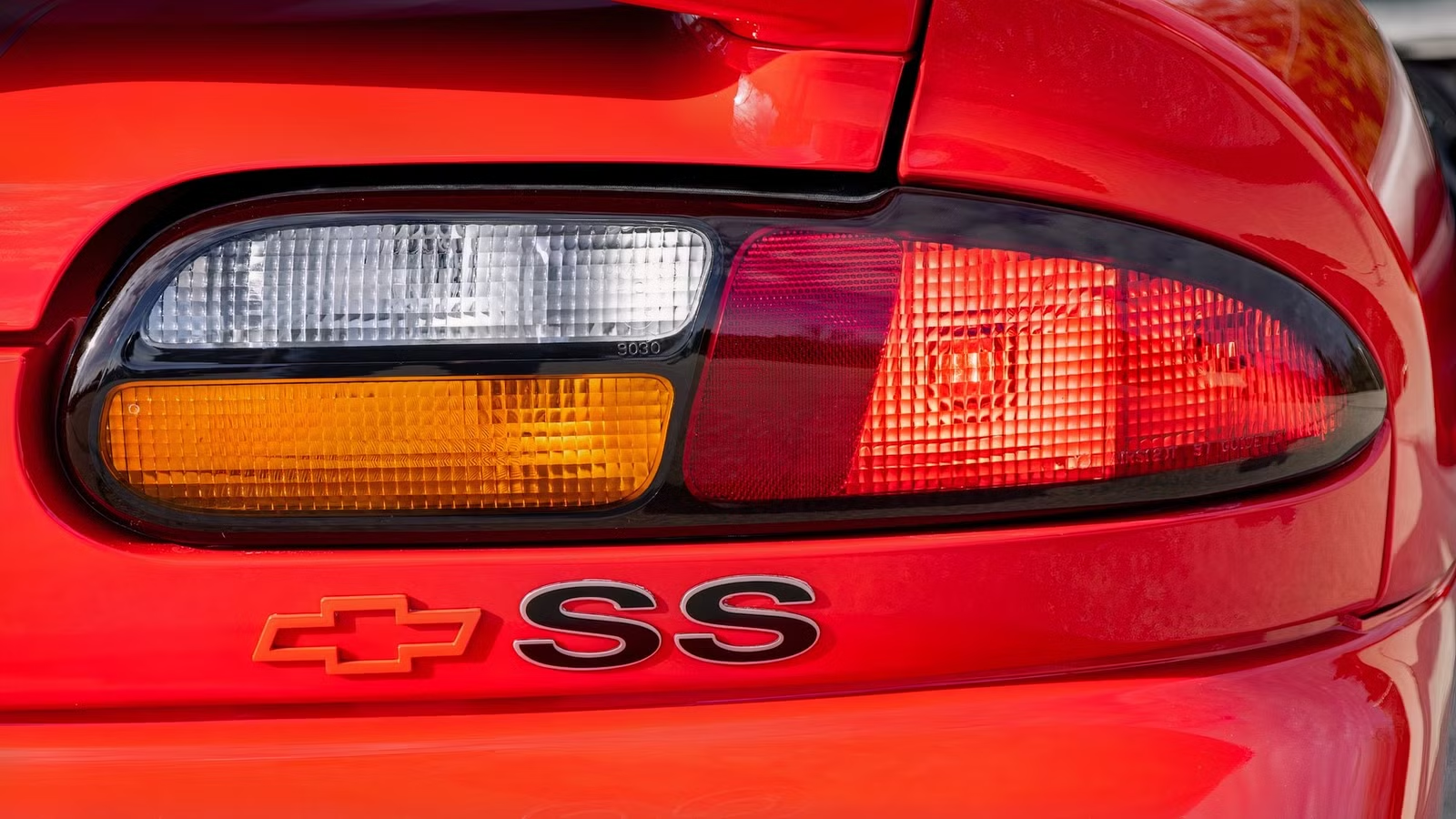
Modern performance. Muscle car heritage. Reasonably priced on the used market. You may have been told you could only pick two of the three, but that’s not true. There’s a forgotten GM muscle car that’s hiding one of the best Corvette engines of all time. Best of all, you can still pick up a stick shift street brawler on the used market for under $15k.
The LS1 V8 Was A Beast

In 1997, Chevrolet debuted a brand-new V8 for the new “C5” Corvettes that changed everything. Gone were the outgoing LT1’s Optispark distributor woes, oil drain-back issues, and rod bolt wear. Major upgrades included coil-near-plug ignition, modern sequential fuel injection, and six-bolt main bearing caps. The new aluminum small block was lighter, stronger, and endlessly tunable. The LS1 became the foundation of GM’s modern performance empire. According to Chevy, this V8 rocketed the C5 Corvette to 60 mph in 4.7 seconds.
Another major upside of this traditional front-mounted V8/RWD powertrain was its transmission. The T56 six-speed manual was also renowned for durability.

Today, C5 Corvettes with this powertrain are becoming collector cars. According to Classic.com, the average C5 Corvette (1997-2004) changes hands for $24,174. Collectors’ editions can command $220,000. But there is another place GM hid the same magic — a car most enthusiasts still overlook.

It gets even better. You can have the same powerplant behind your choice of badges with genuine muscle car heritage, enjoy four useable seats, and not break the bank.
The 1998-2002 Chevy Camaro/Pontiac Firebird Is A Performance Steal

The Chevrolet Camaro and Pontiac Firebird shared GM’s “F-body” platform until 2002. The 4th-gen of this platform ran from 1993 to 2002. You could buy either a Chevy Camaro or Pontiac Firebird with the LS1 V8 and T56 six-speed from 1998 through 2002. That’s right, GM offered the full Corvette powertrain in its Y2K-era pony cars.
The official rating for the 1998 LS1 F-bodies was 305 hp. Later, the top tune (Chevy’s SS and Pontiac’s WS6) was rated at 325 hp. Enthusiasts have pointed out that these tuned LS1 V8s got all the Corvette bits and may have been advertised with lower hp numbers to avoid stealing the Corvette’s thunder.
So Long To The Mullet Of Muscle Cars: The Pontiac Firebird’s Swan Song

After the 2002 model year, GM cancelled both the Camaro and the Firebird. The Camaro would return, complete with retro styling and a starring role in Transformers, for the 2010 model year. But 2002 was the final year for the Firebird.
That means 2002 was the final year of the Trans Am package, and one of Pontiac’s most legendary muscle car nameplates. But it went out with a bang.
You can find a 1998-2002 Firebird with removable T-tops for a real retro style. More than one owner has even decked a 4th-gen Firebird Trans Am out in traditional “screaming chicken” decals.
Jay Leno is a fan of classic Firebirds. But he had to admit that his unmodified 4th-gen offers the best handling and performance of any Firebird generation.
The Best-Kept Bowtie Enthusiast Secret, For Now

When TFL Classic pitted the LS1 Corvette against the Camaro, it found their drag racing times were neck-and-neck. The Camaro did the 1/4 mile in 15.61 seconds; the Corvette eked out a win at 15.46 seconds. The reviewers noted that the Corvette handled better and slowed down quicker.
One major performance advantage the C5 Corvette has is that its T56 transmission is mounted in the rear as a transaxle, complete with independent rear suspension. The layout improves front/rear weight distribution. The C5 Corvette also has much beefier brakes than the F-body. Grassroots Motorsports has campaigned F-body cars successfully—despite the live rear axle setup and the inevitable wheel hop problems—but points out that upgrading the front brakes before hitting the track isn’t optional.
Track enthusiasts also often add headers, upgrade the exhaust, and sometimes even install a more aggressive camshaft. The mother of all upgrades is swapping in an LS6 V8 from the Corvette C5 Z06. It’s almost a “bolt-in” procedure that ups the F-body to well over 400 hp.

TFL Classic concluded that the used Corvette’s premium price tag was difficult to justify. And if you need a daily driver, the Camaro/Firebird’s functional backseat is hard to turn down. Unfortunately, this secret is getting out.
Classic.com found that in the past year, the average 4th-gen Camaro’s average resale value rose to $21,062. Luckily, the bottom of the market is still much lower than the Corvette, with the most recent sale at just $9,200 and the lowest at $2,110. The top sale for a top-trim Camaro SS was just $51,700, while the average was $23,176. But the average for the SS cars has absolutely increased in the past 12 months, breaking the $20,000 mark during winter 2026.
Meanwhile, the 4th-gen Firebird’s average resale is $20,966. As these cars are more collectible, it’s not shocking that the top sale was $80,000. The average Trans Am value over the past 12 months was $24,758, after a serious jump in the average around February 2026. The lowest sale for a Trans Am in the past 12 months was $4,400.
The above averages are for cars listed through dealerships or auction houses that are tracked by Classic.com. There may still be deals available locally, advertised on Craigslist or Facebook Marketplace. But buyers should be ready to move fast.
The “Catfish Camaro” And Final Firebird Have Their Critics

Cheap interior components reveal F-body cars’ price points. These weren’t top-end Corvettes. From the stereo to the interior materials, everything was budget-friendly GM stuff. Leno warns not to leave these cars outdoors much. The sun will crack interior components, the rain may leak through T-tops, and water pooling in the chassis can rust these cars rapidly.
The power windows are known to fail. The leather seats also wear, with bolsters collapsing. Convertible tops and T-top roofs can both leak. Firebird flip-up headlights can stop working as well, either needing a new motor, replaced gears, or both (it’s a good idea to upgrade the plastic gears to brass ones).
If you’re test driving a car, it’s important to look over it for poor modifications using cheap components. Test every gear to make certain none are going out. Listen to the engine, but know that piston slap in cold engines is normal and not overly concerning.

The Camaro Z28 may represent the best used bargain, especially if you plan to modify your car anyway. The Camaro SS was essentially a Z28 sent to SLP Engineering for multiple upgrades such as better aero, a hood scoop, a less restrictive exhaust, suspension upgrades, and aftermarket wheels. Similarly, the Firebird Formula is the sleeper choice, also available with a V8. But the Trans Am WS6 is the trim that was sent to SLP Engineering for similar upgrades to the Camaro SS.
Enthusiasts often hold out for a 2001 or 2002 model year. These cars paired an LS6 intake with the LS1 V8. They also had stouter transmissions and stick shift versions had a lighter aluminum driveshaft.
Is A Y2K-Era Camaro/Firebird Right For You?

Buyers of 4th-gen Camaros and Firebirds fall into two camps. The first camp recognizes these as some of the best-handling and cheapest 300+ hp V8s around, and buys them despite their looks.
A second group is now seeking these cars out because of their looks. Y2K-era sports cars have a certain Fast-and-Furious-fabulous appeal, and the “catfish Camaro” and final Firebird are no different. The Firebird specifically is one of the final cars with flip-up headlights, which some RADwood enthusiast collectors love.
The Firebird prices threaten to increase quickly, possibly even outpacing some C5 Corvettes, as Pontiac enthusiasts snap up some of the final muscle cars to wear the arrowhead badge. The 4th-gen Camaro may not be far behind—the Swiss Army knife of Y2K-era Chevrolets: a Corvette you can actually drive every day. But the fact of the matter is, if you fall into the second camp, and love the 4th-gen Camaro and Firebird for what they are, they are an excellent choice for an enthusiast car. At any price.
Sources: Grassroots Motorsports, TFL Classics, Brangeta Buyers Guide, Classic.com, Chevrolet, Pontiac

Related posts


Latest Post


No Comments