
Allen Millyard’s Dodge Viper V10-Powered Motorcycle Just Sold at Auction — Here’s What It Fetched
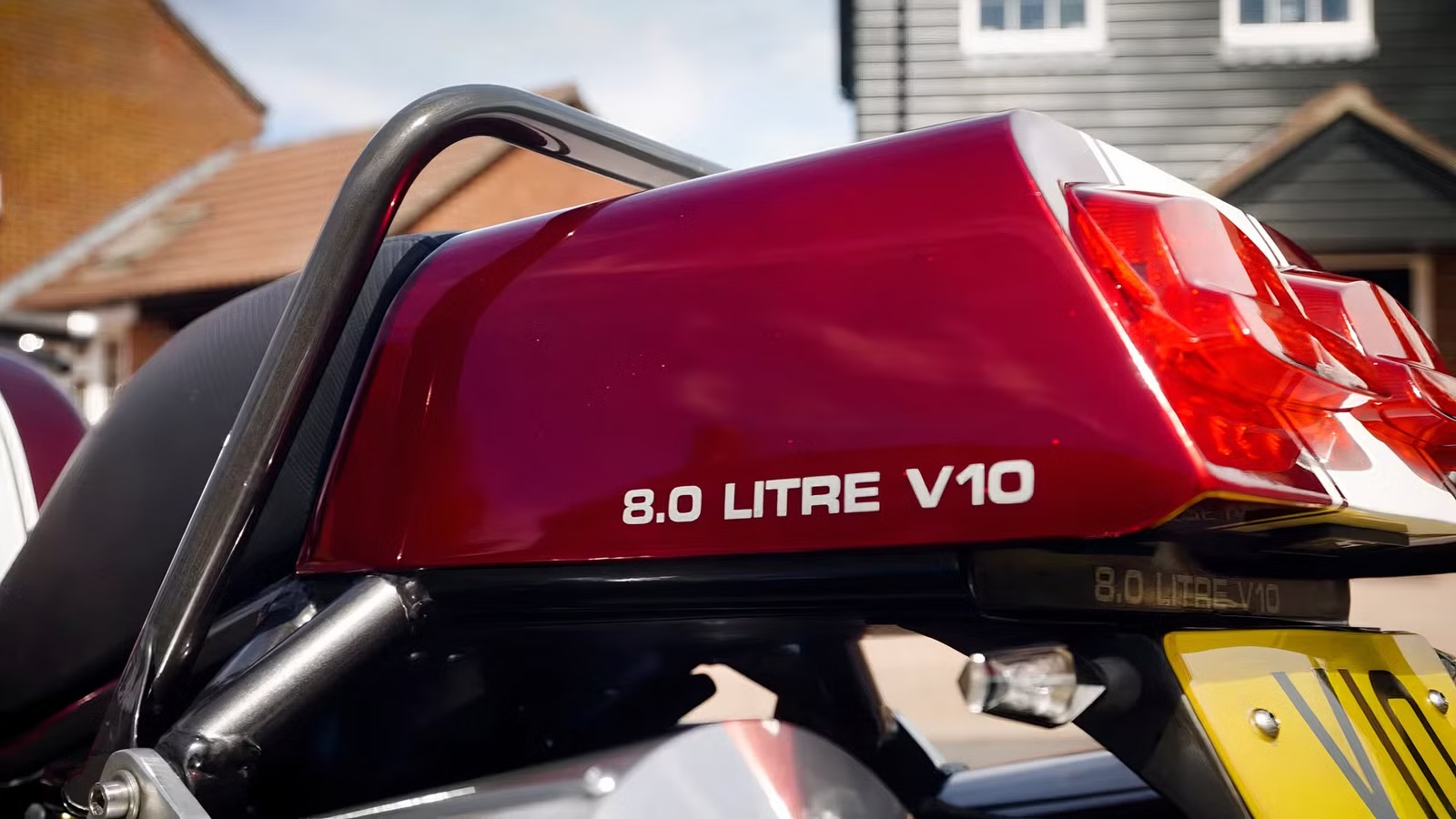
Allen Millyard’s most famous creation — a road-legal motorcycle powered by the full 8.0-liter V10 from a Dodge Viper — has sold at auction, and the result confirmed what the custom-build world already suspected: serious collectors are willing to pay serious money for one-of-a-kind engineering. The bike fetched a significant sum at auction on July 27, 2026, closing a chapter on one of the most extreme engine-swap builds ever to turn a wheel on public roads.

Completed in 2009 and clocked at 207 mph during a Motorcycle News runway test, the machine is the kind of project that makes other custom builders question their ambitions. Millyard — a Northamptonshire engineer who has spent decades grafting engines that have no business being on two wheels onto frames that somehow hold together — hand-fabricated the entire build himself. The fact that it ran, steered, and hit 207 mph is the point. The fact that it sold is the market catching up to what enthusiasts already knew.
Eight Liters, 500 Horsepower, Two Wheels: What Makes This Build Legendary
The Viper V10 motorcycle is not a concept or a show piece. Millyard pulled the 8.0-liter, 500 bhp V10 from a Dodge Viper and adapted it to motorcycle duty through entirely hand-fabricated componentry — custom frame, custom exhaust routing, custom everything. There is no parts catalog for this kind of build. Every bracket, mount, and solution was engineered from scratch in Millyard’s workshop.

The result is a bike that weighs what it weighs, makes around 500 bhp, and will reach 207 mph — a figure verified under controlled conditions by MCN, not claimed on a spec sheet. For context, that puts it in the same conversation as purpose-built land-speed record machines, except this one is road-registered. The Viper V10’s displacement alone — 8,000cc — is roughly four times what you’d find in a high-performance production superbike. Adapting that engine to lean through corners, manage heat in a motorcycle’s open chassis, and survive sustained high-speed running is the engineering challenge that defines the build’s reputation.
The Auction Result and What the New Owner Plans to Do With It

The bike sold on July 27, 2026, with the hammer coming down on what Ride Apart described as “a bunch of money” — precise figures weren’t confirmed in available reporting at time of publication, but the sale drew significant bidding interest consistent with a machine of this provenance. For a bespoke, one-off build with no production run and no replica, the collector market treated it accordingly.
Perhaps more encouraging than the price itself: the new owner has publicly stated plans to ride it. That detail matters in a collector market where significant machines increasingly disappear into climate-controlled storage. A 500 bhp, 207 mph hand-built motorcycle belongs on a road — or at minimum, a runway — not behind glass. Millyard, for his part, appears to have taken some satisfaction in that outcome.
What This Sale Signals for the Extreme Custom Market
Millyard’s work occupies a specific and rarefied corner of the custom motorcycle world. He isn’t building café racers or bobbers for Instagram — he’s grafting Kawasaki KH500 two-stroke quintuplets and Viper V10s onto hand-welded frames because the engineering problem is the point. That kind of work has always had an audience, but auction results that reflect genuine collector-market value are a more recent development.
The Viper V10 sale suggests that bespoke, builder-name provenance carries real weight with buyers — comparable, in some ways, to how the fine art market values the artist’s hand over the medium. A Millyard build isn’t just a motorcycle with a big engine; it’s a documented, verifiable piece of work from a builder with a known body of work and a reputation built over decades. Whether that translates to a broader trend for extreme custom builds or remains specific to a handful of celebrated engineers is the question the market will answer over the next few years. This auction is a data point worth watching.
For now, the Viper V10 motorcycle has a new home and, apparently, a new owner willing to actually use it. That’s the best possible outcome for a machine built to move.

Related posts


Latest Post


No Comments