
Hyundai Elantra N: Sport Sedan Rivaling the Civic Type R
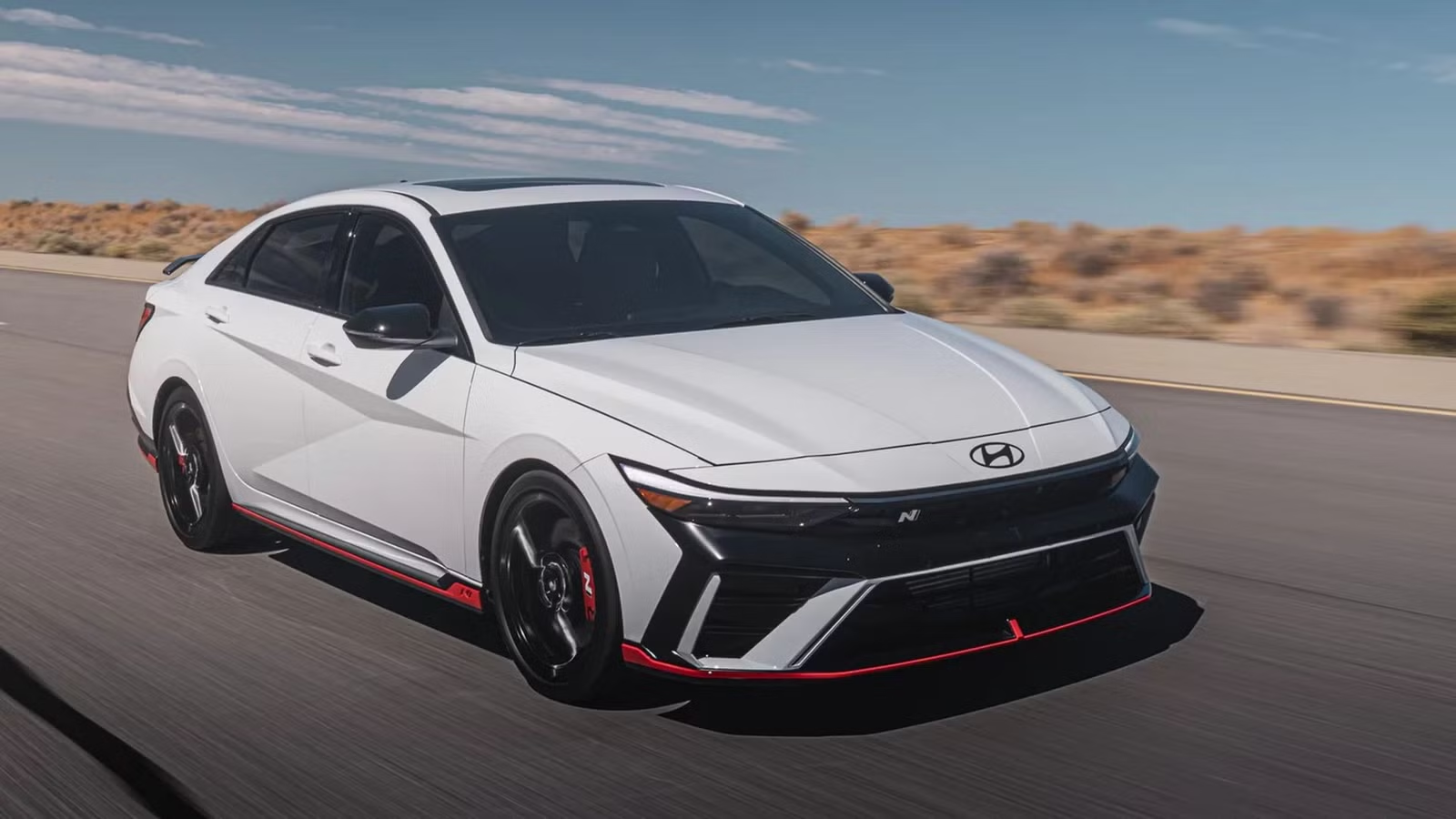
Hyundai spent the better part of a decade building credibility in the performance world, and the Elantra N is the clearest proof that the effort paid off. For around $35,000, buyers get a 276-hp turbocharged sedan wearing Nürburgring-honed suspension tuning, a trick overboost mode, and a choice between a six-speed manual or an eight-speed wet dual-clutch transmission. That’s a genuinely unusual spec sheet at this price point, and it’s why enthusiasts keep mentioning the Elantra N in the same breath as the Honda Civic Type R, a car that costs nearly $10,000 more.

The comparison isn’t perfectly fair, and it isn’t meant to be. The Type R is a hatchback with 315 hp and a stronger track pedigree. The Elantra N is a sedan, built with different priorities in mind. But the gap between them is narrower than the price difference suggests, and that gap is exactly where the Elantra N makes its case. This is a look at the engineering behind that case, the engine, the transmission choice, the chassis hardware, the daily-driving reality, and the value math that makes the Elantra N one of the more interesting performance bargains on sale.
The Engine And Turbo Tech: Theta III And N Grin Shift
The 2026 Hyundai Elantra N’s turbocharged 2.0-liter four-cylinder produces 276 horsepower and 289 pound-feet of torque, figures that look modest next to the Type R’s 315 hp but comfortably outclass the Civic Si’s 200 hp. Hyundai keeps its official terminology simple, calling it a 2.0-liter turbo four rather than attaching a specific engine-family name in its U.S. consumer materials, but the hardware underneath does real work: a twin-scroll turbocharger, an uprated intercooler, and intake and exhaust tuning aimed at flattening the torque curve so power arrives early and stays consistent, rather than spiking only at high rpm.

Hyundai quotes a 0-60 mph run of just under five seconds, with throttle response that feels quick and revs that build with real urgency. That figure applies to independent testing of the manual car; the DCT model has generally tested a touch quicker thanks to faster shift execution, though Hyundai doesn’t officially publish separate quarter-mile or top-speed numbers for the U.S. market, so treat any specific figures you see elsewhere as third-party estimates rather than factory-verified results.

The signature party trick is N Grin Shift. The system temporarily bumps output to 286 horsepower for 20-second bursts, engaged with a steering-wheel-mounted button for a brief window of extra urgency. It’s a different philosophy than Honda’s high-rev VTEC crossover or Ford’s EcoBoost tuning—less a permanent state change and more a driver-triggered moment of aggression, paired with quicker shift logic that keeps the transmission in its most aggressive gear selection while the boost holds. On track, that overboost sensation is real and noticeable. On the daily commute, most owners will rarely reach for it. NGS is a genuine performance tool, not a gimmick, but it’s also not going to transform the school run.
Manual vs. DCT: Two Very Different Elantra Ns

The six-speed manual is the standard gearbox, with the eight-speed wet dual-clutch automatic available as an upgrade, and the two aren’t just different shift mechanisms; they produce two distinct cars.
The manual is the purist’s pick. It pairs a short-throw shift action with a well-weighted clutch and an optional rev-matching function that blips the throttle on downshifts, a feature enthusiasts can switch off if they’d rather heel-toe it themselves. It’s marginally slower to 60 mph than the DCT, and it demands more from the driver in traffic, but it rewards that effort with the kind of mechanical connection that no automatic fully replicates, and it’s the version most likely to appeal to buyers cross-shopping a Civic Type R, which is manual-only.

The DCT trades a fraction of that engagement for outright speed and consistency. Its eight ratios (versus the manual’s six) keep the engine in its power band more precisely, its launch control produces more repeatable off-the-line starts, and its shift times are simply quicker than a human left foot and right hand can manage, lap after lap. Reviewers who’ve tested both note the DCT performs admirably with quick, smooth shifts and is probably the better choice for track days, even while preferring the manual’s more precise, notchy engagement for everyday driving. N Grin Shift is available with either gearbox, but its effect is more pronounced with the DCT, since the transmission’s quicker shift logic makes the overboost window feel more seamless.
The practical takeaway: buyers who want maximum engagement and don’t mind rev-matching their own downshifts should lean manual. Buyers prioritizing lap times, launch consistency, or simply an easier daily commute in traffic will get more out of the DCT. Neither is the “wrong” choice; Hyundai built genuinely different characters into each.
Chassis, Handling, And Nürburgring Heritage

Hyundai’s N division didn’t just bolt a turbo onto an Elantra and call it a day. Standard equipment includes an adaptive suspension, a limited-slip front differential, a variable-valve exhaust, 19-inch wheels, Michelin Pilot Sport 4S summer tires, a rear lip spoiler, and front and rear strut bracing—a genuine hardware package rather than a cosmetic sport package.
The limited-slip differential deserves particular attention. Hyundai’s front differential continuously varies torque distribution between the front wheels under hard cornering and acceleration, managing wheel spin and reducing the torque steer that plagues most powerful front-wheel-drive cars. It’s paired with a reinforced front subframe and structural bracing that stiffens the chassis around the front axle, engineering aimed specifically at putting 276 hp to the ground through the front tires without the car fighting the driver’s inputs. The adaptive suspension reads road inputs in real time and adjusts damping accordingly, letting the same car soften for a commute and firm up for a canyon road or track session without a physical component swap. Larger front rotors than the standard Elantra provide the stopping power to match the added performance, and the variable-valve exhaust opens up under load for a more aggressive note while staying quieter in Normal and Eco modes.

That combination of hardware traces back to Hyundai’s Nürburgring development program, the same testing ground that shaped the i30 N and Veloster N before it. It’s real engineering pedigree rather than marketing shorthand: body control stays composed through quick direction changes, and steering feel is more communicative than Elantra owners are used to.
What the Elantra N can’t escape is its body style. The Civic Type R is a hatchback, with more usable cargo flexibility and a driving position most enthusiasts describe as slightly more track-focused. The Elantra N is a sedan through and through, with a proper trunk and more conventional rear-seat packaging. The Type R’s edge on track comes down to its own chassis tuning, wider footprint, and aerodynamic package rather than any inherent advantage from being a hatchback; body style alone doesn’t decide handling. That’s not a knock against either car; it just means the Elantra N isn’t chasing the Type R’s exact formula. It’s a different answer to a similar question.
Real-World Driving: Daily Usability And Fun Factor

Drive mode selection spans Normal, Sport, and the more aggressive N modes, with throttle response, steering weight, exhaust volume, and suspension damping all shifting noticeably between them. In Normal or Eco, the car is genuinely mild-mannered—the exhaust stays quiet, and the ride softens enough that the Elantra N doesn’t feel like a compromise on a long commute. Flip into N mode, and the throttle sharpens, the exhaust opens up with pops and crackles on lift-off, and the whole car feels more alive.

The trade-off for that sportiness is some added road and wind noise at highway speeds relative to a standard Elantra, though it stops well short of being unbearable, and the firmer suspension settings are best saved for back roads rather than daily potholed commutes. Fuel economy takes the expected hit for a turbocharged performance variant, running noticeably below the standard Elantra’s EPA ratings, though Hyundai doesn’t require premium fuel, which helps offset some of that gap at the pump. Warranty coverage includes a five-year/60,000-mile limited warranty alongside a ten-year/100,000-mile powertrain warranty, longer coverage than Honda offers on the Civic Type R, and a genuine point of reassurance for buyers wary of turbocharged reliability.
Value Proposition: The Budget Breakdown

This is where the Elantra N makes its strongest argument. MSRP lands in the $34,000 range depending on transmission and trim, compared to roughly $32,000 for a Civic Si and north of $43,000 for the Civic Type R. Framed as performance-per-dollar, the Elantra N delivers 276 hp for around $35,000, while the Type R asks for nearly $9,000 more to unlock its additional 39 hp. That’s not a knock against the Type R’s outright capability, but it does mean the Elantra N covers a meaningful chunk of the performance gap at a noticeably lower price.

Total ownership costs favor the Elantra N as well, once insurance, fuel, and maintenance are factored in alongside Hyundai’s longer warranty coverage. Early resale data on the Elantra N is still developing, but comparable N-brand vehicles like the Veloster N have generally held value reasonably well among enthusiast buyers, suggesting the Elantra N shouldn’t depreciate dramatically faster than its rivals. For budget-conscious performance shoppers, the math consistently points toward the Elantra N as the stronger value proposition, even if the Type R remains the more prestigious badge.
The Verdict: Who Should Buy The Elantra N?

The Hyundai Elantra N makes the most sense for buyers who want genuine performance credentials, a Nürburgring-tuned chassis, a legitimate overboost feature, and real turbo power, without stretching into Honda Civic Type R territory on price. It’s the right call for drivers who prefer a traditional sedan shape over hatchback practicality, and who value Hyundai’s warranty coverage and lower running costs as part of the total ownership picture. Anyone cross-shopping performance compacts in the mid-$30,000s should have the Elantra N on their list.
The Civic Type R still makes sense for buyers chasing the absolute ceiling of hot-hatch performance, hatchback flexibility, and the strongest resale value in the segment; it’s simply a different tier of car, and the price reflects that. Meanwhile, the Civic Si remains the smarter pick for buyers who want adequate performance and lower cost of entry without needing the Elantra N’s extra power or the Type R’s track-day intensity.

None of this means the Elantra N dethrones the Type R—it doesn’t—and Hyundai isn’t really trying to claim that it does. What it does mean is that Hyundai has redefined what a hot sedan can offer at this price, delivering enough turbocharged character, chassis polish, and daily usability to make the comparison worth having in the first place. For buyers prioritizing value over ultimate lap times, the Elantra N is one of the smartest performance buys on sale today.
Source: Hyundai U.S.

Related posts




Latest Post


No Comments