
A 2028 Escort RS Could Be The Civic Type R’s Worst Nightmare
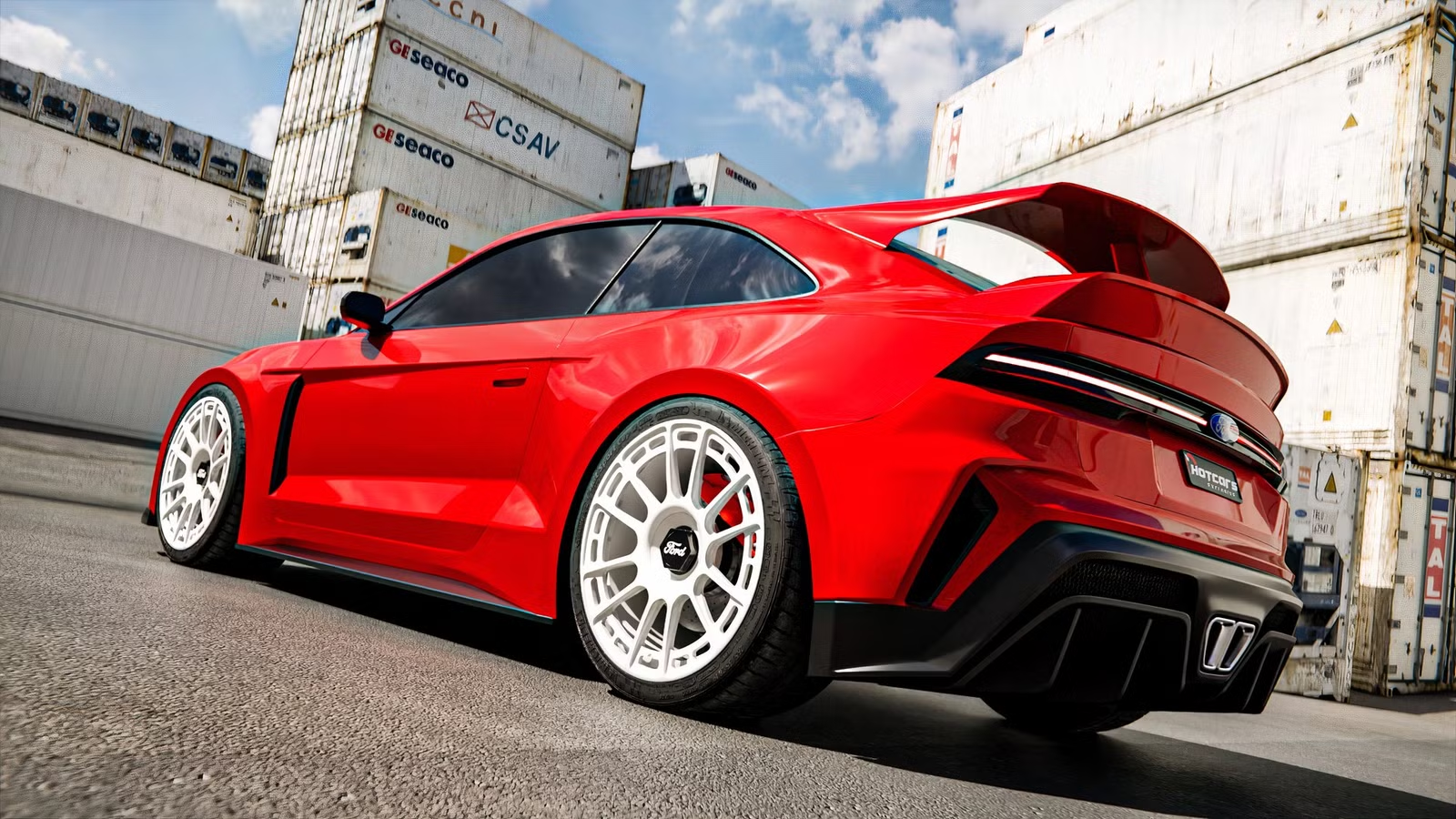
Hot hatches keep getting faster, smarter, and more expensive, but very few look as though they were designed around a rally stage first. Our imagined 2028 Ford Escort RS does that, wrapping a compact three-door body around huge aero, rally-style wheels, and one rear wing subtle enough to be visible from the moon (not really).

The big question is what’s under the hood. For this comeback, a Cosworth-assisted turbo four makes far more sense than simply raiding the current Ford parts shelf.
The 2028 Escort RS Brings Back The Whale Tail
The render goes straight for the Escort RS Cosworth’s most recognizable feature: the whale-tail spoiler. Here it becomes an enormous two-level wing that dominates the rear profile, while blistered fenders, white multi-spoke wheels, deep side skirts, hood vents, and a massive front intake give the car the stance of a modern homologation special. Slim LED lighting keeps the nose contemporary, but the overall shape still looks compact, upright, and ready to throw gravel at spectators.

The 1992 Escort RS Cosworth was created as a Group A rally homologation car, and its road-going version used a turbocharged 2.0-liter Cosworth four-cylinder that made 224 horsepower. Power went to all four wheels through a permanent system with a rear-biased 34:66 torque split, while the giant twin-element rear wing became the car’s signature. Ford built the first 2,500 cars to satisfy homologation requirements, but the Escort Cosworth ultimately became far bigger than a paperwork exercise.
The Escort RS story reaches even deeper. The 1970 Escort RS1600 used a 1.6-liter four engineered by Cosworth, while later RS2000 and RS Turbo models kept turning ordinary compact Fords into serious performance machines. That lineage is why the design here works better with an oversized wing and rally-car aggression than it would with restrained bodywork. An Escort RS should look slightly silly before the engine even starts.
Cosworth Power Is The Right Kind Of Throwback

Ford already owns the obvious modern engine solution. The current Mustang EcoBoost uses a turbocharged 2.3-liter four with 315 horsepower and 350 lb-ft of torque, while the previous Focus RS extracted 350 horsepower and 350 lb-ft from its own specially developed 2.3-liter EcoBoost. That makes a Ford-built turbo four completely believable for a new hot hatch, and it would be the easiest route to serious power without inventing an exotic powertrain from scratch.
Still, this particular car deserves something more, let’s say, distinctive. We’d give the 2028 Escort RS a 2.0-liter turbocharged four developed with Cosworth, targeting roughly 400 horsepower and around 350 lb-ft. The point would be more than chasing a ridiculous dyno number. It would be sharper throttle response, a higher redline, strong midrange boost, and enough personality to make the Escort feel different from a hypothetical Focus RS revival wearing another badge.
What It Deserves

There’s even a current precedent for treating the Escort name as more than nostalgia. The officially licensed new Escort Mk1 RS from Boreham Motorworks is a ground-up car limited to 150 commissions, and its naturally aspirated TEN-K four-cylinder develops roughly 325 horsepower while screaming to 10,000 rpm. That engine takes a very different route from our turbocharged proposal, but the philosophy is exactly right: light weight, immediate response, and an engine that feels like the center of the experience rather than another specification-sheet entry.
A six-speed manual should be mandatory, with a short throw and closely stacked ratios. Pair it with a rear-biased all-wheel-drive system, a proper limited-slip diff, adaptive dampers, big brakes, and a torque-vectoring rear axle. Around 400 horsepower would give the Escort RS enough muscle to feel properly modern without turning every full-throttle launch into a traction-control demonstration. A sub-4.5-second 0-60 mph target would be plenty if the chassis delivers the kind of adjustability the RS badge deserves.
This Hot Hatch Could Take Aim At The Civic Type R And GR Corolla

The current hot hatch field gives a 2028 Escort RS a clear target. The 2026 Honda Civic Type R makes 315 horsepower through the front wheels and pairs it with a six-speed manual. The Toyota GR Corolla produces 300 horsepower and combines a manual option with all-wheel drive, while the Volkswagen Golf R brings 328 horsepower, all-wheel drive, and a claimed 4.4-second run to 60 mph. A roughly 400-hp Escort RS with all-wheel drive would arrive with enough numbers to get attention before anyone even notices the wing.
For North American buyers, the RS badge also carries a certain forbidden-fruit appeal. Earlier Escort RS models were largely European-market heroes, but the Focus RS eventually gave American enthusiasts a proper taste of the formula with 350 horsepower, torque-vectoring all-wheel drive, a manual transmission, and a Drift Mode that instantly became part of the car’s personality. A new Escort RS could pick up that thread without pretending the last decade of Ford Performance never happened.
What We’d Want Ford To Build

Power is great, but it shouldn’t be priced exorbitantly, either. Since we’re coming up with the rules here, put a car like this around the $50,000 mark, keep the manual standard, resist burying the best hardware inside expensive option packages, and the 2028 Escort RS could sit naturally beside the Civic Type R, GR Corolla, and Golf R while offering something they can’t copy: the Escort name, Cosworth history, and that enormous whale tail.
All in, it’s a pretty intriguing package. The design looks modern without sanding away the rally-car grit, the powertrain nods to Cosworth without becoming a museum piece, and the performance target is aggressive enough to matter in America’s shrinking hot hatch market. If the Escort RS ever returns for real, this is the sort of loud, compact, four-wheel-drive troublemaker we’d want Ford to build.

Related posts



Latest Post


No Comments