
Chevy’s Fastest Muscle Car Of The ’60s Was A Sleeper With A Ridiculously Rare Engine
Sixty years on, the muscle car era still captivates enthusiasts — and for good reason. The cars that defined it weren’t born from focus groups or marketing spreadsheets. They were hammered out in engineering skunkworks, built around one obsession: winning at the drag strip. Quarter-mile supremacy was the currency of the age, and every major Detroit automaker was spending it as fast as they could.

But the most interesting machines from that era weren’t the ones plastered across showroom windows. They were the ones that slipped quietly out the back door — limited-run factory weapons ordered by racers who knew exactly what they were getting. Cars that wore ordinary sheet metal over extraordinary hardware.
Those rare creations have since become some of the most coveted muscle cars on the planet. And the one we’re about to look at? It might just be the rarest of them all — a true sleeper packing one of the wildest engines Chevy ever built.
Built For The Strip, Disguised For The Street: The Story Behind The Chevy Impala Z11

In the early 1960s, the drag strip wasn’t only a gearhead’s playground — it was where reputations were made. Every Big Three automaker had its eyes fixed on straight-line domination, and Chevrolet was no exception. The brand’s answer was to take a full-size Impala and quietly transform it into a quarter-mile monster. The result was the 1963 Chevy Z11 — a true masterpiece that remains one of the rarest and most purpose-built factory hot rods the brand has ever unleashed.

On the surface, the Z11 looked like any Impala your neighbor might cruise to the drive-in. But beneath that unassuming skin lurked serious race-bred intent. According to Hemmings, Chevy engineers stripped out every ounce they could. They ditched sound deadening, gutted the interior, and swapped steel body parts for aluminum fenders, hood, and bumper brackets — shedding roughly 300 pounds compared to a stock Impala.
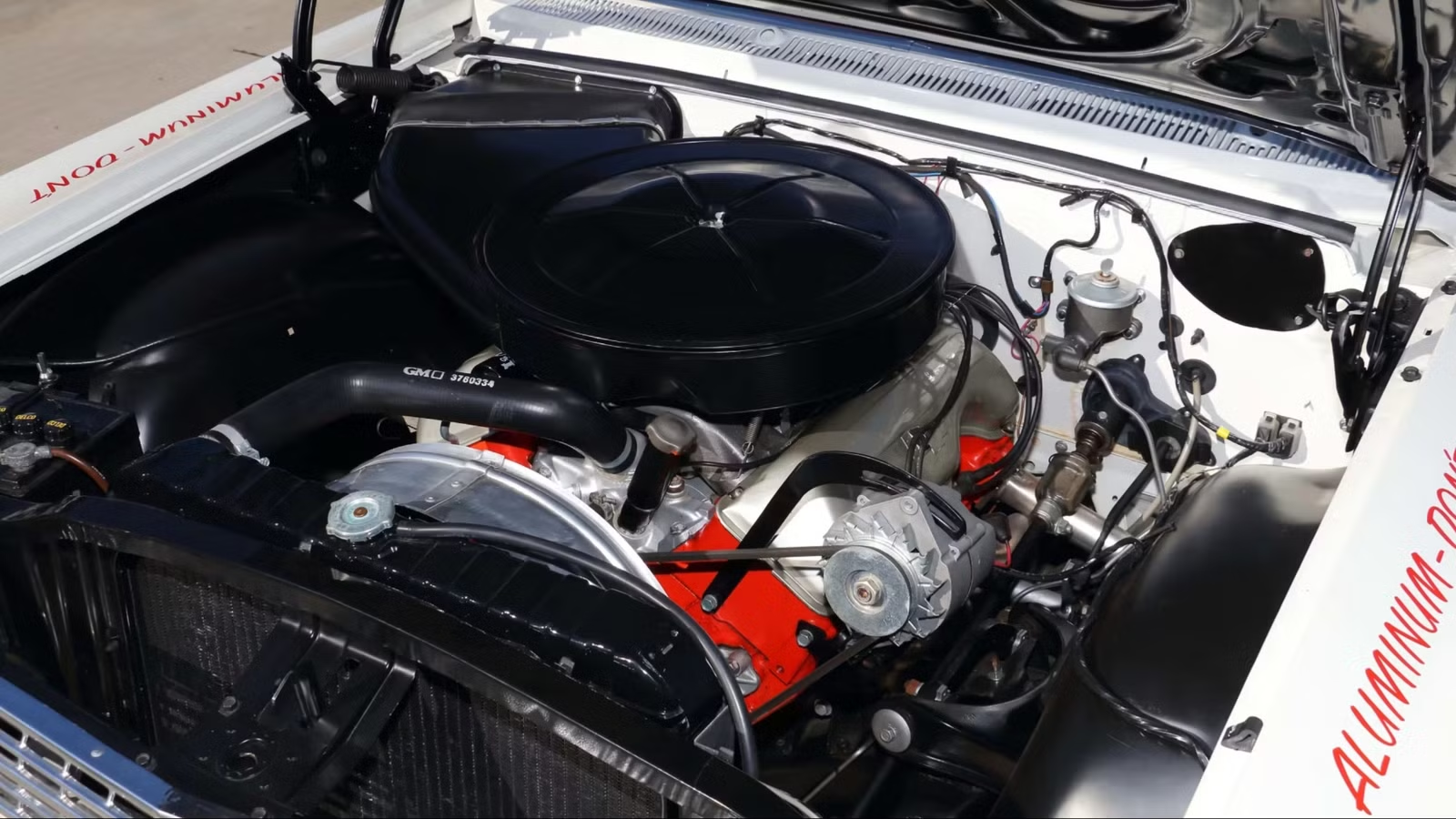
Of course, the real story sat under the hood. According to Over-Drive Magazine, the Z11’s secret weapon was an enlarged version of the already-feared 409 V8: a hand-built 427-cubic-inch (7.0L) W-series V8 that never appeared in any showroom order guide. Fed by dual four-barrel carbs and backed by a heavy-duty driveline, this engine carried a conservatively rated 430 horsepower — though racers whispered the real number was closer to 500 hp in the right hands.

According to Hemmings, Chevy only built 57 Z11s, all intended for one purpose: NHRA Super Stock competition. They were never meant for daily driving. But a few made their way onto the street, where they became the stuff of late-night legend. Today, the Z11 stands as a rare glimpse of what Detroit could do when corporate red tape briefly took a backseat to raw racing passion — a factory-built outlaw, built for the strip, disguised for the street.
Under The Hood: Chevy’s Secret 427 That Never Hit The Showroom Floor
You won’t find the Z11’s engine in any Impala brochure — and that’s exactly how Chevy wanted it. Under the hood sat a hand-built 427 W-series V8, Chevy’s ultimate evolution of the 409, punched out for maximum power. Built in limited numbers, it never appeared as a regular catalog option.
1963 Z11 427 W-Series Specs
|
Engine |
427 cu in (7L) W-series V8 |
|
Horsepower |
430 hp (factory rated), ~500 hp (estimated) |
|
Torque |
575 lb-ft |
|
Transmission |
Borg-Warner T-10 4-speed manual |
|
Driveline |
Rear-wheel drive (RWD) |
|
0-60 mph |
4.3-4.5 seconds |
|
1/4 mile time |
~10.8 seconds |
Every element of the Z11 powerplant was purposeful: dual Carter AFB carburetors, a two-piece aluminum intake manifold with cowl-induction feed, forged internals, and a sky-high 13.5:1 compression ratio. According to Over-Drive Magazine, the factory claimed 430 hp at 6,000 rpm — but whispers from the pits and dyno sheets pointed to the real number closing in on 500 hp, thanks to a tough oil pan and a beefed-up valvetrain.

The Z11’s strength wasn’t just on the top end, either — it came with serious torque. Chevy officially rated the engine at 575 lb‑ft, and it muscled the big Impala down the quarter-mile in around 10.8 seconds.
With only 57 Z11 Impalas ever built, Chevy paired every single engine with a heavy-duty Borg-Warner T-10 four-speed and a stout driveline. There was no showroom fanfare for the Z11 — it was simply land-speed intent welded onto a full-size body.
Why The Z11 Vanished And Why It’s Worth A Fortune Now

The Z11 was gone almost as fast as it arrived. According to Auto Evolution, the Z11 was a $1,240 add-on to a base Impala, pushing its original MSRP to around $4,000 — a price that put it out of reach for most buyers. The secrecy surrounding it, combined with its minuscule production run, made it nearly impossible for anyone outside racing circles to obtain. Then GM quietly pulled the plug: a corporate racing ban and shifting NHRA rules erased the Z11 almost overnight.
Fast-forward six decades, and surviving Z11s have gone full unicorn. According to Hagerty, the average auction result for a 1963 Chevrolet Impala Z11 sits at around $296,000, with top-end examples fetching well over half a million dollars.

Consider the “Terry Prince” 1963 Chevrolet Impala Z11. Finished in bold red, this Z11 was bid up to $298,000 on Bring A Trailer — yet the reserve was not met, and it slipped through the cracks.
Another notable Z11 auction story involves the “Old Reliable IV” 1963 Chevrolet Impala Z11, which brought a whopping $525,000 on the Mecum auction block.

The Impala Z11 wasn’t just forgotten engineering — it was a rare case of Detroit’s secret weapons hitting collector gold. A factory-built drag car so obscure it barely existed on paper, now worth more than ten times its original price. The Z11 is intrigue, performance, and scarcity all rolled into one heavy-hitting historic legend.
Other Rare Big-Block Beasts From Chevy’s Golden Era

Chevy’s 1960s golden era was a time when engineers pushed big-block boundaries to land in the winners’ circle. Beyond the Z11, two machines stand out: the COPO Camaro ZL1 and the Corvette L88. Both emerged from special-order programs loaded with racing-grade engines and built in ultra-limited numbers. Today, these aren’t just cars — they’re collector legends that echo the same bold engineering spirit as the Z11.
The COPO Camaro ZL1 (1969)
In 1969, Chevy’s COPO program quietly unleashed one of the most brutal factory-built street cars ever conceived: the Camaro ZL1. Ordered under COPO 9560, it featured a hand-assembled, all-aluminum 427-cubic-inch V8 originally developed for Can-Am racing. Per Hemmings, the COPO is rated at 430 hp — though real-world output with open headers and proper tuning routinely topped 575 horsepower.
According to Street Muscle Magazine, only 69 units were produced, making it one of the rarest Camaros of all time. Built purely for NHRA Super Stock dominance, ZL1 Camaros ran the quarter-mile in the low 11s and have since become million-dollar legends.
The Corvette L88 (1967–1969)
The Corvette L88 was Chevrolet’s most extreme street-legal racer of the era — though calling it “street-legal” is somewhat generous. Per Hagerty, under the hood sat a solid-lifter 427 V8 underrated at 430 hp, with dyno tests revealing output closer to 560 hp. You couldn’t order it with a radio, heater, or power steering — it was built with race-ready intent and nothing else.
Introduced in 1967, only 20 L88 coupes were built that year. Chevrolet followed with 80 units in 1968 and 116 in 1969, bringing the total to just 216 cars. The L88 added roughly $1,500 to the price of a base Sting Ray, which already carried a sticker of around $4,240.
Just like the Z11, these two cars weren’t showroom fluff. They were bespoke racers masquerading as street cars. Limited production, serious performance, and fierce collector demand have made them legendary jewels of Chevy’s golden era.

At the end of the day, Chevy’s golden-era big-block machines weren’t built to blend in. They were built to prove a point — on the strip, on the track, and sometimes on the street. The Z11 may have been the rarest of the bunch, but it was cut from the same cloth as legends like the COPO Camaro ZL1 and Corvette L88.
Decades later, these rule-breakers still remind us of a time when Detroit wasn’t afraid to throw out the rulebook — an era when Chevy built machines that were as raw as they were rare.
Sources: Hagerty, Hemmings, Mac’s Motor City Garage.

Related posts




Latest Post


No Comments