
The Production Muscle Car That Arrived Too Early
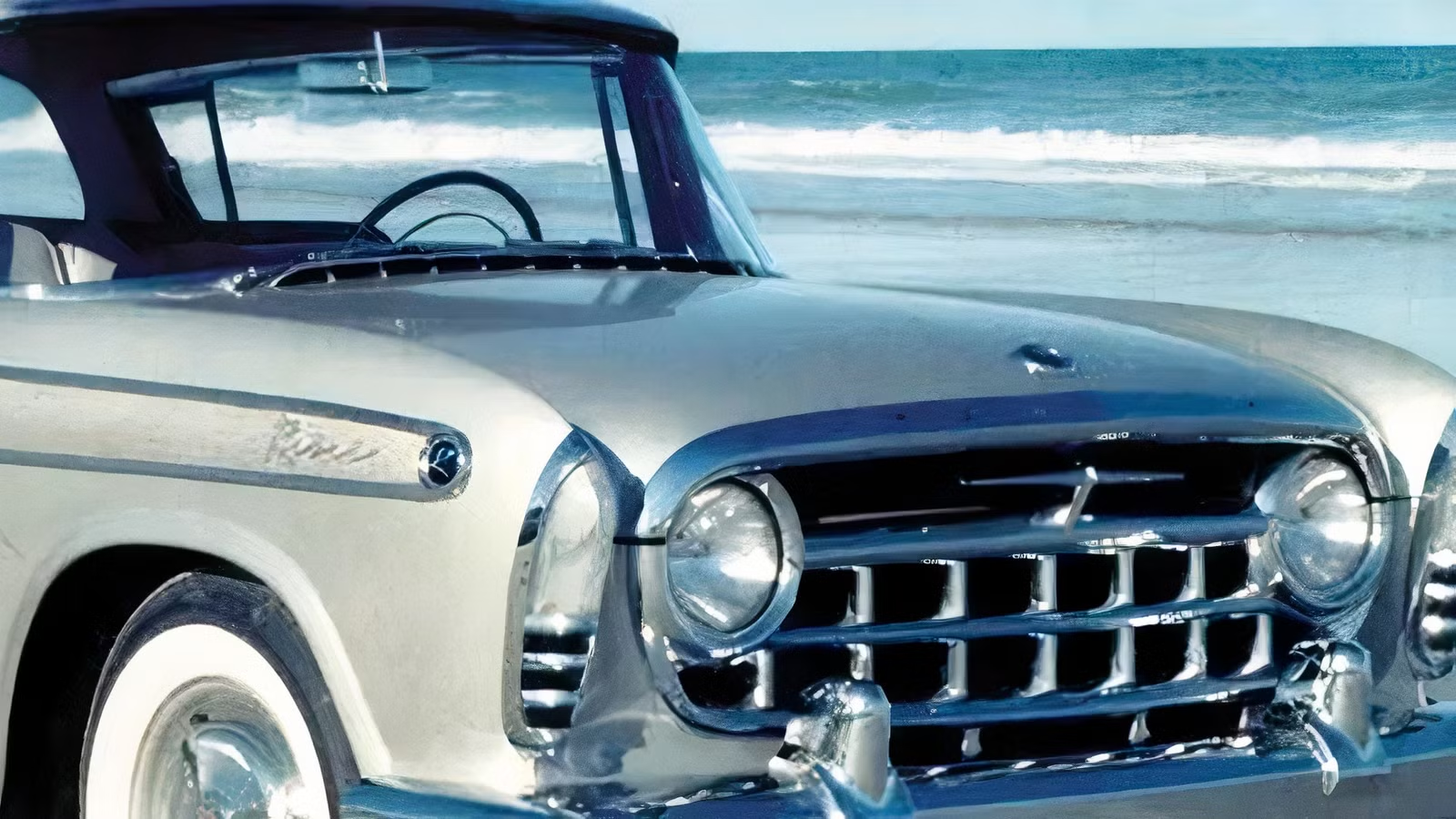
America in the late 1950s liked its cars long, low, and dipped in chrome. Family sedans wore tailfins, sports cars carried the speed badge, and ordinary four-doors hauled groceries instead of hunting Corvettes. Detroit had not yet named the muscle-car recipe, much less turned it into a youth craze. Yet one unlikely manufacturer had already slipped a large V8 into a lighter, midsize body and sent the result to regular dealerships.
The Muscle Car Formula Did Not Officially Exist Yet

Large cars ruled American roads during the 1950s. Buyers wanted roomy cabins, soft seats, large trunks, and enough bright metal to confuse low-flying aircraft. Detroit answered with wide sedans that placed comfort and road presence ahead of low weight. Performance existed, but manufacturers usually attached it to an expensive sports car, a flashy personal-luxury model, or a full-size sedan carrying an increasingly large engine.
Buyers also lacked a clear “muscle car” category. That label became useful only after Pontiac introduced the GTO package for the 1964 Tempest and rival brands rushed to answer it. In 1957, dealers sold sedans, station wagons, sports cars, convertibles, and hardtops. They did not reserve a special showroom corner for affordable midsize cars with tire-melting V8s. The ingredients existed, but the culture around them had not formed yet.
The formula that later worked so well looked simple. A manufacturer took a relatively light compact or midsize platform, installed an engine associated with a larger model, and sold the combination in an attainable body style. The result needed strong straight-line speed, room for several passengers, and a price that did not require sports-car money. Handling could remain a secondary concern and brakes sometimes seemed like an afterthought.

The Unlikely Company That Broke the Rules

One car arrived with that exact recipe years before the industry was ready. Interestingly, that car did not come from Chevrolet, Pontiac, Ford, Chrysler, or another brand closely tied to racing and high-performance advertising. It also did not emerge from a sports-car program or a designer’s attempt to impress young buyers. The company behind it had limited money, a small place in the market, and little room for an expensive engineering adventure.
American Motors Corporation had formed from the 1954 merger of Nash-Kelvinator and Hudson. Under company president George Romney, AMC promoted economy, usable interior room, and sensible transportation while larger rivals kept adding inches and chrome. Period advertising even compared oversized American cars with dinosaurs.
AMC still had the pieces for a performance car, though. Its engineers had developed a new V8 family in 250- and 327-cubic-inch forms. The larger version served the senior Nash Ambassador and Hudson Hornet, while a newer platform had enough room for a V8. Both engine sizes shared the same basic exterior dimensions, so the 327 could fit without a heroic redesign. AMC already owned the large engine and the lighter body, and someone only had to introduce them. What a rebel idea.
The 1957 Rambler Rebel Was a Muscle Car Before Muscle Cars

That unlikely creation was the 1957 Rambler Rebel, a limited-production four-door hardtop that joined everyday sedan usefulness with one of AMC’s most powerful engines. The company installed its 327-cubic-inch V8 in the Rambler body, added performance hardware, and offered the result as a complete factory model. It carried passengers, had a proper trunk, and came through the same dealer system as far calmer Ramblers. AMC built only 1,500 examples, all wearing metallic silver-gray paint with bronze-gold anodized side trim.
The carbureted 327 produced 255 hp at 4,700 rpm and 345 lb-ft of torque at only 2,600 rpm. Solid valve lifters, a 9.5:1 compression ratio, a Carter four-barrel carburetor, and dual exhaust helped create that output. Despite the familiar displacement, this was an AMC-designed engine, not the Chevrolet 327 that arrived several years later. Buyers could choose a heavy-duty three-speed manual with overdrive or GM’s four-speed Hydra-Matic automatic. AMC also fitted adjustable shock absorbers, thicker anti-roll bars, stronger brake drums, power steering, and power brakes.
The figures mattered because the Rebel carried less bulk than many large American sedans. Its shipping weight sat near 3,350 pounds, giving it roughly 13 pounds to move for each advertised horsepower. Many contemporary cars had large engines, but they also carried several hundred extra pounds of body, frame, trim, and living-room furniture disguised as seats. The Rebel’s strong low-speed torque and favorable gearing made it jump hard from a stop. The manual version used a 4.10:1 rear axle ratio, which favored acceleration over relaxed highway cruising. It was not a tiny car, but it placed serious power in a package compact enough to make every pound work harder.

Motor Trend recorded a 0–60 mph time of about 7.5 seconds during its 1957 performance comparison. The only car in that group to beat the Rebel was a fuel-injected Corvette, which reached 60 roughly half a second sooner. That put AMC’s four-door near specialized machinery such as the Chrysler 300-C, supercharged Ford models, and the Studebaker Golden Hawk.
The Rebel also checked the boxes that would later define the muscle car category. It used a powerful engine associated with AMC’s larger cars, and placed that engine in a lighter platform. Buyers could order it as a finished production vehicle rather than build one with aftermarket parts. Its practical body carried a family, and its $2,786 price included features such as reclining seats, a radio, a padded dashboard, power steering, and power brakes.
An even more advanced version nearly reached buyers. AMC originally presented the Rebel with Bendix electronic fuel injection and announced an estimated 288 horsepower. The system used ideas Bendix had developed for aircraft, but early automotive electronics struggled with cold starts and the constantly changing demands of road driving. AMC replaced the system with the Carter carburetor before normal production. That change cut the advertised output to 255 hp, though the engine kept its higher compression and solid lifters.
The Rebel Was Forgotten While Later Muscle Cars Became Legends

The Rebel reached the market before the social conditions that turned muscle cars into a national craze. By the early and middle 1960s, millions of young buyers had more spending power, automakers openly chased them, and organized drag racing gave straight-line speed a public stage. Pontiac’s 1964 GTO package arrived with a clear performance identity and helped establish the category in buyers’ minds. Competitors followed with increasingly aggressive cars, names, advertising, and engine options. The market finally understood the product.
Later muscle cars also sold theater along with speed. They came as coupes and hardtops with hood scoops, stripes, bright colors, bold badges, loud exhausts, and names that suggested weapons, storms, wild animals, or poor anger management. Advertisements showed smoking tires and quoted horsepower figures without apology. The Rambler Rebel took a quieter approach: its silver paint and copper-colored trim looked upscale rather than threatening. It carried special Rebel scripts, but no giant hood scoop warned nearby drivers. AMC promoted its acceleration after road testers proved it, yet the car still resembled a sensible Rambler. It could surprise other motorists partly because nobody expected a practical AMC sedan to pull away so quickly.
The four-door body helped and hurt it. In 1957, AMC lacked the money to create a full range of new Rambler body styles, so the company concentrated on four-door sedans and wagons. The Rebel used the stylish pillarless hardtop version, which removed the center roof post and gave the car an open look with the windows lowered. Four doors made it useful, comfortable, and easy to sell to a household with children. Later enthusiasts, however, linked muscle cars with two-door coupes.
Oldsmobile Almost Got There First

It is worth mentioning that the 1949 Oldsmobile 88 still holds a strong rival claim in any debate about the first muscle car. Oldsmobile paired its new 303 Rocket V8 with the lighter body used by the six-cylinder Series 76. That combination created an excellent power-to-weight ratio and built a major competition reputation. The 88 succeeded in stock-car racing, entered popular music, and showed that a powerful modern V8 could transform an ordinary American model. Its place in performance history remains secure.
The Rambler Rebel, though, more closely previewed the packaged muscle cars of the next decade. AMC created it as a named, limited performance model with tuned suspension parts, heavy-duty driveline hardware, special trim, a large engine from the company’s senior range, and clearly measured acceleration. It used what buyers would soon recognize as a midsize platform rather than another full-size American body. The Oldsmobile established an important idea eight years earlier, but the Rebel refined that idea into something much closer to the 1960s template.
The Car That Proved the Formula Before America Was Ready

So, an ordinary-looking four-door anticipated one of America’s most celebrated automotive categories. The 1957 Rambler Rebel came from an economy-minded company, used a factory-installed 327 V8, delivered 255 hp and 345 lb-ft of torque, and reached 60 mph in about 7.5 seconds under favorable test conditions. It carried several passengers and normal luggage while running close to some of the quickest American cars available.
Its obscurity does not point to weak engineering – it points to weak timing and unclear perception. Buyers knew Rambler as the sensible choice, and the Rebel did not look different enough to rewrite that reputation overnight. Its four doors worked against the image that later performance cars made famous. Limited production kept it rare, while its one-year mechanical package prevented the name from building momentum. For 1958, AMC used the Rebel name on less powerful V8 Ramblers and kept the 327 for the larger Ambassador. The original idea faded before enough drivers could understand what it represented.
The industry soon repeated the Rebel’s central trick on a much larger scale. Manufacturers installed big engines in intermediate bodies, wrapped them in aggressive two-door styling, aimed advertising at younger drivers, and gave them names that looked good on fenders and magazine covers. The cars became symbols of American performance. The Rebel received little credit because it lacked the right image and arrived seven years before the 1964 GTO gave the segment a widely accepted starting point. History often remembers the car that starts the party. It pays less attention to the one that arrived early, turned on the lights, and wondered where everyone went.
The 1957 Rambler Rebel deserves recognition as a genuine production muscle car before the category officially existed. It paired a large V8 with a lighter midsize body. It offered factory-built speed in a body ordinary families could use. It produced acceleration that challenged specialized performance machines. Most of all, it proved that a practical American sedan could become thrilling through smart engine placement and a favorable power-to-weight ratio. Later cars turned that same idea into a nationwide phenomenon. The Rebel had already shown them how. America simply needed several more years to catch up.
Source: AMC, Motor Trend, Hagerty, Hemmings

Related posts



Latest Post


No Comments