
The Muscle Car Ryan Gosling Hand-Built For A Legendary Cult-Classic
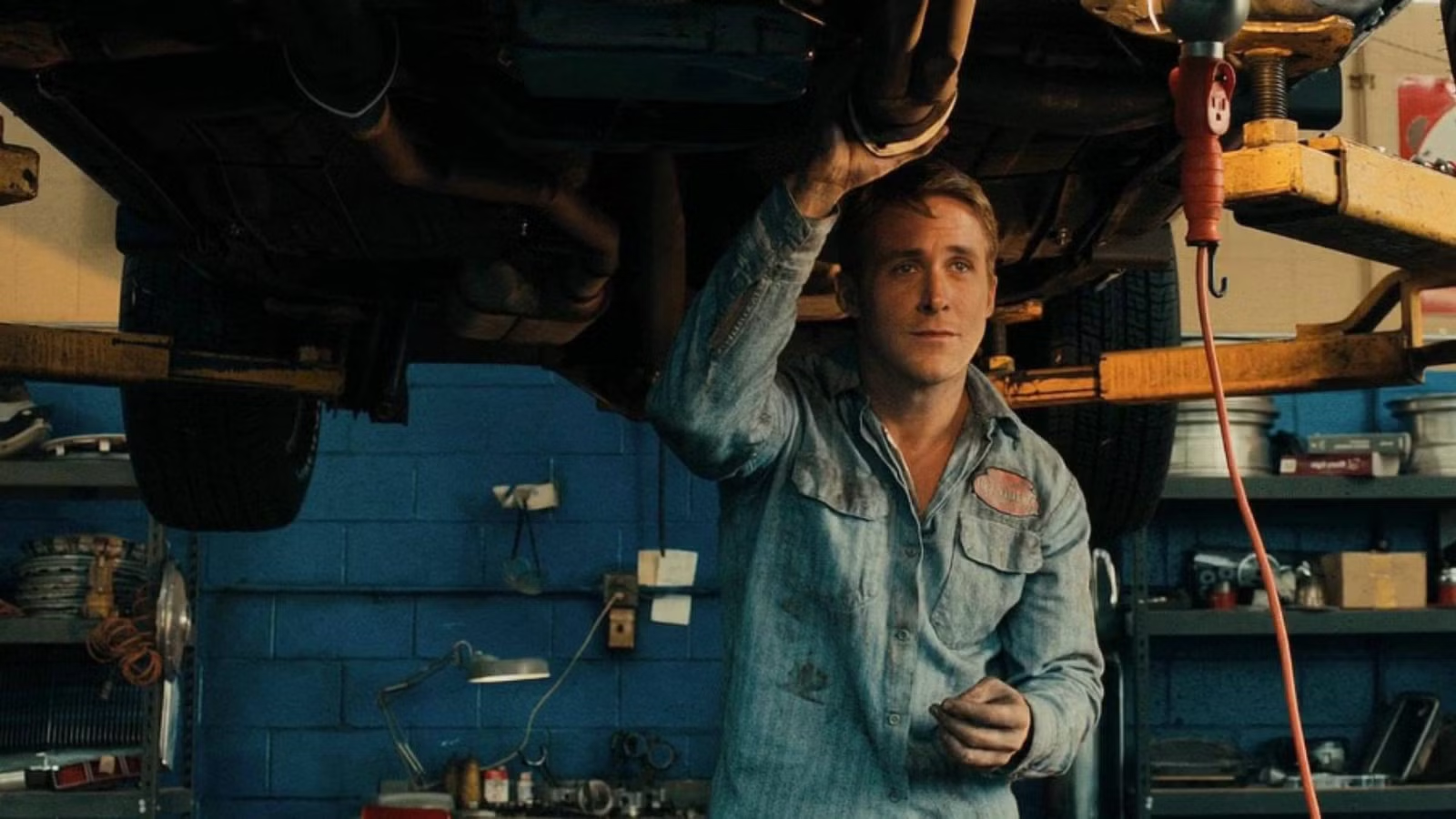
A good movie hero needs a good car. Elite hero-car pairings are so iconic, they become characters in their own right. James Bond and his Aston Martin DB5. Dominic Toretto and his supercharged second-generation Dodge Charger. And for fans of 2011’s Drive, Ryan Gosling’s unnamed protagonist and his pride and joy: a primer-gray muscle car. But what most folks don’t know is that Gosling poured as much of his heart and soul into that car as any other aspect of his character, choosing the junkyard project and working on it himself before filming began.
Movie Cars Are Normally Built By Specialists, Not Stars

The cars used on movie sets are props. They are purpose-built machines assembled on a budget. Even if a film is about automotive enthusiasts, the vehicles the actors and stunt team drive are often shockingly soulless.
Film crews buy up entire parking lots full of cars, often setting up duplicates for stunts or interior shots. They paint and finish each one just enough for the specific shots it will appear in. They think nothing of swapping body panels or rebadging entire vehicles. Some films even standardize several supposed makes and models with the same modern powertrain. That’s why director Nicolas Winding Refn’s approach to Ryan Gosling’s car for Drive was so unique.
The two men were interested in collaborating and met for dinner. But when it came to the details of a potential project, the conversation felt like a dead end to Gosling. Refn didn’t eat anything. When Gosling found out Refn was feeling under the weather, he offered to drive the director home.


“It’s quiet in the car, so I turn up the radio to kill the silence. Suddenly REO Speedwagon comes on – Can’t Fight This Feeling. Nicolas… I hear him crying. I look over, he’s crying. And he’s singing: ‘I can’t fight this feeling any more…’ He’s banging his knees. And he looks at me and says, ‘This is it! This is the movie! It’s about a man who drives around listening to pop music at night because it’s the only way he can feel.’”
In that moment, Gosling’s unforgettable protagonist was born. But Refn knew that for the film to work, he’d need to pour even more of his star into the character. So he did something unorthodox.
“Nic said I could pick the car, and it could be any car I wanted.” Gosling searched Los Angeles until he found the perfect ride for his character. “It cost $2,000 from a junkyard.” But Refn wasn’t done. Gosling would get into the head of his character by working on the car himself. There was only one problem: “I didn’t know anything about cars.”
Ryan Gosling Built The Muscle Car Himself

Gosling found a shop and a mentor, then got to work. “This guy Pedro would sit there and tell me what to do, but he wouldn’t touch the car. He just barked orders, and I followed them.”
The star admits that the learning curve was steep. “It took forever.” But he explained to his mentor why he wanted to do the work himself: “I told him, ‘I have one chance in my life to take the time to learn this.’”
Unfortunately, Gosling eventually ran out of time. “The last thing was the transmission; it was a very emotional day for me, because I was finishing the car. And Pedro f—ed with me and did it the night before! He knew it would hurt me but he did it anyway! I was going to take it out but I didn’t have time because the movie needed the car. So I can’t say I did everything on it.”

Gosling realized exactly how much the process had meant to him. “I was angry, upset. I got all teared up. And Pedro said, ‘I just put that transmission up in there because I had to get some real jobs in here.’”
With filming underway, Gosling had to focus on the movie. Luckily, he’d already completed some of the most dedicated method-acting preparation of his career. “My character never has to talk about cars or do anything underneath a car, so it doesn’t really matter. But it felt important to me.”
Drive’s Hero Car Is A 1973 Chevrolet Chevelle Malibu

Gosling didn’t choose the most iconic or expensive performance car around. His junkyard find was a 1973 Chevrolet Chevelle Malibu Sport Coupe. By 1973, Malibu was a mid-level series within the Chevelle family, above the base Deluxe and below the Laguna. So the movie car is accurately described as both a Chevelle and a Malibu.
The 1973 model year also launched the Chevelle’s third generation. Unlike the aggressive muscle cars that put the nameplate on the map, this redesign had a curvier, more formal silhouette. In many ways, it previewed the malaise-era cars to come. But that is exactly what makes it perfect.
A 1973 Chevelle is one of the final V8-powered coupes you might find abandoned in a junkyard. It’s a car you could fix yourself, paint in flat gray primer, and turn into a truly anonymous sleeper. For a guy who “didn’t know anything about cars,” Gosling nailed it. The modified Chevelle Malibu perfectly fit the personal car his character would choose.

The surviving screen double, VIN 1D37H3R412028, is listed with a 350-cubic-inch Chevrolet V8 and an automatic transmission. Its “454” fender badges were movie dressing, not proof of a big-block engine. The car Gosling built may have been mechanically similar, but its exact drivetrain has never been documented.
Fans of the movie know that for the professional wheelman’s chases, he reaches for the keys to something newer and faster. The Chevelle is what he drives in his daily life. The car he “drives around listening to pop music at night because it’s the only way he can feel.”
It was exactly those drives that helped Gosling discover the emotional core of the film. “The movie became about driving. Not about stunts. Not about crashes. It became about the spell that being in a car puts you in. You start somewhere, and then you get to your destination and you don’t remember how you got there.”
Gosling’s Malibu Had Help From Two Screen Doubles

As soon as Ryan Gosling had finished his work, Refn’s film crew still needed cars for the shots that would risk destroying the vehicle. The team used three 1973 Chevelles during filming.
Whatever models they started as, the cars ended up painted in anonymous gray primer, with “454” badges on their fenders. The surviving double is documented with a reliable 350-cubic-inch Chevrolet V8 and automatic transmission.

One car was sacrificed to stunt work. VIN 1D37H3R412028 was more of a hybrid: ClassicCars described it as the interior car and backup stunt car, while Heritage later called it a hero car prepared for stunt work. The conflicting labels suggest it served several jobs instead of fitting neatly into one category.
This surviving car had a full interior finished in black vinyl. It also featured aftermarket gauges on the dashboard, a racing steering wheel, and safety equipment added for production. While it had an automatic transmission, a floor-mounted shifter made it appear to be a manual on screen.
Where The Chevelles From Drive Are Today

During filming, one stunt Chevelle was totaled. What happened to the wreck afterward is not publicly documented. VIN 1D37H3R412028 survived with a certificate of authenticity identifying it as the “Hero Interior car” and a backup stunt car.
This Chevelle changed hands several times. It appeared at a Profiles in History auction hosted by Heritage on December 17, 2019, where it failed to sell. Bonhams says Movie Cars Central acquired it from a private British collector in January 2020. It later sold through Bonhams in Paris on November 28, 2025, for €61,600, including the buyer’s premium.

The third car, the one Ryan Gosling worked on with his own hands, was too important to him to give up. He loved the sound of the V8 most of all. “My favorite part of the movie is that sound you hear as the cars are going by.” More than a decade later, it appears to be no less important to him.
While on the press tour for 2024’s The Fall Guy, in which Gosling plays another stuntman and driver, he mentioned the Chevelle again. When his co-star Emily Blunt explained she’d kept a parrot-shaped umbrella from Mary Poppins Returns, Gosling admitted, “I have my car from Drive.”
Sources: GM Heritage, Heritage Auctions, WBAL-TV 11, Classic Cars, Revolution Films, Netflix, Hollywood News, Esquire, Bonhams

Related posts
Latest Post


No Comments