
Kawasaki Skipped The Displacement Race With A Supercharger That Spins Up To 140,000 RPM
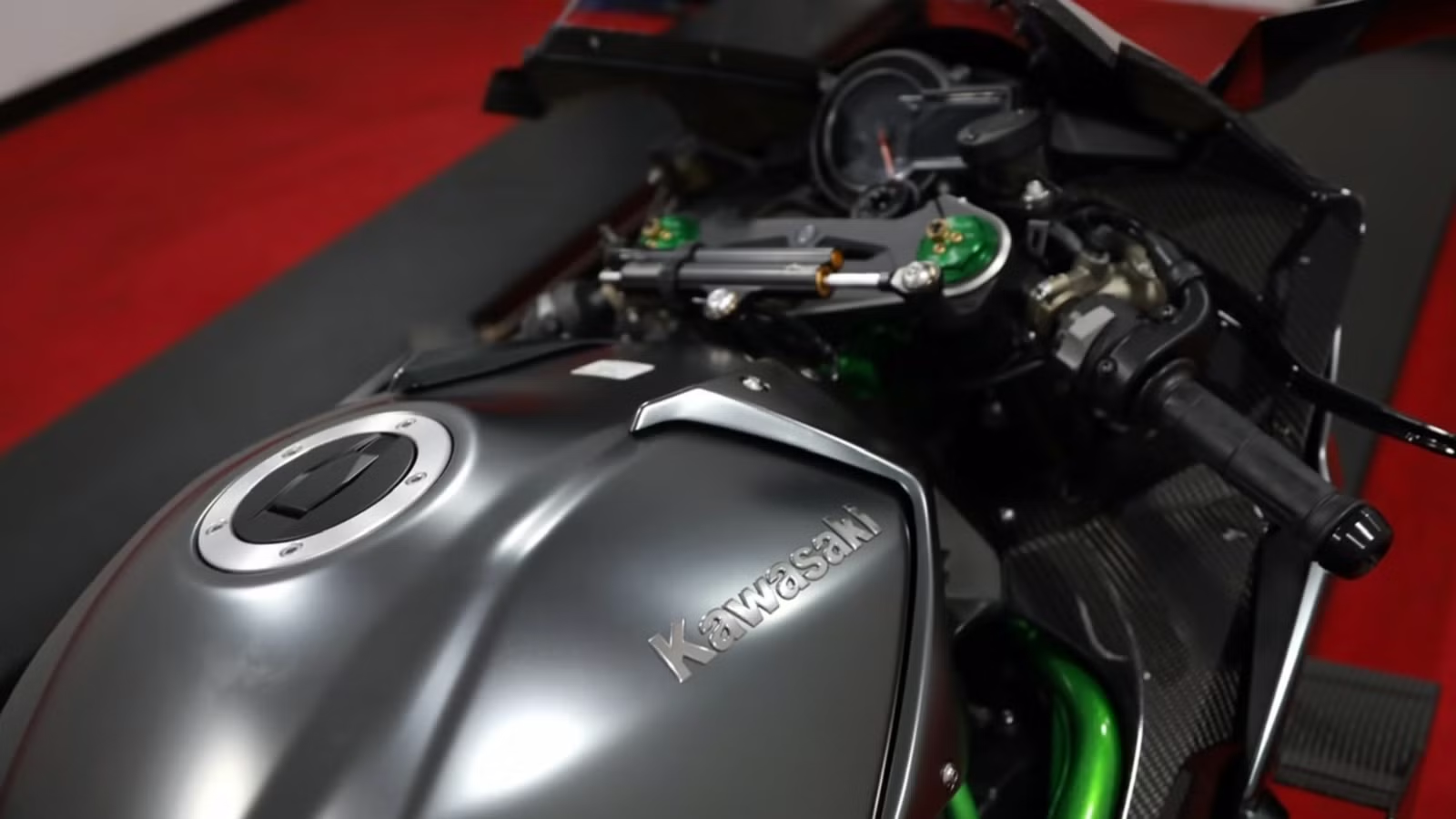
The bridge was closed to traffic, and the rider had less than half a minute to do it. In 2016, a Kawasaki howled across a suspension bridge in Turkey and hit a speed few road vehicles of any kind have touched. It didn’t get there with a giant engine. Kawasaki skipped the old formula of adding displacement and went to its own aerospace and gas turbine engineers instead. The part they came up with spins at speeds more familiar to turbine engines than motorcycles, and it changed what a liter-class motorcycle could do.
Why Bigger Engines Stopped Winning The Hyperbike Speed War

By the late 1990s, the fastest motorcycles were chasing speed with sheer size. Suzuki’s Hayabusa used a 1,299 cc inline-four, and Kawasaki answered with the 1,199 cc ZX-12R. More cubic inches meant more power, but also more weight, longer engines, and bikes that felt big everywhere except a straight road.
Then the contest stalled. Manufacturers voluntarily agreed to cap production bikes at 186 mph to avoid a regulatory crackdown, and the ZX-12R stopped right at that number. On the street, the speed war was over. Kawasaki needed a different way to show what it could build.
How Kawasaki’s Jet Engine Engineers Built A Motorcycle Supercharger


Kawasaki had an advantage no other motorcycle maker could match. Its parent, Kawasaki Heavy Industries, builds gas turbines and aircraft components. For its next flagship, the motorcycle division designed a supercharger in-house, with help from the KHI Gas Turbine and Machinery Company, the Aerospace Company, and the Corporate Technology Division.
Forced induction was the answer to the displacement problem. A supercharger crams more air into a small engine, giving big-engine power without the big-engine weight and bulk. Building it in-house meant Kawasaki could shape the whole engine around the blower, rather than bolting an aftermarket unit onto something designed without it.
The Kawasaki Ninja H2R Hit 248 MPH On A Closed Bridge
The Kawasaki Ninja H2R arrived for 2015 with a supercharged 998 cc inline-four, the same displacement as a regular superbike. Kawasaki rates the 2026 version at 321.5 hp with ram air, at 14,000 rpm. It has no lights, no mirrors, and no license plate, because Kawasaki built it strictly for closed courses.
That’s where it proved itself. Five-time World Supersport champion Kenan Sofuoğlu took an H2R onto the closed Osman Gazi Bridge across Turkey’s Izmit Bay and reached 248.5 mph, or 400 km/h, in just 26 seconds, covering 2,682 meters, about 1.67 miles. The run was kept that short to limit the risk of a tire failure at speed.
How The H2R’s Supercharger Impeller Reaches 140,000 RPM

The supercharger is driven straight from the crankshaft. A step gear and an 8:1 planetary gearset spin the impeller at about 9.2 times engine speed. Kawasaki’s own launch press kit says the impeller turns at almost 130,000 rpm when the engine hits about 14,000 rpm, while a period technical analysis put its ceiling at up to 140,000 rpm.
At those speeds, the impeller moves more than 200 liters of air per second and builds up to 20.5 psi of boost. Kawasaki also skipped the intercooler. The supercharger’s efficiency kept intake temperatures low enough to run without one, which saved weight and plumbing in an already tight package.
Why The Street-Legal Ninja H2 Stays Under The Speed Cap

Kawasaki sells a road-going version too. The Ninja H2 uses the same supercharged 998 cc layout in a milder tune, with Kawasaki rating the 2026 model at 240 hp with ram air. It adds lights, mirrors, and street-legal bodywork, plus an electronic limiter that holds top speed to the industry’s 186 mph cap.
That split is the clever part. On the street, Kawasaki stays inside the voluntary agreement. On a closed course, the H2R shows what the same engine design can do without it. The gearing on the road bike alone was calculated to allow around 209 mph if the limiter weren’t there.
What A Kawasaki Ninja H2R Costs Against The Street-Legal H2

Removing the limits costs serious money. The 2026 Ninja H2R carries a US MSRP of $59,100, while the street-legal Ninja H2 ABS starts at $32,700. That’s a gap of $26,400 for a bike that can’t legally be ridden on a public road.
Kawasaki also builds both bikes only to order, with US customers placing special orders during a limited window. For riders who want the supercharged experience on the street, the H2 delivers most of it. For anyone chasing the numbers that a closed bridge in Turkey made famous, only the H2R will do.
Sources: Cycle World, Kawasaki, DanProHD YouTube Channel, Mecum, Bring a Trailer.

Related posts
Latest Post



No Comments